


FHIR Data
Get Started with a Free Demo
New Lead: FUSION
FUSION Landing Page Form, connected with the Mailchimp.
"*" indicates required fields
In healthcare technology, FHIR data is key to making information flow seamlessly. Created by Health Level Seven International (HL7), FHIR (Fast Healthcare Interoperability Resources) is the modern standard built to make it easy to share healthcare information between different systems.
Here, we’ll discuss FHIR data: what it is, how it helps, and which platforms and solutions are best for hospitals and clinics.
What is FHIR Data?
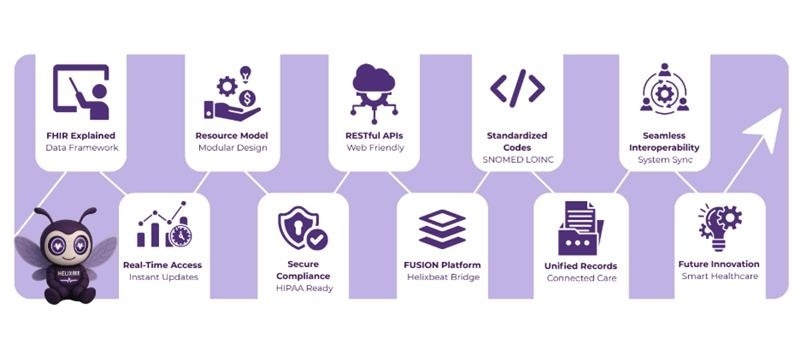
FHIR data consists of discrete units called resources, which serve as the building blocks for healthcare information exchange. These resources represent common healthcare concepts such as patients, observations, medications, diagnostic reports, etc. Each resource includes standardized elements like identifiers, codes, and references, facilitating consistent representation of data. For example, a Patient resource might contain details like name, date of birth, and contact information, while an Observation resource could capture vital signs or lab results.
FHIR data leverages RESTful APIs, similar to those used in web development. This approach draws from modern web technologies, making it more accessible to developers compared to older standards like HL7 v2 or v3. Resources can be exchanged individually or bundled together to form comprehensive documents, such as a patient’s full medical history. The standard also has an extension mechanism, so organizations can add custom elements without causing compatibility problems.
One key aspect of FHIR data involves its integration with established medical coding systems. Terminology bindings link resources to vocabularies like SNOMED CT for clinical terms, LOINC for laboratory observations, and ICD for diagnostic codes. This integration maintains consistency and semantic accuracy.
Besides, FHIR data operates through modular components, including foundation layers for definitions, security modules for privacy, and clinical modules for specific content areas. This modularity enables implementers to focus only on relevant aspects. Overall, FHIR data transforms fragmented healthcare information into a cohesive, actionable asset.
Benefits of FHIR Data in Healthcare
Adopting FHIR data brings multiple advantages to healthcare organizations. First, it enhances interoperability, facilitating disparate systems, like EHRs, laboratory information systems, and mobile health apps, to share information effortlessly. This reduces silos and improves care coordination, especially in scenarios where multiple providers are involved.
Another huge benefit lies in real-time data access. FHIR data supports immediate updates and queries, which means clinicians can view the latest patient information during consultations or emergencies. For patients, this means better engagement through apps that pull FHIR data to display personalized health summaries or medication reminders.
From an operational standpoint, FHIR data streamlines workflows and reduces costs. By minimizing the need for custom interfaces, hospitals can integrate new technologies faster and accelerate innovation. Analytics and reporting also benefit, as standardized data facilitates population health studies and quality metrics. Also, security features embedded in FHIR, such as authentication and consent management, help organizations meet regulatory requirements like HIPAA while protecting sensitive information.
Moreover, FHIR data promotes scalability. As healthcare systems grow, the standard accommodates increasing data volumes without performance degradation. Because it follows standard web practices, it’s future-proof and ready to support new technologies like AI diagnostics and telemedicine platforms. In essence, FHIR data empowers healthcare to become more patient-centered, efficient, and innovative.
FHIR Data Integration Platforms for Hospitals
FHIR data integration platforms for hospitals provide the infrastructure needed to convert existing data into FHIR format. These platforms typically include tools for data mapping, API management, and real-time synchronization. They also handle complex workflows, such as routing patient admissions data to multiple departments or aggregating information for care teams.
Key considerations when selecting FHIR data integration platforms for hospitals include compatibility with existing EHRs, scalability for high-volume environments, and robust security measures. By implementing FHIR data integration platforms, hospitals can achieve faster data flows, reduce administrative burdens, and improve clinical outcomes.
Beyond integration, FHIR healthcare solutions for hospitals and clinics encompass a broader range of tools designed to optimize daily operations. These solutions leverage FHIR data to enable applications like telehealth platforms, patient portals, and predictive analytics engines.
For hospitals, FHIR healthcare solutions facilitate enterprise-wide data sharing, like coordinating care across inpatient and outpatient settings. Similarly, clinics benefit from lightweight implementations that support mobile access, so that providers can retrieve FHIR data on-the-go for point-of-care decisions.
Introducing FUSION by Helixbeat: A Leading FHIR Server
If you’re looking to implement FHIR data efficiently, FUSION by Helixbeat is the go-to solution. Built with RESTful APIs, FUSION serves as a dedicated FHIR server designed to deliver easier, faster, and more accurate data exchange. This platform stores patient data in FHIR format, adhering to the global standard for healthcare information, which enables various apps, hospitals, and systems to communicate and share critical health details in real-time.
What distinguishes FUSION is its comprehensive approach to data consistency. It incorporates medical coding systems like SNOMED CT, LOINC, and ICD directly into its storage mechanisms. This integration keeps all FHIR data uniform, precise, and prepared for clinical applications, reporting, and advanced analytics.
Therefore, FUSION acts as a smart bridge between existing infrastructures and new technologies. Whether exchanging records with external laboratories or enabling app-based clinical tools, FUSION facilitates these connections without replacing the current systems entirely.
Key features of FUSION include:
- Key features of FUSION include
- FHIR-native architecture
- Plug-and-play
- APIs for rapid deployment
- Real-time data sharing across multiple endpoints
- Strong security controls that meet compliance standards
- Support for both structured and unstructured data
How FUSION Enhances FHIR Data for Hospitals
In hospital settings, FUSION revolutionizes FHIR data management by centralizing storage and access. For example, a large hospital network can use FUSION to aggregate patient records from multiple sites, creating a unified view accessible via standard APIs. This setup supports FHIR data integration platforms for hospitals by providing a reliable backend.
1. 20+ Years of Expertise
2. 50+ IT Professionals
A dedicated crew powers AERIS, delivering unmatched support and innovation.
3. 1,000+ Customers
Join a thriving community of healthcare leaders already transforming with AERIS.
4. 10,000+ Projects Completed
Proven success across countless integrations and workflows.
5. 95% Returning Customers
Our clients trust AERIS to deliver, time and time again.
Providers adopting AERIS report faster diagnoses, lower costs, and improved outcomes, positioning it as the go-to tool for future-proof HIE.
The AERIS Advantage: Numbers That Speak for Themselves
| Metric | Without AERIS | With AERIS | Your Benefit |
| Data Exchange Delays | Frequent bottlenecks | Reduced by 50% | Faster care in emergencies |
| Return on Investment | Slow, costly overhauls | 100% faster ROI | Grow without breaking the bank |
| Operational Costs | High redundancies | Cut by 30% | Save thousands annually |
| Error Rates | Up to 20% manual errors | Slashed by 90% | Precision for better patient outcomes |
Your Benefits, Amplified
1. 50% Fewer Delays
2. 100% Faster ROI
3. 30% Cost Savings, 90% Fewer Errors
How FUSION Enhances FHIR Data for Hospitals
In hospital settings, FUSION revolutionizes FHIR data management by centralizing storage and access. For example, a large hospital network can use FUSION to aggregate patient records from multiple sites, creating a unified view accessible via standard APIs. This setup supports FHIR data integration platforms for hospitals by providing a reliable backend.
Clinics can benefit from its scalability. They can deploy FUSION to handle growing patient numbers without ever running into performance issues. Imagine a scenario where a hospital integrates FUSION with its EHR system. Lab results arrive in real-time, coded with LOINC, and are immediately available to physicians through mobile apps. This not only speeds up diagnosis but also reduces manual data entry errors. This example illustrate how FUSION turns FHIR data into a practical asset.
Final Thoughts
FHIR data represents a transformative force in healthcare, offering standardized, interoperable information that powers modern solutions. By choosing FUSION by Helixbeat, organizations gain a robust FHIR server that simplifies data exchange, incorporates essential coding systems, and supports real-time collaboration; all while maintaining security and compatibility.
This approach not only meets current demands but also prepares for future innovations, ultimately benefiting patients through more connected, efficient care. Contact Helixbeat today to learn how FUSION can transform your healthcare operations!
Frequently Ask Questions
1. Why is health information exchange important in healthcare?
It improves care coordination, reduces duplicate tests, minimizes errors, and helps providers make timely, data-driven decisions across different healthcare settings.
2. What are the main models of health information exchange?
3. Which standards guide health information exchange?
Standards like FHIR and HL7 define consistent data formats, making it easier for EHRs, HIEs, and other healthcare platforms to exchange information.
4. What are the benefits of using health information exchange?
HIE improves care coordination, reduces healthcare costs, supports population health management, enhances research, and increases operational efficiency.
5. How does AERIS enhance healthcare information exchange?
AERIS leverages FHIR standards, connects legacy systems, automates workflows, reduces manual errors, and provides real-time access to patient records and lab results.
1. What is FHIR data in healthcare?
FHIR (Fast Healthcare Interoperability Resources) data is a modern standard used to share healthcare information between different systems. It consists of discrete units called resources representing common healthcare concepts.
2. How does FHIR data improve healthcare interoperability?
FHIR data enhances interoperability by allowing different systems, such as EHRs, laboratory information systems, and mobile health apps, to exchange information seamlessly, thus reducing data silos and improving care coordination.
3. How does FUSION benefit hospitals and clinics?
FUSION centralizes FHIR data storage and access, helping hospitals manage patient records across multiple sites, while clinics can deploy it to handle increasing patient volumes without compromising performance.
4. Can FHIR data be used for real-time patient data exchange?
Yes, FHIR data supports real-time patient data exchange, making it possible for healthcare providers to access updated patient information immediately during consultations or emergencies, improving decision-making.