

Importance of custom software consultancy For Tech Companies
Get Started with a Free Demo
New Lead: Product Development Services
"*" indicates required fields
Recent studies indicate that nearly 70% of technology projects fail to meet their objectives, often due to poor planning, unclear requirements, or technical misalignment rather than weak coding.
Many tech companies begin development with strong ideas but later struggle with scalability issues, integration errors, performance delays, and rising maintenance costs. These challenges typically occur when there’s no solid technical roadmap connecting business goals with the right software architecture.
This is where custom software consultancy becomes essential. Consultants act as both technical strategists and problem solvers, identifying system flaws, recommending the right tools, and building frameworks that support long-term growth.
They bridge the gap between business expectations and engineering realities, helping companies deliver software that performs reliably and scales effectively.
What is Custom Software Consultancy?
Custom software consultancy is a professional service that helps businesses design and implement software tailored to their specific goals and challenges. Instead of offering generic solutions, consultants analyze an organization’s workflows, technical infrastructure, and growth objectives to create a customized plan.
This includes choosing the right technology stack, defining architecture, managing integration, and ensuring scalability. In simple terms, custom software consultancy provides the technical direction and strategic guidance companies need to turn complex requirements into high-performing, efficient software solutions.
What a Custom Software Consultancy Actually Does (Beyond Coding)
A custom software consultancy plays a much bigger role than just developing code. It acts as a bridge between business goals and technology, helping organizations plan, design, and execute the right software strategies for long-term success. Here’s how a software consultancy company adds real value through its expertise:
1. Technical Assessment and Strategic Planning
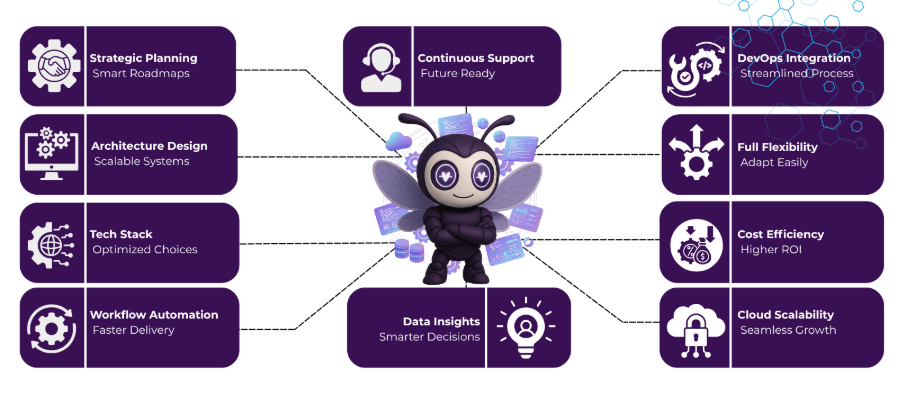
Consultants begin by analyzing the company’s existing systems, infrastructure, and workflows. Through detailed technical audits, they identify performance gaps and create a roadmap that fits business objectives. This makes custom software consultancy for business a vital step before development even begins.
According to Deloitte, companies that start with a strong technology strategy experience 30% fewer project failures.
2. Architecture and System Design
One of the main tasks of custom software development and consulting is to design a strong software architecture. Consultants define how different modules, APIs, and databases will interact, ensuring scalability, security, and long-term performance.
Studies show that 45% of software downtime is caused by poor architecture planning; something consultants help prevent.
3. Technology Selection and Stack Optimization
Choosing the right technology stack is crucial for success. A custom software engineering consultant helps select the most suitable tools, programming languages, and cloud platforms based on your project goals and budget, ensuring efficiency and smooth integration.
Research by Gartner reveals that optimized tech stack decisions can reduce development costs by up to 25%.
4. Workflow and Process Optimization
Beyond the code, consultants improve development workflows by introducing automation tools, DevOps practices, and Agile methodologies. This makes collaboration easier and speeds up project delivery — a key benefit of custom software consultancy for business.
Organizations that adopt consultant-led workflow optimization report 40% faster product delivery cycles.
5. Continuous Support and Technical Guidance
A reliable software consultancy company doesn’t stop after deployment. Consultants offer ongoing support, performance monitoring, and updates to keep your system future-ready. Their strategic input helps businesses stay ahead of technological changes and market demands.
Research shows that businesses partnering with ongoing technical consultants experience 35% better system uptime and reliability.
In essence, custom software consultancy turns complex technical challenges into structured, scalable, and high-performing solutions — giving tech companies the clarity and direction they need to grow efficiently.
How Tech Companies Leverage Software Consultancy for Faster Growth
Tech companies often turn to custom software consultancy to overcome technical roadblocks, optimize performance, and scale faster. By combining technical expertise with business strategy, consultants help organizations turn ideas into efficient, revenue-generating systems. Here’s how they make growth possible:
1. Building Scalable and Cloud-Ready Architectures
Modern tech companies need systems that can handle heavy traffic, large datasets, and rapid user growth. Consultants design scalable architectures using cloud-based technologies like AWS, Azure, or Google Cloud to make applications more flexible and cost-efficient.
They also implement microservices and API-driven architectures, allowing each module to function independently — so teams can deploy updates without breaking the whole system. As per IDC, businesses that move to scalable cloud architectures grow 35% faster than those using legacy systems.
2. Integrating Automation and DevOps Practices
Software consultants streamline development by introducing DevOps pipelines, CI/CD tools, and automated testing frameworks. These tools reduce manual errors and speed up releases, ensuring that every update moves from development to deployment quickly and reliably.
With automation in place, teams can deliver new features faster, improving customer satisfaction and reducing downtime. Companies using DevOps-led consultancy achieve 60% shorter development cycles on average.
3. Data-Driven Decision Making with Advanced Analytics
Consultants help companies make smarter decisions by implementing data engineering and analytics systems that collect and visualize real-time data. This enables leadership teams to monitor KPIs, detect performance bottlenecks, and forecast user trends with precision.
The integration of AI-based insights and predictive analytics gives businesses a competitive edge, helping them stay agile in changing markets. According to McKinsey, data-driven organizations are 23 times more likely to acquire customers and 19 times more likely to be profitable.
In short, software consultancy companies help tech firms modernize their infrastructure, automate their workflows, and make smarter data-backed decisions — creating the foundation for faster, sustainable growth.
Real-World Examples: How Consultancy Drives Innovation
Here are two real-world examples showing how a custom software consultancy approach drives innovation and transformation:
In one instance, Wells Fargo partnered with a consultancy-led software intelligence provider to analyse its enormous portfolio of more than 4,500 applications and tens of millions of lines of legacy code. Using automated tools and expert guidance, they were able to build a migration roadmap in weeks rather than the months or years that manual efforts would have required.
In another case, a global advisory firm EY employed consultancy support to undertake technology due-diligence on a software company. They analysed over 1.2 million lines of code across 2,600 files in less than a week — reducing assessment time by more than 75 %.
These examples demonstrate how engaging a specialized software consultancy translates technical challenges (legacy code, big portfolios, risk-mitigation) into measurable, innovative outcomes.
Red Flags to Avoid When Choosing a Consultancy Partner
Choosing the wrong consultancy can slow your project and increase costs. Here are a few warning signs to watch out for before you commit to a software consultancy company:
No Discovery or Research Phase
If a consultancy skips the initial discovery stage and jumps straight into development, it’s a major concern. A good custom software consultancy always begins by understanding your business goals, existing systems, and challenges before suggesting any solutions.
Lack of Technical Transparency
Be cautious if the consultants can’t clearly explain their technical choices, pricing model, or project timeline. Reliable firms maintain full transparency, sharing updates, reports, and recommendations throughout the process.
Limited Industry Experience
A consultancy that lacks experience in your industry may not fully grasp your operational or compliance needs. Always look for a custom software engineering consultant with proven case studies and domain-specific expertise.
No Long-Term Support or Maintenance
Some consultants end their involvement once the software goes live. Avoid firms that don’t provide continuous monitoring, updates, or support — because true custom software development and consulting continues even after launch to keep systems secure and optimized.
Want to Simplify Your Software Strategy with Expert Help?
Building the right software strategy doesn’t have to be complicated. At HelixBeat, our team of experts simplifies every step of your digital transformation — from planning and architecture design to implementation and long-term optimization. As a trusted custom software consultancy, we focus on turning complex business needs into clear, scalable, and result-driven software solutions.
Here’s how partnering with HelixBeat helps your company grow faster and smarter:
Here’s how partnering with HelixBeat helps your company grow faster and smarter:
- Customised Software Roadmaps: We build 100% customized technology plans that align software goals with your business objectives, helping clients reduce project risks by up to 35%.
- Scalable System Design: Our custom software engineering consultants create architectures that can handle 5× more user load and scale effortlessly with your growth.
- Agile and Transparent Process: With our agile framework, clients experience 40% faster delivery times and full visibility at every project milestone.
- Data-Driven Decision Support: We integrate analytics tools that improve accuracy in business forecasting by up to 50%, leading to better decision-making and resource use.
- Continuous Support and Optimization: Our long-term maintenance model has helped partners achieve 99.9% system uptime and cut operational costs by 25% annually.
At HelixBeat, we don’t just consult; we collaborate, innovate, and deliver measurable impact. Want to simplify your software strategy?
Frequently Ask Questions
1. Why is health information exchange important in healthcare?
It improves care coordination, reduces duplicate tests, minimizes errors, and helps providers make timely, data-driven decisions across different healthcare settings.
2. What are the main models of health information exchange?
3. Which standards guide health information exchange?
Standards like FHIR and HL7 define consistent data formats, making it easier for EHRs, HIEs, and other healthcare platforms to exchange information.
4. What are the benefits of using health information exchange?
HIE improves care coordination, reduces healthcare costs, supports population health management, enhances research, and increases operational efficiency.
5. How does AERIS enhance healthcare information exchange?
AERIS leverages FHIR standards, connects legacy systems, automates workflows, reduces manual errors, and provides real-time access to patient records and lab results.
1. How is custom software consultancy different from outsourcing?
Outsourcing focuses on completing specific development tasks, while custom software consultancy provides strategic direction, technical guidance, and system design expertise. Consultants help you plan what to build and how to build it efficiently before development begins.
2. When should a company hire a software consultant?
You should consider hiring a software consultancy company when facing challenges like unclear project requirements, recurring system failures, scalability issues, or when transitioning to new technologies such as cloud or AI.
3. How long does a typical consultancy engagement last?
It depends on the project’s complexity. Short-term consulting for strategy or audits may take 2–4 weeks, while full-scale technical consultation and implementation planning can extend up to 3–6 months.
4. Do software consultants only work with large enterprises?
No. Custom software consultancy for business applies to startups, SMEs, and enterprises alike. Consultants adapt strategies based on the company’s size, goals, and technical maturity.
5. What are the measurable results of working with software consultants?
Businesses typically experience 30–40% faster delivery times, 25% lower maintenance costs, and improved system performance due to better architecture and automation — making consultancy a long-term investment in efficiency and growth.