


data warehousing india
Every business generates vast amounts of data every day—from customer transactions to operational logs—but making sense of this data and turning it into actionable insights can be challenging. This is where data warehousing India plays a key role.
A modern data warehouse enables businesses to centralize their information, streamline operations, and make data-driven decisions instead of relying on guesswork. Whether for large enterprises or small businesses, it supports faster reporting, smooth integration with data lakes, and real-time analytics.
With Helixbeat DaaS, businesses get cloud-based, scalable solutions tailored for the Indian market, helping them harness the full potential of their data to boost efficiency and drive growth.
But What Exactly is Data Warehousing?
Data drives decisions, but only when it’s organized effectively. A data warehouse provides a centralized repository to collect and store data from multiple sources, enabling meaningful analysis and reporting. Unlike traditional databases, it is designed for business intelligence and strategic insights. Key concepts include:
- ETL (Extract, Transform, Load): Moving data from different sources into the warehouse.
- Data Modeling: Structuring data for analytics.
- OLAP (Online Analytical Processing): Enables multidimensional queries for deeper insights.
How Data Warehousing Works
A modern data warehouse architecture works by consolidating data from applications such as sales, inventory, HR, and external sources into a single repository. It processes, cleans, and organizes data for analytics, allowing users to generate dashboards, trend reports, and predictive insights to make data-driven decisions.
Difference Between Data Warehousing and Databases
Feature | Database
| Data Warehouse |
Purpose | Daily transactions
| Analytics & reporting
|
Data Type | Current operational data
| Historical & aggregated data |
Optimization | CRUD operations | Query performance & analysis
|
Users | Operational staff |
Analysts, managers, executives
|
Importance of Data Warehousing for Indian Businesses
Implementing a cloud based data warehouse can transform how Indian businesses manage data, improve efficiency, and drive growth.
Benefits for SMEs and Large Enterprises
A data warehouse for small business or large enterprise enables:
- Optimized inventory and supply chain management
- Better understanding of customer behavior
- Streamlined operations and higher efficiency
Enhancing Decision-Making with Analytics
Data warehouses in India provide real-time insights that help executives make informed decisions quickly. From forecasting demand to spotting market trends, analytics gives businesses an edge over competitors.
Improving Operational Efficiency
Centralizing data reduces redundancy and improves collaboration across departments. With automated reporting and analytics, businesses save time, reduce errors, and increase productivity.
Data Warehousing Trends in India
Understanding the latest trends helps businesses choose the right approach for their needs.
Cloud vs On-Premises Solutions
Cloud-based data warehouses are increasingly popular in India for their lower upfront costs, scalability, and easy remote access. On-premises solutions provide full control but require significant infrastructure investment. Many Indian companies are adopting hybrid or cloud-first strategies.
Adoption Statistics in India
Recent reports highlight:
- 55% of Indian enterprises adopt cloud-based data warehousing
- Small and medium businesses are the fastest-growing segment for cloud adoption
- Data lakes and data warehouses are being integrated by 40% of enterprises for advanced analytics
Choosing the Right Data Warehousing Solution in India
Selecting the perfect data warehousing solution ensures your business can leverage data efficiently. The right choice supports scalability, performance, and long-term growth.
Key Features to Consider
When selecting a solution, consider:
- Scalability: Can the system grow with your business as data volume increases?
- Integration: Works seamlessly with your existing software and data sources.
- Performance: Enables fast queries and real-time reporting.
- Security: Complies with Indian IT regulations and data protection standards.
Cost Factors and ROI
Understanding costs upfront ensures maximum return on investment. Key considerations include:
- Cloud vs On-Premises: Cloud-based data warehouse solutions offer pay-per-use and minimal maintenance.
- Implementation Costs: Vary depending on scale, customization, and infrastructure.
- ROI Metrics: Reduced manual work, better forecasting, and higher operational efficiency.
- Time Savings: Companies report up to 35% faster reporting cycles using modern data warehouse architecture.
- Long-Term Value: Investment in a scalable system prevents frequent overhauls and reduces downtime costs.
Implementation and Best Practices
A well-planned approach ensures that a data warehouse delivers actionable insights and long-term value.
Steps to Implement a Data Warehouse
- Identify business goals and KPIs to guide architecture decisions.
- Choose the right architecture: cloud-based data warehouse, on-premises, or hybrid.
- Design efficient ETL pipelines to move and transform data.
- Integrate with BI and analytics tools for real-time dashboards.
- Test, optimize, and deploy while monitoring performance.
Common Challenges and Solutions
- Data Quality Issues: Implement automated cleaning and validation to maintain accuracy.
- High Costs: Cloud solutions reduce upfront investments by up to 50% compared to on-premises setups.
- Complex Integration: Use standardized APIs for seamless integration with data lakes and data warehouses.
- Change Management: Train staff on new workflows to maximize adoption.
- Scalability Challenges: Modern data warehouse architecture allows expansion without downtime.
Security and Compliance in India
- Encrypt data both at rest and in transit.
- Follow IT Act, ISO 27001, and GDPR standards.
- Implement role-based access controls and regular audits.
- Maintain audit logs for regulatory compliance.
- Conduct periodic security assessments to identify vulnerabilities.
Why Choose Helixbeat DaaS for Your Data Warehousing Needs
Choosing the right partner ensures your data investment drives value and growth.
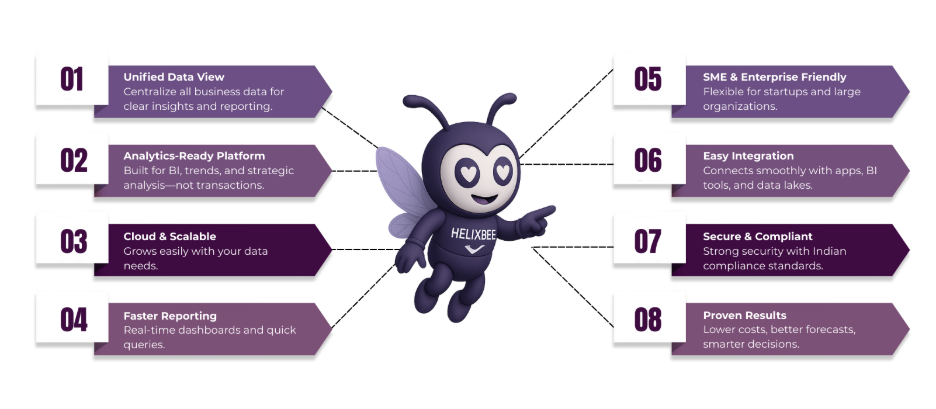
- Scalable Solutions: Cloud-based data warehouses grow with your business and handle increasing data volumes.
- Integration Capabilities: Seamlessly connects with existing software, BI tools, and data lakes and data warehouses.
- Cost-Effectiveness: Data warehouse for small business solutions save up to 50% compared to traditional setups.
- Modern Data Warehouse Architecture: Supports real-time analytics, dashboards, and predictive insights.
- Expert Support: Helixbeat DaaS provides ongoing assistance to ensure smooth operations and optimization.
Hear From Our Clients
“With Helixbeat DaaS, our cloud-based data warehouse reduced reporting time from 7 days to just 1 hour. Real-time insights have transformed our decision-making.” – Rohan S., Retail Manager
“Using Helixbeat DaaS to combine data lakes and warehouses allowed us to predict inventory needs accurately, cutting waste by 25% and improving efficiency.”– Meera P., SME Owner
“Helixbeat DaaS helped us implement a small business data warehouse without high IT costs. We now track customer behavior instantly and make data-driven decisions.” – Aditya K., Startup Founder
Ready to Transform Your Business with Data Warehousing?
Centralize your data, enhance analytics, and boost business efficiency with Helixbeat DaaS. Our modern, cloud-based, and small business-ready data warehouses are just a call away.
What Users Say About AERIS
Dr. Sarah L.
Hospital Administrator
John T.
Telemedicine Provider
Emily P.
Healthcare Executive
Frequently Asked Questions
- What is the cost of a data warehouse in India?
Costs vary based on scale and architecture. Cloud solutions are cost-effective and suitable for SMEs.
- Can small businessesbenefitfrom a data warehouse?
Yes, modern cloud solutions and Helixbeat DaaS packages make warehouses accessible to small businesses.
- How does a data warehouse differ from a database?
Databases handle daily operations, while data warehouses store historical, structured data for analysis and reporting.
- Are cloud-based warehouses secure?
Yes, with encryption, access control, and compliance with IT Act and GDPR.
- Why chooseHelixbeat DaaS?
Helixbeat DaaS offers scalable, cloud-ready, and customized data warehouses, with expert support and seamless integration.
- Can data warehouses integrate with data lakes and other analytics tools?
Yes, modern data warehouses are designed to integrate seamlessly with data lakes, BI tools, and AI/ML platforms, enabling advanced analytics and real-time insights.