


Cloud Based Performance Testing
Get Started with a Free Demo
New Keyword Page
New Keyword Page
"*" indicates required fields
Modern development teams release software faster using CI/CD pipelines. However, testing application performance in such fast cycles is difficult. Traditional testing methods often require heavy infrastructure and cannot easily simulate real-world traffic.
As applications become more complex with microservices and global users, many teams struggle with the performance testing of cloud based applications, which can lead to slow systems and poor user experience.
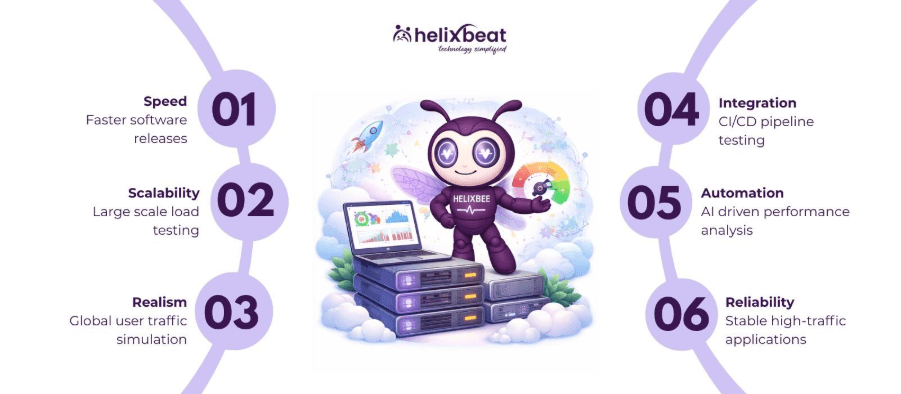
To solve this challenge, many organizations now use cloud-based performance testing. With the help of cloud-based performance testing tools, teams can run large-scale cloud-based load testing without maintaining expensive infrastructure. This approach allows teams to simulate real user traffic, identify performance issues early, and deliver more reliable applications.
In this blog, we will explore how cloud-based performance testing is transforming software quality with the help of CI/CD and AI-driven testing.
Why Traditional Performance Testing Is No Longer Enough
Traditional performance testing methods were designed for monolithic applications and static infrastructure, but modern software environments are highly dynamic and distributed.
As organizations adopt cloud-native architectures and continuous delivery practices, legacy testing approaches struggle to keep pace with evolving performance demands.
1. Limited Scalability for Distributed Architectures
Traditional testing environments often rely on fixed on-premise infrastructure, which limits the ability to simulate large-scale traffic. Modern applications built on microservices, containers, and Kubernetes clusters require highly scalable testing environments that traditional setups cannot easily support.
2. Lack of Realistic Global Traffic Simulation
Legacy testing tools usually generate load from a single location or limited servers. This makes it difficult to replicate geographically distributed user traffic, network latency variations, and real-world workload patterns needed for accurate cloud based load testing.
3. Slow Feedback in DevOps and CI/CD Workflows
Traditional performance testing is often executed late in the development cycle, making it difficult to detect bottlenecks early. This delays issue resolution and disrupts automated pipelines where performance testing of cloud based applications should ideally run continuously.
Because of these limitations, many organizations are shifting toward cloud based performance testing and modern testing frameworks that provide scalable infrastructure, real-time analytics, and seamless CI/CD integration.
The Role of Cloud Based Performance Testing in CI/CD Pipelines
In modern DevOps environments, testing must keep pace with continuous integration and continuous delivery (CI/CD). Integrating cloud based performance testing into CI/CD pipelines allows teams to evaluate application performance during every build and deployment stage.
1. Continuous Performance Validation During Development
Efficient billing is critical for customer satisfaction, and pos billing software for restaurant makes it simple:
- Faster, accurate order processing, reducing wait times.
- Minimized errors that lead to happier customers.
- Supports complex menus and combo deals, ideal for software for fast food restaurant operations.
2. Faster Feedback for DevOps Teams
CI/CD pipelines rely on fast feedback loops. By using cloud based performance testing tools, teams can quickly simulate thousands of virtual users and receive real-time performance metrics such as response time, throughput, and latency. This allowes developers to optimize performance before releasing new features.
3. Scalable Testing Without Infrastructure Management
Cloud platforms allow teams to scale testing environments on demand. Instead of maintaining dedicated hardware, teams can perform large-scale performance testing of cloud based applications directly in the cloud, making it easier to test applications under peak traffic conditions.
According to industry research, over 70% of DevOps teams now integrate automated testing into their CI/CD pipelines to improve software reliability and release speed.
By embedding cloud based performance testing into these workflows, organizations can maintain both speed and quality in modern software delivery.
AI and Automation in Modern Performance Testing
As modern applications become more complex, analyzing performance data manually is no longer efficient.
AI and automation are transforming cloud based performance testing by enabling faster analysis, intelligent test execution, and proactive identification of performance issues in dynamic environments.
1. Intelligent Detection of Performance Anomalies
AI-powered testing systems can analyze large volumes of performance data and automatically detect unusual patterns such as latency spikes, memory leaks, or CPU bottlenecks.
For example, during cloud based load testing, AI can identify abnormal response times in a microservice and alert teams before it impacts users.
2. Automated Test Generation and Optimization
Automation tools can automatically create and execute performance test scenarios based on application behavior.
Modern cloud based performance testing tools can adjust virtual user loads, optimize test scripts, and run tests continuously within CI/CD pipelines without manual intervention.
3. Predictive Insights for Performance Engineering
AI algorithms can predict how an application will behave under future workloads by analyzing historical performance data.
This helps teams proactively improve the performance testing of cloud based applications, ensuring systems remain stable during peak traffic events such as product launches or seasonal sales.
According to industry reports, AI-powered testing can reduce performance analysis time by nearly 30–40%, helping DevOps teams improve efficiency and software reliability.
Future Trends: AI-Driven and Autonomous Performance Testing
As software systems become more distributed and cloud-native, performance testing is evolving toward intelligent and autonomous systems.
AI is allowing testing platforms to analyze performance patterns, adapt test strategies automatically, and predict potential failures before they impact users.
1. Self-Learning Performance Testing Systems
Future testing platforms will use machine learning models to learn from historical performance data and automatically adjust test scenarios.
For example, an AI-powered platform testing a streaming application can identify peak viewing hours and automatically run cloud based load testing to simulate millions of concurrent users.
According to industry reports, over 60% of testing tools are expected to include AI-driven capabilities by 2027.
2. Autonomous Test Execution and Optimization
Autonomous testing systems will automatically generate, execute, and optimize performance tests without manual intervention.
Modern cloud based performance testing tools are already moving toward automated pipeline integration, where tests are triggered automatically during deployments.
For instance, a SaaS company can run automated performance testing of cloud based applications every time a new microservice update is pushed to production.
Why Choose Us?
Performance issues often appear only when real users start interacting with an application. That’s why we focus on practical and scalable cloud based performance testing that reflects real-world usage. Our team works closely with development and DevOps teams to ensure applications remain stable, responsive, and ready for high traffic.
We help organizations run reliable cloud based load testing and improve the performance testing of cloud based applications as part of their CI/CD workflows. Instead of testing at the last stage, we help teams detect performance bottlenecks early so they can fix issues before deployment.
What you get when you work with us:
- Access to advanced cloud based performance testing tools for scalable testing
- Easy integration with CI/CD pipelines and DevOps environments
- Real-world cloud based load testing that simulates global user traffic
- Faster identification of performance bottlenecks using intelligent analytics
This approach helps your team release applications with confidence, knowing the system has already been tested under realistic load conditions.
Want to ensure your applications perform flawlessly under real-world traffic? Get in touch with our experts today to start your cloud-based performance testing process.
Frequently Ask Questions
1. Why is health information exchange important in healthcare?
It improves care coordination, reduces duplicate tests, minimizes errors, and helps providers make timely, data-driven decisions across different healthcare settings.
2. What are the main models of health information exchange?
3. Which standards guide health information exchange?
Standards like FHIR and HL7 define consistent data formats, making it easier for EHRs, HIEs, and other healthcare platforms to exchange information.
4. What are the benefits of using health information exchange?
HIE improves care coordination, reduces healthcare costs, supports population health management, enhances research, and increases operational efficiency.
5. How does AERIS enhance healthcare information exchange?
AERIS leverages FHIR standards, connects legacy systems, automates workflows, reduces manual errors, and provides real-time access to patient records and lab results.
1. What features should teams look for in cloud based performance testing tools?
Good cloud based performance testing tools should support global traffic simulation, real-time performance monitoring, and easy CI/CD integration. They should also allow teams to test APIs, web applications, and microservices efficiently.
2. How does cloud based load testing simulate real user traffic?
Cloud based load testing generates user traffic from multiple locations to replicate real-world usage patterns. This helps teams understand how an application performs when many users access it at the same time.
3. Why is performance testing of cloud based applications important?
The performance testing of cloud based applications helps identify system slowdowns and scalability issues before deployment. It ensures the application can handle increasing user traffic without affecting performance.