


Data Warehousing for Business Intelligence
Get Started with a Free Demo
New Keyword Page
New Keyword Page
"*" indicates required fields
Every day, US businesses generate enormous amounts of data across sales, HR, finance, and operations. Yet, without proper organization, much of this information remains unused, scattered, or inaccessible. This inefficiency leads to missed opportunities, delayed decisions, and reduced operational effectiveness.
Data warehousing for business intelligence changes this scenario by consolidating all your enterprise data into a single, structured platform ready for analytics. US business owners and BI teams can now turn fragmented data into actionable insights, driving growth, enhancing efficiency, and uncovering hidden opportunities.
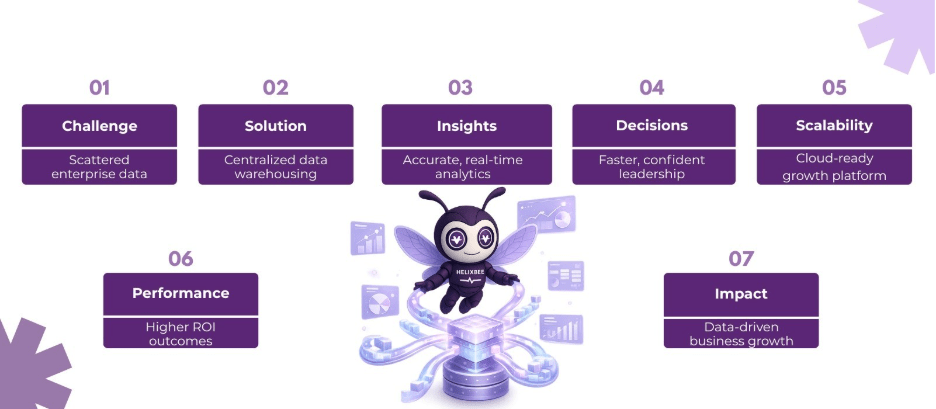
Understanding What Businesses Really Seek from Data Warehousing
When searching for data warehousing for business intelligence, US companies want more than storage—they seek strategic clarity, actionable insights, and scalable solutions that drive decision-making.
Centralized Data Access
Decision-makers need a unified platform to access all operational and customer data instantly, eliminating delays and fragmented information.
Accurate Business Insights
Executives expect analytics to forecast trends, highlight opportunities, and reduce guesswork, enabling confident, informed decisions.
Scalable and Cost-Effective Solutions
US businesses prefer warehouses that grow with their operations while keeping costs lower than traditional BI systems.
How Data Warehousing Powers Business Intelligence for US Companies
The right business data intelligence warehousing ensures BI tools deliver meaningful, actionable results that drive business growth.
Integration Across Multiple Sources
Data from sales, marketing, finance, and operations is consolidated into one platform for seamless analytics and reporting.
Enhanced Decision-Making
Centralized data allows leadership to quickly identify patterns, enabling faster and smarter strategic decisions.
Business Data Intelligence Warehousing Advantages
Dashboards update in real-time, reporting is automated, and predictive analytics help forecast trends efficiently.
Role of Data Warehousing in Business Intelligence
Data warehousing and business intelligence form the backbone of advanced analytics, making insights reliable, actionable, and future-ready.
Improved Forecast Accuracy
Structured warehouses boost forecasting accuracy by 20–30% compared to unstructured systems, reducing planning errors.
Analytics for Customer Insights
Analyzing historical and real-time customer data enables personalized strategies that increase retention and engagement.
Streamlined Reporting
Automated dashboards reduce manual reporting, giving leadership immediate access to key performance metrics.
Selecting the Right Tools for Data Warehousing and BI
Choosing the right data warehouse business intelligence tools determines how effectively US businesses transform raw data into actionable intelligence.
Data Warehouse Business Intelligence Tools
ETL platforms, visualization dashboards, and predictive analytics software are essential for insights that guide business strategy.
Cloud vs On-Premises Warehousing
Cloud warehouses offer fast scalability and cost efficiency, while on-premises warehouses provide tighter control and security.
Ensuring Security and Compliance
US enterprises require compliance with GDPR, HIPAA, and industry standards, supported by secure storage and detailed audit trails.
Measuring ROI with Helixbeat DaaS
Helixbeat DaaS allows US businesses to quantify gains from data warehousing for business intelligence with measurable improvements in efficiency and revenue.
ROI Metrics
Metric | Before Helixbeat DaaS | After Helixbeat DaaS | Impact |
Decision-making speed | 6 days | Real-time | 85% faster |
Forecast accuracy | 65% | 90% | +25% |
Operational efficiency | Moderate | High | +30% |
Data accessibility | Fragmented | Centralized | Complete visibility |
Helixbeat DaaS Benefits
Faster strategic decisions, reduced operational overhead, and increased revenue potential, all enabled by a unified cloud platform.
Implementing Data Warehousing Successfully
Successful implementation ensures US businesses can fully leverage data warehousing for business intelligence while improving accuracy, speed, and decision-making across teams.
Assess Business Needs
Before implementation, organizations must identify critical datasets, reporting priorities, and analytics goals, so the data warehouse in business analytics aligns with real business outcomes.
Design Efficient ETL Processes
Well-designed ETL processes extract, clean, and load data consistently, ensuring high-quality inputs for reliable business intelligence and analytics.
Analytics and Dashboard Integration
By integrating dashboards and BI tools, businesses enable real-time visibility, allowing leadership teams to act faster with confidence.
Overcoming Challenges in Data Warehousing for Business Intelligence
While powerful, data warehousing for business intelligence comes with challenges that must be addressed to maintain performance and reliability.
Data Quality and Consistency Issues
Automated validation and cleansing workflows ensure consistent data across systems, which strengthens trust in analytics and reporting.
Managing Big Data Volumes
Cloud-enabled platforms scale efficiently, allowing enterprises to manage growing data volumes without sacrificing performance.
Cost vs Benefits
Factor | Traditional Approach | Helixbeat DaaS | Advantage |
Implementation cost | High | Moderate | Cost-effective |
Maintenance | Manual | Automated | Reduced effort |
Decision support | Delayed | Real-time | Faster actions |
Data accuracy | Medium | High | Reliable insights |
Make Your Data a Strategic Asset
When implemented correctly, a data warehouse in business analytics transforms scattered information into a centralized asset that improves forecasting, strengthens planning, and increases ROI. With Helixbeat DaaS, organizations can confidently turn data into decisions that drive measurable business impact.
Frequently Ask Questions
1. Why is health information exchange important in healthcare?
It improves care coordination, reduces duplicate tests, minimizes errors, and helps providers make timely, data-driven decisions across different healthcare settings.
2. What are the main models of health information exchange?
3. Which standards guide health information exchange?
Standards like FHIR and HL7 define consistent data formats, making it easier for EHRs, HIEs, and other healthcare platforms to exchange information.
4. What are the benefits of using health information exchange?
HIE improves care coordination, reduces healthcare costs, supports population health management, enhances research, and increases operational efficiency.
5. How does AERIS enhance healthcare information exchange?
AERIS leverages FHIR standards, connects legacy systems, automates workflows, reduces manual errors, and provides real-time access to patient records and lab results.
1. What is data warehousing for business intelligence?
It is the process of consolidating data into a structured warehouse for analytics and actionable insights.
2. How does Helixbeat DaaS improve decision-making?
It provides real-time dashboards, predictive analytics, and centralized data access for executives.
3. Can US businesses ensure data security with Helixbeat DaaS?
Yes, Helixbeat DaaS complies with GDPR, HIPAA, and international security standards.
4. How long does it take to implement a data warehouse?
Typically, 4–12 weeks, depending on data complexity and integration requirements.
5. Which industries benefit most from data warehousing?
Finance, healthcare, retail, manufacturing, and logistics gain maximum value.
6. What tools integrate with data warehouses?
ETL platforms, BI dashboards, predictive analytics software, and cloud storage solutions.
7. How is ROI measured for BI investments?
Metrics include decision speed, forecast accuracy, operational efficiency, and revenue growth.