


EHR Data Integration
Get Started with a Free Demo
New Keyword Page
New Keyword Page
"*" indicates required fields
The modern healthcare ecosystem cannot function without EHR data integration. Patient information is scattered across hospitals, clinics, laboratories, and pharmacies, with each system speaking its own language. This fragmentation makes it difficult for healthcare providers to access complete, accurate, and up-to-date records, slowing down care, increasing errors, and creating administrative bottlenecks.
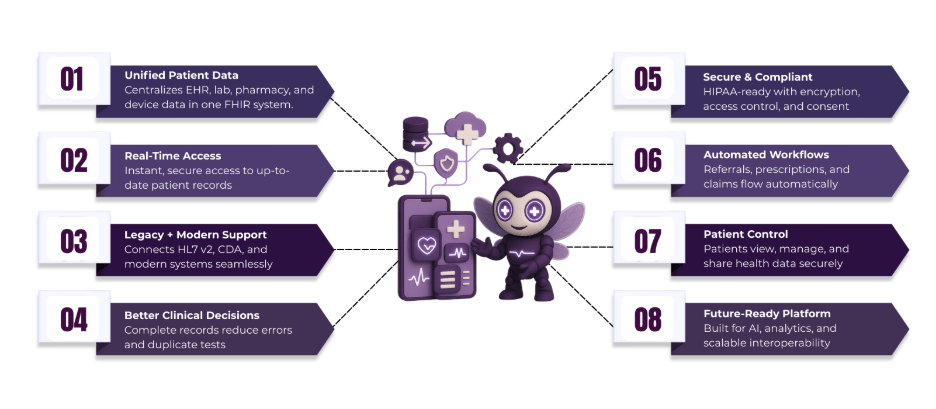
FUSION, a robust FHIR server, solves this problem by unifying all health data into a standardized, centralized system. With seamless electronic health record integration, hospitals can operate efficiently, clinicians can make informed decisions, and patients benefit from coordinated, timely care. EHR integration in healthcare is no longer optional—it’s essential for a fully functioning hospital.
Transform your operations with ehr data integration that works in real time.
What is EHR Data Integration?
EHR data integration is the process of consolidating patient health information from multiple sources into a unified, standardized format. Without integration, providers struggle to obtain a complete view of patient history, which can result in:
- Repeated diagnostic tests
- Delayed treatments
- Increased administrative workload
- Higher operational costs
- Medical errors due to incomplete information
The need for electronic health record integration is more pressing than ever. Healthcare organizations aim to deliver patient-centric care, reduce operational overhead, and comply with evolving regulatory standards such as HIPAA, CMS, and ONC interoperability mandates.
FUSION acts as a FHIR server, enabling real-time, standardized exchange of healthcare data. By converting disparate EHR data into FHIR-compliant resources, FUSION makes EHR integration in healthcare faster, more accurate, and future-proof.
Why EHR Data Integration is Crucial
- Improves Clinical Decision-Making
Integrated EHR data ensures that physicians have access to a complete medical history, lab results, medications, and imaging records. Real-time access allows for timely, data-driven decisions that improve patient outcomes. - Reduces Redundant Testing
When multiple providers have access to the same patient information, unnecessary diagnostic tests can be avoided, saving costs and minimizing patient inconvenience. - Enhances Care Coordination
EHR integration in healthcare enables collaboration between primary care physicians, specialists, laboratories, pharmacies, and telehealth providers, creating a seamless continuum of care. - Empowers Patients
Integrated systems allow patients to access their records via secure portals or apps. They can monitor their health, schedule appointments, and share selected data with providers, improving engagement. - Supports Regulatory Compliance
Standardized data exchange with FUSION ensures compliance with HIPAA and CMS interoperability rules, safeguarding patient information and meeting audit requirements.
How FUSION Enables EHR Data Integration
As a full-fledged FHIR server, FUSION offers a robust framework for ehr data integration:
1. Centralized FHIR Repository
All patient data is stored as standardized FHIR resources such as Patient, Observation, Medication, CarePlan, and DiagnosticReport. This ensures:
- Uniform structure across all connected systems
- Easy retrieval and updates
- Modular expansion for new data types
A hospital using Epic and a clinic using Cerner can both share patient information seamlessly through FUSION without custom integrations.
2. Real-Time Data Access
FUSION provides RESTful APIs that allow clinicians, applications, and devices to access patient information instantly. Real-time ehr data integration eliminates delays, enabling faster clinical decisions and better patient care.
A diabetic patient’s glucose readings from a wearable device are automatically updated in FUSION, accessible to the endocrinologist and primary care physician simultaneously.
3. Legacy System Compatibility
Healthcare organizations often operate legacy EHR systems in HL7 v2, CDA, or proprietary formats. FUSION maps these formats to FHIR resources, ensuring electronic health record integration across both old and new systems.
Benefit: No need for costly system replacements—FUSION integrates existing infrastructure seamlessly.
4. Security and Compliance
FUSION ensures that ehr integration in healthcare meets the highest security standards:
- Role-Based Access Control: Clinicians, administrators, and patients access only what they need.
- End-to-End Encryption: TLS and AES protect data at rest and in transit.
- Consent Management: Patients define which providers can access their health data, ensuring privacy compliance.
5. Workflow Automation
FUSION automates critical healthcare workflows:
- Referrals are updated in real-time.
- Prescriptions are sent to pharmacies automatically.
- Insurance claims are processed using standardized FHIR resources.
Outcome: Less manual effort, fewer errors, and improved operational efficiency.
6. Patient Empowerment
Patients gain control over their health information through FUSION:
- View complete medical records via secure portals
- Track lab results and medications
- Share data selectively with new providers
- Integrate wearable device data for continuous monitoring
Impact: Higher patient engagement and satisfaction.
Unlock the power of electronic health record integration with FUSION’s secure, scalable FHIR server. Learn More
Use Cases of FUSION in EHR Data Integration
1. Multi-Hospital Networks
Hospitals within a network can share patient records seamlessly, reducing redundant tests and improving care continuity.
Example: A hospital network integrated FUSION to centralize patient data, resulting in a 30% reduction in duplicate lab tests.
2. Telemedicine and Remote Care
Telehealth providers can access real-time patient data from wearables and home monitoring devices. This ensures virtual consultations are informed and accurate.
Example: Remote monitoring of chronic conditions such as diabetes or heart disease allows providers to adjust treatments promptly.
3. Clinical Research
Researchers can query de-identified FHIR resources from multiple institutions, enabling multi-center studies without manual data harmonization.
Example: Standardized FHIR data facilitated a clinical trial across five hospitals, accelerating patient recruitment and reporting.
4. Insurance Claims Automation
Insurance companies can retrieve standardized patient data directly from FUSION, reducing errors and speeding up claims processing.
Example: Automated claims workflows reduced processing time by 40% for a regional insurer.
5. Public Health Monitoring
Aggregated FHIR data supports population health management and outbreak tracking.
Example: Public health agencies used FUSION to monitor vaccination trends and disease outbreaks in real-time.
Core Components of EHR Data Integration
Successful ehr data integration relies on four technical layers. FUSION supports all layers, enabling scalable and secure integration:
Component | Function | Data Sources |
Data Sources | Collects and stores patient data from multiple systems | EHRs, lab systems, imaging, wearables |
Integration Engine | Processes, normalizes, and routes data between systems | Cloud platforms like FUSION, AERIS |
Standards Layer | Ensures interoperability through healthcare standards | HL7 v2, FHIR, CDA, DICOM |
Security Layer | Protects patient data with authentication, encryption, and auditing | OAuth 2.0, TLS/AES encryption, audit logs |
This layered architecture ensures seamless ehr data integration, connecting providers, devices, and applications while maintaining security and compliance.
How FHIR Powers Modern EHR Data Integration
Fast Healthcare Interoperability Resources (FHIR, pronounced “fire”) is the latest HL7 standard for modern healthcare data exchange. FHIR uses RESTful APIs and JSON/XML payloads familiar to web developers, making EHR integration in healthcare more accessible.
FHIR Resources in Action with FUSION
FHIR Resource | Purpose / Example |
Patient | Stores demographic data, contact info, and identifiers |
Observation | Captures vitals, lab values, and clinical measurements |
MedicationRequest | Records prescriptions, dosage, and administration instructions |
Encounter | Tracks office visits, hospital admissions, and telehealth sessions |
By standardizing patient information into FHIR resources, FUSION enables seamless ehr data integration across hospitals, clinics, labs, and remote care platforms.
Benefits of Using FUSION for EHR Data Integration
Implementing FUSION for ehr data integration provides measurable improvements:
- Enhanced Interoperability: Standardized FHIR resources allow all systems to communicate efficiently.
- Real-Time Decision Making: Clinicians access up-to-date information instantly.
- Cost Reduction: Reduces redundant tests, manual work, and administrative overhead.
- Patient-Centric Care: Patients securely access and share their health records.
- Future-Ready Architecture: Supports AI, analytics, and predictive health tools.
- Regulatory Compliance: Role-based access, encryption, and consent management ensure HIPAA and CMS adherence.
FUSION by the Numbers — Real Results
FUSION’s performance metrics show real impact when deploying EHR data integration:
Metric | Impact / Result |
70% Faster Data Sharing | Real‑time interoperability between care systems |
30% Reduction in Redundant Tests | Eliminated duplicate diagnostics |
60% Faster Referral Processing | Reduced delays in patient care |
Cut Errors by 90% | Through FHIR standardization |
Save Up to $400 per Patient Annually | From streamlined data workflows |
CMS Compliance w/ 100% Regulatory Adherence | Eliminates penalties up to $1.5M |
These verified performance numbers show how FUSION’s electronic health record integration delivers tangible business and clinical benefits.
Certification proves...
These metrics highlight how FUSION enables large-scale electronic health record integration, reducing inefficiencies and improving care.
- HIPAA Certified: Ensures secure handling of patient information for compliant ehr integration in healthcare.
- SOC 2 Type 2 Certified: Provides assurance of strong controls for data security, availability, and confidentiality in ehr data integration.
- Drummond Health IT Compliance: Validates interoperability and adherence to FHIR standards for seamless electronic health record integration.
- Cloud Security Standards: HIPAA-compliant cloud infrastructure guarantees safe storage and transmission of sensitive health data.
- Trust & Reliability: Certifications demonstrate FUSION’s commitment to secure, efficient, and scalable ehr data integration across healthcare organizations.
How FUSION Works: Step-by-Step
- Data Collection: FUSION ingests information from EHRs, labs, pharmacies, and wearables.
- Data Standardization: Converts all data into FHIR-compliant resources.
- Centralized Storage: Stores data securely in one location.
- API Access: Enables real-time retrieval and updates by clinicians, apps, and devices.
- Workflow Automation: Referrals, prescriptions, and claims are automated.
- Patient Access: Patients monitor and share their health records through portals and mobile apps.
Final words
FUSION revolutionizes ehr data integration, unifying patient records, streamlining workflows, and enhancing care quality. Empower your healthcare organization with real-time, secure, and compliant electronic health record integration. Take the next step toward seamless interoperability—Book a Free Demo with FUSION today and transform your healthcare data management.
Frequently Ask Questions
1. What is EHR data integration?
It unifies patient data from multiple sources. FUSION ensures seamless electronic health record integration for accurate, up-to-date information.
2. How does FUSION help with electronic health record integration?
FUSION uses FHIR standards to connect EHRs, labs, and devices for real-time ehr integration in healthcare.
3. What are the benefits of using FUSION?
It enhances interoperability, reduces redundant tests, supports patient care, and ensures efficient ehr data integration.
4. Can FUSION work with legacy healthcare systems?
Yes, it converts HL7 v2, CDA, and other formats into FHIR for full electronic health record integration.
5. How secure is FUSION for patient data?
FUSION provides encryption, role-based access, and audit logs for compliant ehr integration in healthcare.