


FUSION FHIR Server: Enabling Seamless Interoperability and EHRIntegration
Get Started with a Free Demo
New Keyword Page
New Keyword Page
"*" indicates required fields
Healthcare organizations invest billions in electronic health records, yet achieving true interoperability and EHR connectivity remains one of the industry’s most persistent challenges. Despite regulatory mandates, clinical data remains trapped in silos, forcing care teams to navigate multiple systems to access complete patient information.
FUSION is a production-grade FHIR Server built on HL7 FHIR R4 standards, designed to solve the interoperability and EHR integration challenge. FUSION acts as a centralized FHIR data repository that enables hospitals and healthcare enterprises to achieve seamless interoperability and EHR data exchange across systems, applications, payers, and public health networks.
Understanding Interoperability and EHR in Modern Healthcare
Electronic Health Records (EHRs) are digital systems that capture and manage comprehensive patient clinical data—from demographics and vital signs to lab results, prescriptions, and imaging reports.
Interoperability and EHR refers to the ability of different EHR systems to access, exchange, and meaningfully use clinical data in a coordinated way. True interoperability of EHR systems occurs when systems can exchange data and interpret it without manual intervention.
The 21st Century Cures Act and TEFCA mandate that ehr interoperability standards be adopted to improve care coordination, reduce administrative burden, and empower patients with direct access to their health information.
Why EHR Interoperability Fails Without a FHIR Server
Despite decades of investment, EHR interoperability in healthcare remains fragmented. A 2023 Office of the National Coordinator survey found that nearly 40% of hospitals face significant challenges exchanging patient data.
Proprietary Data Models: Legacy EHR vendors use proprietary structures that don’t communicate with competitors’ systems, creating vendor lock-in and requiring expensive custom interfaces.
Missing API Infrastructure: While ehr interoperability standards like HL7 FHIR exist, many organizations lack the infrastructure to implement them at scale. Without a FHIR Server, clinical data remains trapped in databases.
Inconsistent Data Formats: Clinical data exists in multiple formats—HL7 v2 messages, CDA documents, proprietary XML. Converting between formats manually is error-prone and unsustainable.
Lack of Real-Time Access: Traditional integration relies on batch processing and overnight file transfers. Care teams need immediate access to patient data for clinical decision-making.
The root problem: Organizations attempt interoperability and EHR integration without foundational infrastructure—a FHIR Server—to standardize and expose clinical data through modern APIs.
How a FHIR Server Enables Interoperability of EHR Systems
A FHIR Server is purpose-built infrastructure that implements the HL7 FHIR specification, providing a standardized way to store, retrieve, and exchange clinical data for achieving interoperability of EHR systems.
Standardized Resource Storage: Stores clinical data as discrete FHIR resources (Patient, Observation, Medication) that conform to international standards, eliminating proprietary data models.
RESTful API Layer: Exposes data through REST APIs, making clinical data accessible to EHRs, mobile applications, and third-party tools through a single interface that follows ehr interoperability standards.
Real-Time Data Exchange: Enables synchronous queries. Clinicians can instantly retrieve lab results, medication history, or imaging reports through standardized FHIR API calls.
Built-In Validation: Automatically validates incoming data against FHIR profiles, ensuring data quality while providing audit logging and role-based access control for HIPAA compliance.
Legacy System Translation: Ingests HL7 v2 messages and CDA documents, transforming them into FHIR resources. This allows organizations to achieve modern EHR interoperability in healthcare without replacing legacy systems.
How FUSION Delivers Interoperability and EHR Integration
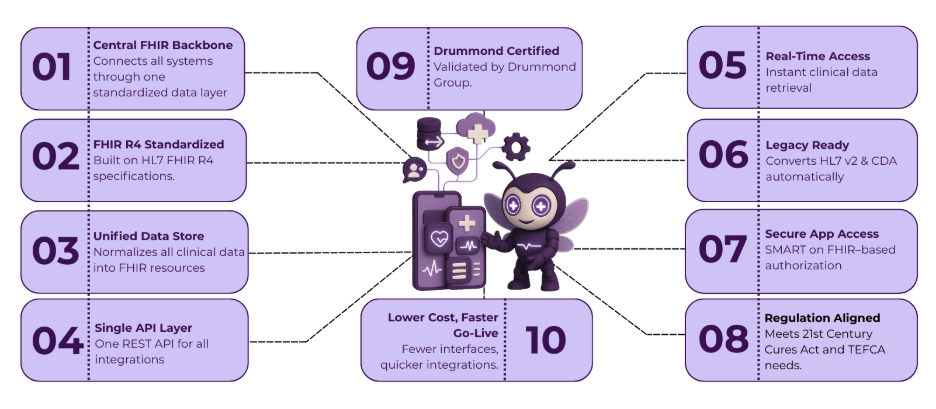
FUSION serves as the central FHIR backbone, providing production-ready infrastructure for comprehensive interoperability and EHR connectivity across your care ecosystem.
Centralized FHIR Data Repository
FUSION stores all clinical data as standardized FHIR R4 resources. Whether data originates from your primary EHR, specialty system, medical device, or patient application, FUSION normalizes it into a consistent format accessible through FHIR APIs.
Comprehensive FHIR R4 Support
FUSION implements the complete HL7 FHIR R4 specification, supporting over 140 resource types including Patient, Observation, Condition, and Procedure. It validates all incoming data automatically, ensuring data meets ehr interoperability standards.
Universal RESTful APIs
FUSION exposes clinical data through RESTful FHIR APIs, enabling:
- EHR-to-EHR exchange: Query patient records across different EHR vendors
- EHR-to-app integration: Power patient portals and telehealth platforms with live EHR data
- EHR-to-payer connectivity: Share prior authorization requests and claims data
- EHR-to-public health reporting: Submit immunization records and quality reports
Every connection uses the same standardized API, enabling true interoperability of EHR systems.
SMART on FHIR Authorization
FUSION supports SMART on FHIR, enabling third-party applications to securely access EHR data with appropriate patient or provider consent. This allows organizations to build modern app ecosystems without compromising security.
Automatic Legacy Format Transformation
FUSION converts HL7 v2 messages and CDA documents into FHIR resources automatically, allowing legacy lab systems and radiology PACS to participate in modern EHR interoperability in healthcare without expensive upgrades.
See how FUSION enables real-time clinical data exchange across EHRs, applications, and care partners. Our experts will demonstrate FUSION’s Drummond-certified interoperability and EHR capabilities tailored to your organization’s specific integration challenges and show you exactly how FUSION implements production-ready interoperability of EHR systems.
Real-World Applications
EHR-to-EHR Care Coordination: A regional health system with three hospitals using different EHR vendors deployed FUSION as their central FHIR Server. When patients transfer between facilities, clinicians query FUSION’s API to retrieve complete medication lists and lab results in real time—reducing duplicate testing and improving patient safety.
EHR-to-Mobile App Integration: A healthcare enterprise used FUSION to expose a single FHIR API aggregating data from all connected EHRs. The mobile app uses SMART on FHIR to authenticate patients and retrieve clinical data. The app launched in four months instead of 18.
EHR-to-Payer Prior Authorization: An orthopedic clinic’s EHR writes clinical data to FUSION as FHIR resources. The payer’s authorization system queries FUSION’s API directly, retrieving documentation automatically. Prior authorization turnaround decreased by 60%.
EHR-to-Public Health Reporting: FUSION aggregates lab results, vaccination records, and demographic data as FHIR resources. Public health agencies query FUSION using standardized APIs, enabling real-time surveillance while reducing reporting burden.
Key Benefits for Healthcare Organizations
Accelerated Integration: Traditional EHR integrations take 6-12 months. With FUSION providing standardized FHIR APIs, new connections establish in weeks.
Future-Proof Infrastructure: FUSION ensures any system supporting ehr interoperability standards can connect to your clinical data ecosystem without rearchitecting your integration layer.
Reduced Total Cost: Point-to-point integrations require ongoing maintenance. A single FHIR Server eliminates dozens of connections, reducing support costs dramatically.
Improved Care Coordination: Real-time access to comprehensive patient data across care settings enables better clinical decisions and coordinated care.
Regulatory Compliance: The 21st Century Cures Act requires certified EHRs to support standardized APIs. FUSION provides the infrastructure to meet these requirements.
Speak directly with our healthcare IT architects about your current integration roadblocks.
Why FUSION Stands Out: Drummond Certified for Trusted Interoperability and EHR Integration
FUSION 2.0 has earned the prestigious Drummond Certificate of Health IT Compliance, demonstrating independently verified adherence to the highest ehr interoperability standards mandated by federal regulations. This certification validates that FUSION meets rigorous testing requirements for secure, reliable interoperability and EHR data exchange.
Unlike uncertified solutions, FUSION’s Drummond certification ensures compliance with the 21st Century Cures Act and ONC’s Certification Criteria, guaranteeing that your interoperability of EHR systems implementation meets regulatory requirements from day one. This eliminates compliance risk and accelerates your path to meaningful use attestation.
The certification process rigorously tests FUSION’s ability to exchange Patient, Observation, Medication, and other critical FHIR resources accurately and securely across healthcare networks. Healthcare organizations choosing FUSION benefit from a pre-validated solution that health IT auditors, payers, and regulatory bodies recognize and trust.
FUSION’s Drummond certification also future-proofs your investment. As EHR interoperability in healthcare regulations evolve, FUSION maintains compliance through continuous certification updates, protecting your organization from costly remediation and ensuring uninterrupted clinical data exchange.
Choosing a Drummond-certified FHIR Server like FUSION means selecting proven, compliant infrastructure that delivers interoperability and EHR integration with confidence, backed by independent validation that meets the industry’s most stringent technical and security standards.
Take the Next Step Toward Seamless Interoperability and EHR Integration
Healthcare organizations can no longer afford fragmented data and disconnected systems. The imperative for achieving real interoperability and EHR connectivity is clear: better care coordination, reduced administrative burden, improved patient outcomes, and regulatory compliance.
FUSION provides the FHIR Server infrastructure that makes this possible—by establishing a standardized data layer that connects existing systems and enables new capabilities.
Download detailed technical documentation on FUSION 2.0’s FHIR Server architecture, API specifications, Drummond certification details, security framework, and deployment options.
Frequently Ask Questions
What is the difference between a FHIR Server and traditional integration middleware?
A FHIR Server is a specialized clinical data repository that stores and manages FHIR resources natively, while traditional middleware simply routes messages between systems. FUSION validates data quality, enforces ehr interoperability standards, and provides a centralized source of truth for patient data.
How long does it take to implement FUSION in our environment?
Implementation timelines vary based on your existing infrastructure, but most organizations achieve their first production integration within 8-12 weeks. FUSION’s standardized FHIR APIs significantly reduce integration time compared to custom point-to-point interfaces that can take 6-12 months.
Can FUSION work with our existing EHR system?
Yes. FUSION is vendor-neutral and works with any EHR that supports FHIR APIs or can export data in HL7 v2 or CDA formats. FUSION automatically transforms legacy formats into FHIR resources, enabling interoperability and EHR integration regardless of your current technology stack.
Does FUSION require replacing our existing systems?
No. FUSION acts as an additional layer that sits alongside your existing EHR and clinical systems. It doesn’t require replacing any current infrastructure—instead, it connects to existing systems through FHIR APIs or data transformation, enabling interoperability of EHR systems without disruption.
How does FUSION ensure data security and HIPAA compliance?
FUSION includes role-based access control, comprehensive audit logging, patient consent management, and encryption for data at rest and in transit. All data access is authenticated and authorized through SMART on FHIR protocols, ensuring full HIPAA compliance for EHR interoperability in healthcare.