


QA Testing Company
Get in Touch
New Lead: Testing as a Service
Testing as a Service Landing Page Form, connected with the Mailchimp.
"*" indicates required fields
According to recent industry reports, nearly 38% of software projects fail due to inadequate testing and poor quality assurance practices. Even more concerning, over 60% of post-release issues could have been prevented with proper QA intervention. These numbers highlight one undeniable truth: no matter how innovative your product is, without reliable testing, it’s vulnerable to failure.
Modern software ecosystems are complex – integrating APIs, cloud systems, mobile platforms, and third-party plugins. Without rigorous validation, one small error can lead to downtime, security breaches, or broken user experiences that drive customers away.
By partnering with a trusted software QA testing and automation company, businesses can detect defects early, streamline releases, and maintain consistent performance across all environments. Outsourcing to expert software testing outsourcing companies also cuts costs, accelerates timelines, and gives you access to specialized tools and certified professionals.
Why a QA Testing Company is Essential for Software Qualit
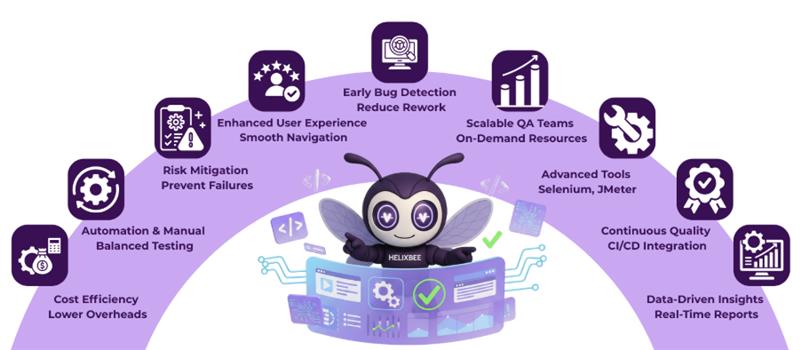
A QA testing company plays a crucial role in preventing software failures and maintaining performance consistency across platforms. Quality assurance isn’t just about finding bugs — it’s about creating a seamless user experience and protecting your brand reputation.
Here’s why partnering with a professional QA team is essential for your software:
- Early Defect Detection: Identifies and fixes bugs during the development cycle, reducing rework costs by up to 60%.
- Enhanced User Experience: Ensures smooth navigation, faster load times, and compatibility across devices, directly improving user satisfaction.
- Risk Mitigation: Prevents critical issues like data leaks, downtime, or functionality errors before release.
- Continuous Improvement: Uses automation and real-time analytics to maintain software reliability across multiple versions and updates.
In short, a QA testing company helps you deliver not just functional software — but a dependable, high-quality product that meets user expectations and builds long-term trust.
5 Main Types of QA Services In India
India has become a global hub for software testing, offering reliable, affordable, and high-quality QA solutions. Businesses across the world choose a QA testing company in India for its skilled workforce, advanced tools, and efficient delivery. Here are the five most important QA services in India, backed with real-world data and impact:
1. Functional Testing
Functional testing ensures that every part of your software from login to checkout — works exactly as expected. Studies show that nearly 45% of software defects come from overlooked functional errors.
QA teams in India perform detailed test case validation and user flow checks to catch these issues early, helping companies save up to 30% in post-release fixes.
2. Automation Testing
Automation testing, led by advanced software QA testing and automation companies, speeds up testing cycles using tools like Selenium, Appium, and Cypress.
According to industry data, automated testing can reduce total testing time by 50–70%. Indian QA experts build reusable scripts and frameworks that make future releases faster and more reliable.
3. Performance and Load Testing
Performance testing ensures your app performs well under heavy usage. A one-second delay in response time can lower customer satisfaction by 16%, according to Google research.
QA teams in India simulate thousands of users simultaneously to assess response time, stability, and scalability: helping businesses maintain smooth performance during peak traffic.
4. Security Testing
With cyberattacks increasing by 38% in 2024, security testing has become critical. Indian software testing and quality assurance companies use OWASP guidelines to detect vulnerabilities like SQL injections, cross-site scripting, and weak encryption. This proactive testing helps prevent data breaches and keeps your users’ trust intact
5. Mobile App Testing
Over 85% of digital interactions now happen on mobile devices, making mobile app testing a top priority. QA teams in India test across multiple OS versions, screen sizes, and network conditions to guarantee seamless performance. They use both real devices and emulators to uncover hidden bugs that could impact user experience.
In summary, these five QA services make India a go-to destination for businesses looking to outsource software quality assurance services.
Automation vs Manual: How a Software QA Testing and Automation Company Balances Both
Aspect | Manual Testing | Automation Testing | How a QA Testing Company Balances Both |
1. Testing Approach | Relies on human observation to find usability issues and unexpected behaviors. | Uses scripts and tools like Selenium, Appium, or Cypress for repetitive and regression tests. | The company assigns manual testers for exploratory tests and automates stable workflows for faster validation. |
2. Accuracy & Efficiency | Prone to human error but allows better understanding of user experience. | 99% accuracy for repetitive tasks and supports continuous testing. | QA teams combine human intuition with automated precision to achieve both accuracy and adaptability. |
3. Test Coverage | Covers smaller, scenario-based cases. | Covers larger datasets and multi-environment tests efficiently. | A software QA testing and automation company uses automation for regression suites while manual testers focus on edge cases. |
4. Cost & Time | Slower and costlier for large-scale projects. | Reduces testing time by 50–70% after initial setup. | Companies balance costs by automating high-frequency tests and keeping manual checks for complex interfaces. |
5. Maintenance & Scalability | No setup required but limited scalability. | Requires script maintenance but scales easily across releases. | QA teams maintain reusable test scripts for core modules and perform manual tests during major updates or UI changes. |
How Software Testing Outsourcing Companies Save Time and Money
Partnering with software testing outsourcing companies gives businesses access to skilled QA professionals, advanced tools, and proven frameworks; all without the overhead of managing in-house teams.
Here’s how outsourcing QA testing delivers both speed and cost efficiency:
1. Reduced Infrastructure and Hiring Costs
- Setting up an in-house QA department involves hiring testers, purchasing licenses, and maintaining test labs — all of which can cost 40–60% more than outsourcing.
- Outsource software quality assurance services offer ready-to-use environments and expert teams, eliminating the need for long recruitment and training cycles.
2. Faster Project Turnaround
- With round-the-clock testing across global time zones, outsourced teams accelerate the testing process and reduce time-to-market by up to 35%.
- QA experts use automation frameworks and continuous integration tools to perform parallel testing, allowing developers to fix issues faster.
3. Access to Specialized Tools and Expertise
- Outsourcing partners invest in premium tools like Selenium, JMeter, Postman, and TestRail — tools that can be expensive for smaller companies to license individually.
- A software QA testing and automation company brings domain-specific knowledge, enabling faster identification of edge-case issues that in-house teams might miss.
4. Scalability Without Overheads
- As project demands change, outsourcing partners can scale QA teams up or down instantly — avoiding the costs of idle resources.
- This flexibility ensures you pay only for active testing hours, making it an efficient model for both startups and large enterprises.
By choosing to outsource software quality assurance services, businesses gain the perfect mix of cost savings, faster delivery, and expert-driven testing.
Role of a Software Quality Assurance Consultant in Scaling Your Product
A software quality assurance consultant plays a critical role in helping businesses transform functional prototypes into scalable, enterprise-grade products. Here’s how their expertise contributes to building long-term software success:
1. Designing a Scalable QA Strategy
A software quality assurance consultant begins by analyzing your product architecture, workflows, and release cadence to design a scalable QA strategy. They define testing frameworks, automation layers, and CI/CD integrations tailored to your business needs. This structured approach helps minimize defect leakage and accelerates delivery cycles.
They also implement risk-based testing and test case prioritization models — ensuring that critical modules receive deeper coverage while optimizing resource usage and testing time.
2. Implementing Automation Frameworks
Manual testing alone can’t keep up with continuous deployments. That’s why consultants from a software QA testing and automation company implement automation frameworks like Selenium, TestNG, or Cypress to enhance speed and consistency.
They create reusable scripts, integrate them into CI/CD pipelines using Jenkins or GitLab CI, and apply data-driven and keyword-driven testing models for higher efficiency.
With tools like BrowserStack and LambdaTest, consultants ensure comprehensive testing across devices, browsers, and operating systems; crucial for scaling apps globally.
3. Setting Up Quality Gates in CI/CD Pipelines
For large-scale projects, maintaining code quality during rapid releases is challenging. Consultants set up quality gates using tools such as SonarQube or Azure DevOps, ensuring every build meets specific performance and security thresholds.
This automated validation process, implemented by experienced teams from software testing outsourcing companies, prevents unstable builds from reaching production and supports continuous delivery.
4. Introducing Advanced Testing Practices
Scaling requires intelligent testing beyond traditional methods. Consultants leverage AI-powered test analytics, predictive models, and automated regression suites to detect bottlenecks before release.
They also promote shift-left testing practices — embedding QA early in the development pipeline helping companies fix issues before they escalate, reducing rework costs by up to 60%.
5. Building a Continuous Quality Culture
A software quality assurance consultant also drives cultural transformation within teams. They introduce metrics like Defect Removal Efficiency (DRE), Mean Time to Detect (MTTD), and Automation ROI to align QA goals with business KPIs.
In short, working with a skilled software quality assurance consultant help businesses to build resilient, scalable, and high-performing software
Top Metrics to Evaluate a Software Testing and Quality Assurance Company
Evaluating a software testing and quality assurance company goes beyond checking experience — it’s about measuring how effectively they deliver results, reduce defects, and enhance performance. The right metrics help you assess whether the QA partner can maintain product stability and scalability.
Here are the top five metrics to consider before choosing your QA partner:
1. Defect Detection Efficiency (DDE)
Measures how effectively the QA team detects bugs before release. A higher DDE (above 90%) indicates proactive defect management and strong test coverage.
2. Test Coverage Percentage
Shows how much of your application’s functionality and codebase is tested. Leading QA testing companies aim for at least 80% functional and code coverage to minimize risk areas.
3. Automation Rate
Represents the percentage of test cases automated by the software QA testing and automation company. A balanced automation rate (40–70%) ensures faster regression testing without sacrificing flexibility.
4. Defect Leakage Ratio
Tracks the number of bugs that escape into production. The lower this ratio, the more reliable the QA process. Top software testing outsourcing companies maintain defect leakage below 5%.
5. Mean Time to Detect (MTTD)
Measures how quickly issues are identified once introduced. Shorter MTTD indicates an efficient QA pipeline and continuous monitoring setup.
In conclusion, these metrics help you choose a software testing and quality assurance company that not only tests but also strengthens your development ecosystem.
Example: How Outsource Software Quality Assurance Services Improved Performance
A leading fintech startup struggling with frequent production bugs and delayed releases decided to outsource software quality assurance services to a specialized QA testing company. Within the first quarter, the QA partner implemented automated regression testing using Selenium and JMeter, reducing manual testing efforts by 65%. They also integrated continuous testing into the CI/CD pipeline, allowing the development team to detect and fix issues 40% faster during each sprint.
Over the next six months, the results were measurable and consistent. The defect leakage rate dropped from 12% to just 3%, while customer-reported issues decreased by 55%. Page load times improved by 30%, and overall system uptime reached 99.7%.
By collaborating with a software QA testing and automation company, the startup transformed its QA process into a performance engine — accelerating product delivery, improving user satisfaction, and saving nearly $70,000 annually in operational costs.
Why Leading Companies Choose Helixbeat for Quality Assurance Testing
Leading companies choose Helixbeat because we don’t just test software; we help make it stronger, faster, and ready for the real world. As a trusted QA testing company, we combine smart automation tools with expert manual testing to find and fix issues early. Our goal is to help your product perform perfectly, stay secure, and deliver great experiences to every user.
At Helixbeat, we design QA strategies that fit your business goals. Whether you’re a growing startup or a large enterprise, our software QA testing and automation company helps you release faster, reduce bugs, and save costs.
With 40% quicker delivery, we make quality your biggest advantage. Contact us for quality testing services.
FAQs
1. What does a QA testing company actually do?
A QA testing company helps businesses identify bugs, performance issues, and usability problems before software goes live, ensuring smooth, secure, and reliable user experiences.
2. Why should I hire a software QA testing and automation company instead of building an in-house team?
A software QA testing and automation company offers specialized expertise, tools, and frameworks that speed up testing cycles and reduce costs — without the need to hire and train a full internal QA team.
3. How do software testing outsourcing companies maintain data security?
Leading software testing outsourcing companies follow strict NDA agreements, data encryption standards, and ISO-compliant testing environments to protect your business information during every project phase.
4. What is the role of a software quality assurance consultant in product development?
A software quality assurance consultant designs testing strategies, implements automation frameworks, and ensures that every release meets performance and compliance benchmarks — helping your product scale safely and efficiently.
5. When is the right time to outsource software quality assurance services?
You should outsource software quality assurance services when your team struggles with testing bandwidth, needs faster releases, or lacks access to automation tools and expert QA engineers. This helps improve quality while reducing operational costs.