


Restaurant Stock Management Software
Get Started with a Free Demo
New Keyword Page
New Keyword Page
"*" indicates required fields
Managing stock in a restaurant is not easy. Many restaurant owners struggle with problems like overstocking, running out of ingredients, food wastage, and mismatched stock reports. When inventory is tracked manually or in spreadsheets, small mistakes can quickly turn into big losses. This is where restaurant stock management software helps by giving clear, real-time control over inventory.
For example, imagine a restaurant that sells biryani every day. If the kitchen uses extra rice or spices without proper tracking, the stock finishes earlier than expected, and orders get delayed. With restaurant stock management software, every sale automatically updates ingredient stock, sends low-stock alerts, and helps the owner order supplies on time. This ensures accurate inventory control and smoother daily operations.
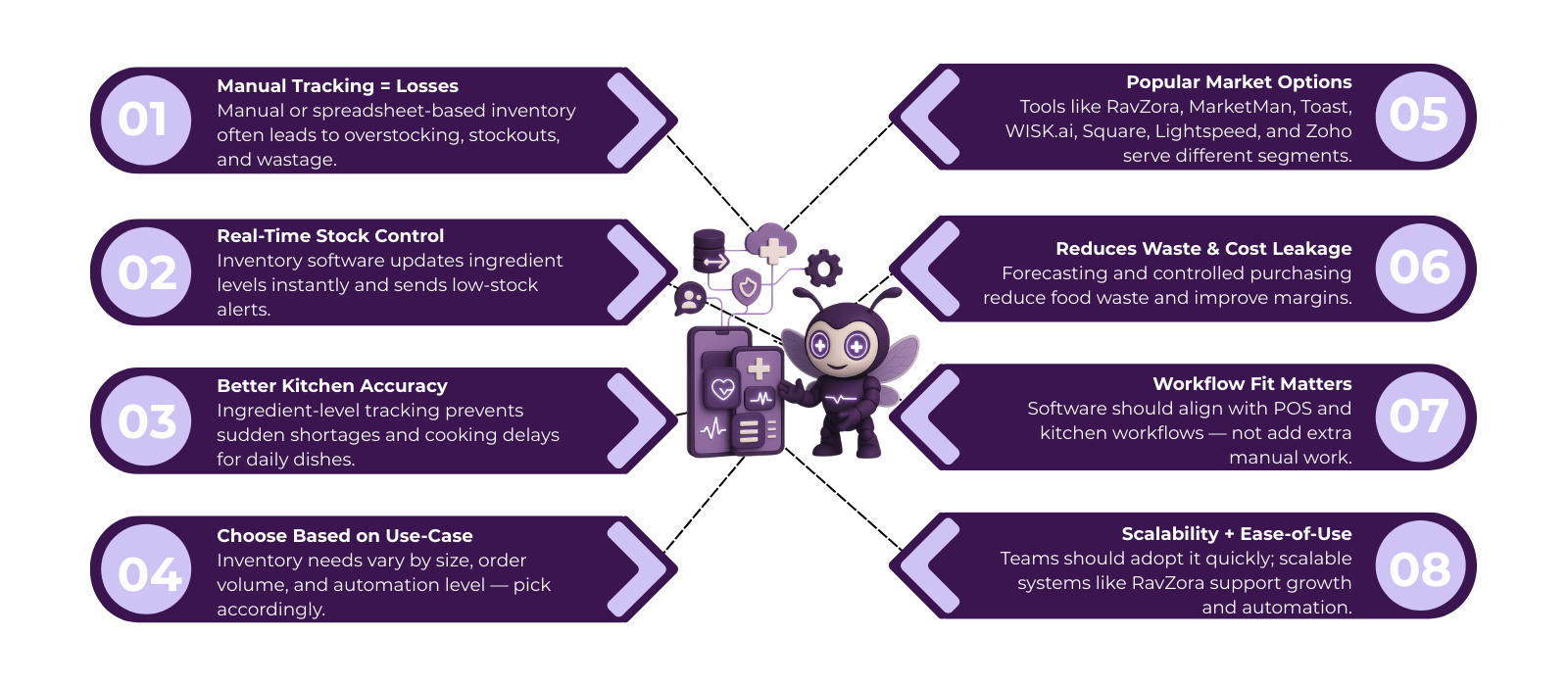
7 Best Restaurant Stock Management Software
Choosing the right restaurant stock management software depends on your restaurant size, daily order volume, and automation needs, which is why we’ve listed the best options based on real restaurant use cases.
Software 1: RavZora
Overview & Best Use Case
RavZora is an all-in-one restaurant stock management software designed to give complete visibility into inventory, sales, and operations from a single dashboard. It helps restaurants track stock in real time and reduce losses caused by manual errors.
Best for:
Small restaurants, cloud kitchens, growing chains
Key inventory features
- Real-time stock tracking
- Automatic stock deduction from sales
- Ingredient-level inventory control
- Low-stock and reorder alerts
- Centralized dashboard for reports
Accuracy level & automation
High accuracy with automated stock updates linked directly to billing and sales.
Pros & cons
- Easy to use and quick to implement
- Combines POS and inventory in one system
- Advanced customization may depend on business size
Ideal restaurant type
Restaurants looking for a simple, scalable, and accurate stock management solution without juggling multiple tools.
Software 2: MarketMan
Overview & Best Use Case
MarketMan focuses heavily on food cost tracking and supplier management, making it ideal for restaurants that want deeper cost visibility.
Best for:
Mid-sized restaurants and multi-unit operations
Key inventory features
- Purchase order management
- Supplier price comparison
- Food cost and usage reports
- Invoice tracking
Accuracy level & automation
High accuracy with semi-automation for purchasing and stock updates.
Pros & cons
- Strong cost control features
- Interface may feel complex for small teams
Ideal restaurant type
Restaurants focused on cost control and supplier optimization.
Software 3: Toast Inventory
Overview & Best Use Case
Toast Inventory works best for restaurants already using the Toast POS ecosystem.
Best for:
Small to medium restaurants using Toast POS
Key inventory features
- Automatic stock deduction from POS
- Menu-level inventory tracking
- Sales-based inventory reports
Accuracy level & automation
High accuracy within the Toast ecosystem.
Pros & cons
- Seamless POS integration
- Limited flexibility outside Toast
Ideal restaurant type
Restaurants already committed to Toast POS.
Software 4: WISK.ai
Overview & Best Use Case
WISK.ai uses AI-based insights to help restaurants forecast demand and reduce overstocking.
Best for:
Bars, restaurants, and chains with complex inventory
Key inventory features
- AI-powered demand forecasting
- Waste tracking
- Variance and usage reports
Accuracy level & automation
Very high accuracy with smart automation and predictive insights.
Pros & cons
- Advanced analytics
- May feel advanced for small restaurants
Ideal restaurant type
Data-driven restaurants looking for predictive inventory control.
Software 5: Square for Restaurants
Overview & Best Use Case
Square offers basic inventory management bundled with its POS, ideal for smaller setups.
Best for:
Small restaurants, cafés, food trucks
Key inventory features
- Simple stock tracking
- Low-stock alerts
- POS-linked inventory
Accuracy level & automation
Moderate accuracy with basic automation.
Pros & cons
- Easy setup
- Limited advanced inventory features
Ideal restaurant type
Small businesses needing simple inventory control.
Software 6: Lightspeed
Overview & Best Use Case
Lightspeed supports multi-location inventory tracking and advanced reporting.
Best for:
Multi-outlet restaurants and chains
Key inventory features
- Centralized stock management
- Supplier and purchase tracking
- Detailed reports
Accuracy level & automation
High accuracy with automated syncing across outlets.
Pros & cons
- Scales well
- Higher learning curve
Ideal restaurant type
Restaurants planning multi-location expansion.
Software 7: Zoho Inventory
Overview & Best Use Case
Zoho Inventory is a general inventory tool adapted by restaurants needing basic stock tracking.
Best for:
Small restaurants with simple menus
Key inventory features
- Stock level monitoring
- Order and supplier tracking
- Basic reporting
Accuracy level & automation
Moderate accuracy with limited restaurant-specific automation.
Pros & cons
- Affordable
- Not built specifically for restaurants
Ideal restaurant type
Restaurants with simple inventory needs and tight budgets.
By comparing these restaurant stock management software solutions based on features, accuracy, and suitability, you can choose the right tool to maintain accurate inventory control and reduce daily stock issues.
For better order handling and inventory coordination, explore how an online food ordering system for restaurants fits into modern restaurant operations.
2 Ways to Choose the Right Restaurant Stock Management Software
Choosing the right restaurant stock management software is about finding a solution that matches your daily operations, improves inventory accuracy, and reduces manual effort without adding complexity.
1. Choose software that fits your restaurant’s daily workflow
Every restaurant operates differently. A small café may need simple stock control software for restaurant, while cloud kitchens and chains need a complete restaurant stock control system with real-time updates.
The right solution should adapt to your workflow – not force you to manage stock manually or across multiple tools.
2. Pick software that’s easy to use and ready to scale
Your team should be able to use the system without long training sessions. Choose a restaurant stock management solution that is simple, automated, and supported by a responsive team.
Tools like RavZora are built to simplify stock control, combine inventory with POS, and scale easily as your restaurant grows.
Final Words
Accurate inventory control plays a key role in running a smooth and profitable restaurant. When stock is tracked properly, restaurants can reduce food waste, avoid frequent stockouts, and maintain better control over daily operations without unnecessary stress.
By understanding your restaurant’s needs and choosing the right restaurant stock management software, you can simplify inventory tracking and improve decision-making over time. A well-matched solution helps create consistency, accuracy, and better operational control across the kitchen and store.
Frequently Ask Questions
1. Why is health information exchange important in healthcare?
It improves care coordination, reduces duplicate tests, minimizes errors, and helps providers make timely, data-driven decisions across different healthcare settings.
2. What are the main models of health information exchange?
3. Which standards guide health information exchange?
Standards like FHIR and HL7 define consistent data formats, making it easier for EHRs, HIEs, and other healthcare platforms to exchange information.
4. What are the benefits of using health information exchange?
HIE improves care coordination, reduces healthcare costs, supports population health management, enhances research, and increases operational efficiency.
5. How does AERIS enhance healthcare information exchange?
AERIS leverages FHIR standards, connects legacy systems, automates workflows, reduces manual errors, and provides real-time access to patient records and lab results.
1. Can restaurant stock management software work without internet access?
Some systems offer limited offline functionality, but most cloud-based software needs an internet connection to sync data and provide real-time updates.
2. How often should restaurant inventory be audited when using software?
Even with software, physical stock checks are recommended weekly or bi-weekly to ensure system data matches actual inventory.
3. Is restaurant stock management software suitable for seasonal menus?
Yes, most tools allow you to update menus and ingredients easily, making them suitable for restaurants with frequently changing or seasonal menus.
4. Can stock management software track both raw ingredients and finished items?
Many restaurant-focused systems are designed to track raw materials, semi-prepared items, and finished dishes separately for better control.
5. How long does it usually take to see results after implementation?
Most restaurants start noticing improvements in stock accuracy and waste reduction within a few weeks of proper setup and staff usage.