


How AI is Transforming Software Performance Testing in 2026
Get Started with a Free Demo
New Keyword Page
New Keyword Page
"*" indicates required fields
Modern development teams release software faster using CI/CD pipelines. However, testing application performance in such fast cycles is difficult. Traditional testing methods often require heavy infrastructure and cannot easily simulate real-world traffic.
As applications become more complex with microservices and global users, many teams struggle with the performance testing of cloud based applications, which can lead to slow systems and poor user experience.
To solve this challenge, many organizations now use cloud-based performance testing. With the help of cloud-based performance testing tools, teams can run large-scale cloud-based load testing without maintaining expensive infrastructure. This approach allows teams to simulate real user traffic, identify performance issues early, and deliver more reliable applications.
In this blog, we will explore how cloud-based performance testing is transforming software quality with the help of CI/CD and AI-driven testing.
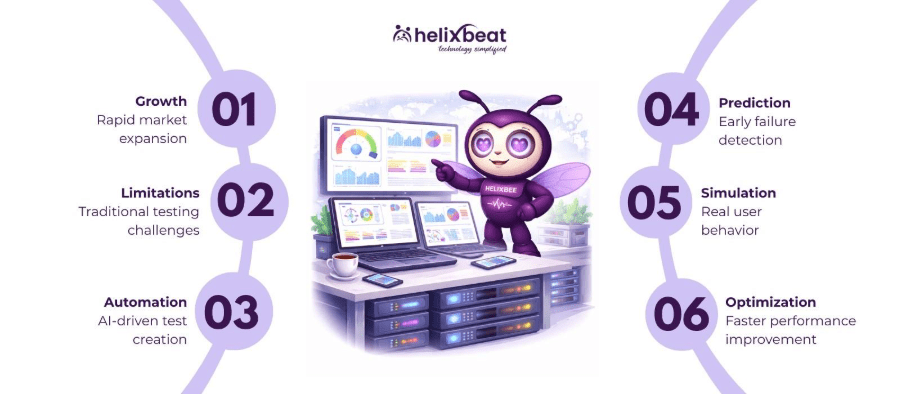
Why Traditional Performance Testing is No Longer Enough
Traditional approaches to performance testing in software testing rely heavily on manual scripting and predefined scenarios.
This makes it difficult to simulate real user behavior, especially in modern systems built on microservices, cloud, and continuous deployments. As applications grow more complex, these static methods often miss hidden performance issues.
Another major limitation is timing – most issues are detected late in the development cycle, increasing costs and delays.
Traditional methods are reactive, not proactive, making it hard to predict failures before they impact users. This gap highlights the need for smarter, AI-driven solutions in software performance testing.
What AI Brings to Software Performance Testing
Software performance testing is evolving rapidly with AI, enabling teams to move from manual effort to intelligent automation and prediction.
- Smarter test creation & coverage
AI can automatically generate test cases and improve coverage without guesswork, helping teams identify critical scenarios faster
- Faster execution & productivity
Developers using AI tools complete tasks up to 55% faster, accelerating testing cycles and releases
- Predictive issue detection
AI analyzes historical data to detect patterns and predict failures before they impact users, shifting testing from reactive to proactive
- Intelligent test prioritization
AI helps teams focus on high-risk areas instead of running all tests, improving efficiency and relevance in modern systems
- Autonomous & self-healing testing
In 2026, AI-driven “agentic testing” systems can generate, execute, and fix tests automatically, reducing human effort significantly
- High ROI and business impact
Around 92% of teams report positive ROI from AI in testing, showing strong real-world value
- Better scalability for modern apps
AI supports testing for cloud, microservices, and performance testing for mobile applications, where traditional methods struggle
In short, software performance testing with AI is no longer just about finding issues – it’s about predicting, optimizing, and continuously improving performance in real time.
5 Key Ways AI is Transforming Performance Testing
Software performance testing is becoming smarter and more efficient with AI, helping teams move beyond traditional limitations.
1. Intelligent Test Case Generation
AI automatically creates test scenarios based on user behavior and past data. This improves coverage and reduces manual effort in software performance testing.
Example: AI generates test cases for peak login times during a product launch without manual scripting.
2. Predictive Performance Analysis
AI analyzes historical data to predict system failures and traffic spikes. This helps teams fix issues before they impact users.
Example: AI predicts a surge in traffic during a festive sale and alerts teams to scale servers in advance.
3. Self-Healing Test Scripts
AI updates broken test scripts automatically when applications change. This reduces maintenance time and improves testing reliability.
Example: When a button ID changes in an app, AI automatically updates the test script without human intervention.
4. Real User Behavior Simulation
AI mimics real-world user interactions more accurately than traditional methods. This is especially useful for performance testing for mobile application environments.
Example: AI simulates thousands of users browsing, adding to cart, and making payments in an e-commerce app.
5. Faster Root Cause Analysis
AI quickly identifies performance bottlenecks and their sources. This speeds up debugging and enhances overall performance testing in software testing.
Example: AI detects that a slow API response is caused by a database query issue within seconds.
Overall, software performance testing with AI shifts the focus from reactive testing to proactive performance optimization.
Difference Between Performance Testing with AI and Without AI
Aspect | Without AI (Traditional Approach) | With AI in Software Performance Testing |
Test Design Strategy | Relies on predefined scripts based on assumptions | Uses ML models to generate test scenarios from real user traffic patterns (logs, analytics) |
Data Utilization | Limited use of historical data | Continuously learns from production data, APM tools, and past test runs |
Bottleneck Detection | Identified after test execution via manual analysis | Uses anomaly detection algorithms to flag performance deviations in real time |
Load Modeling | Static load patterns (e.g., 1000 virtual users) | Dynamic load modeling based on actual user behavior (spikes, drop-offs, concurrency trends) |
Script Maintenance | Breaks frequently with UI/API changes, requires manual fixes | Self-healing using element recognition and adaptive locators |
Root Cause Analysis | Engineers manually trace logs across layers | AI correlates logs, traces, and metrics to pinpoint root causes faster (e.g., DB vs API latency) |
CI/CD Integration | Runs as a separate stage, often delayed | Integrated into pipelines with intelligent test selection (runs only high-risk tests) |
Mobile Performance Testing | Limited real-device behavior simulation | AI simulates real-world device conditions for performance testing for mobile application and performance testing for android apps |
Failure Prediction | No prediction, only detection | Predicts failures using trend analysis and alerts before SLA breach |
Resource Optimization | Over/under provisioning during tests | AI suggests optimal resource allocation (CPU, memory, bandwidth) based on test insights |
In modern systems, software performance testing with AI is not just faster – it’s context-aware, data-driven, and aligned with real production behavior.
3 Challenges of Using AI in Performance Testing
Software performance testing with AI offers powerful capabilities, but it also comes with a few practical challenges:
- High Initial Setup & Integration Complexity
Implementing AI in performance testing in software testing requires integrating with CI/CD pipelines, APM tools, and cloud environments, which can be complex and time-consuming.
- Dependency on Quality Data
AI models depend on accurate historical data, especially in performance testing for mobile application, where diverse user behavior and device conditions impact results.
- Skill Gap & Learning Curve
Teams need to understand AI/ML concepts to apply them effectively in performance testing for android apps, which can be challenging for traditional testers transitioning to AI-driven approaches.
Why Helixbeat is the Best Software Performance Testing Provider
At Helixbeat, we focus on delivering performance testing that goes beyond standard execution, like aligning with real-world usage patterns, system architecture, and business objectives.
Our approach is structured, data-driven, and customised to modern application needs, including cloud-native and performance testing for mobile application environments. Why we stand out:
- AI-Enabled Performance Optimization
We leverage AI to enhance performance testing in software testing, enabling predictive insights and faster issue identification.
- Specialized Mobile & Android Testing Expertise
We deliver reliable performance testing for android apps, addressing device diversity and network variability.
- Smooth Integration with Development Workflows
We integrate performance testing into CI/CD pipelines to support continuous delivery and faster releases.
At Helixbeat, our goal is to provide software performance testing services that ensure your applications perform consistently under real-world conditions while supporting long-term scalability.
Frequently Ask Questions
1. Why is health information exchange important in healthcare?
It improves care coordination, reduces duplicate tests, minimizes errors, and helps providers make timely, data-driven decisions across different healthcare settings.
2. What are the main models of health information exchange?
3. Which standards guide health information exchange?
Standards like FHIR and HL7 define consistent data formats, making it easier for EHRs, HIEs, and other healthcare platforms to exchange information.
4. What are the benefits of using health information exchange?
HIE improves care coordination, reduces healthcare costs, supports population health management, enhances research, and increases operational efficiency.
5. How does AERIS enhance healthcare information exchange?
AERIS leverages FHIR standards, connects legacy systems, automates workflows, reduces manual errors, and provides real-time access to patient records and lab results.
1. How is AI improving software performance testing in modern applications?
AI improves software performance testing by enabling predictive analysis, automated test creation, and faster identification of performance issues before they impact users.
2. Why is traditional performance testing not enough for today’s applications?
Traditional methods in performance testing in software testing are reactive and struggle with dynamic environments like cloud, microservices, and continuous deployments.
3. How does AI help in performance testing for mobile applications?
AI enhances performance testing for mobile application by simulating real user behavior, different devices, and varying network conditions more accurately.
4. What are the key benefits of using AI in performance testing?
AI enables faster testing cycles, early issue detection, reduced manual effort, and improved scalability in software performance testing.
5. Why should businesses consider software performance testing services?
Professional software performance testing services help ensure applications perform reliably under real-world conditions, reducing downtime and improving user experience.