


FHIR Interoperability: Revolutionizing Healthcare Data Exchange
Get Started with a Free Demo
New Lead: FUSION
FUSION Landing Page Form, connected with the Mailchimp.
"*" indicates required fields
Fast Healthcare Interoperability Resources (FHIR), developed by Health Level Seven International (HL7), is a standard that facilitates seamless data exchange between disparate healthcare systems. By enabling standardized, efficient, and secure communication, FHIR interoperability addresses longstanding challenges in healthcare data management.
Here, we’ll discuss the significance of FHIR interoperability, its role in semantic interoperability in healthcare, its impact on telemedicine platforms, and the technical underpinnings of the FHIR interoperability standard.
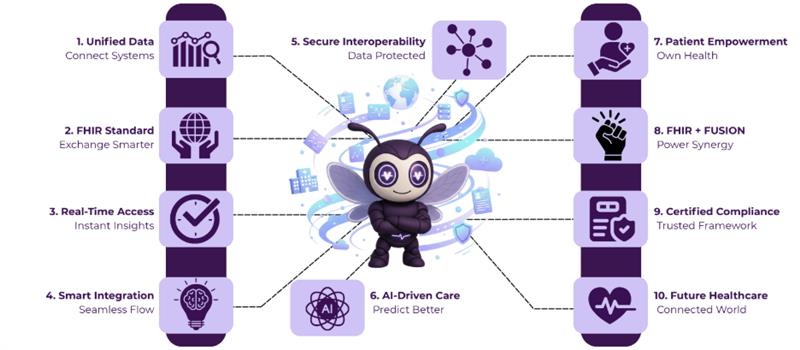
What is FHIR Interoperability?
FHIR interoperability refers to the ability of healthcare systems, applications, and devices to exchange, interpret, and use health data in a standardized way using the FHIR framework. FHIR, pronounced “fire,” is built on modern web technologies like RESTful APIs, JSON, and XML, making it accessible and adaptable for developers. Unlike older standards such as HL7 v2 or CDA, FHIR focuses on simplicity, modularity, and scalability, enabling systems to share specific data elements, or “resources,” like patient demographics, medications, or lab results.
The FHIR interoperability standard creates consistency across platforms by defining exactly how data should be structured and exchanged. This standardization reduces errors, improves care coordination, and supports data-driven decision-making.
Why FHIR Interoperability Matters
Healthcare has historically struggled with data silos, where systems like EHRs, billing platforms, and wearables operate independently. FHIR interoperability breaks down these barriers by providing a universal language for health data. Here are key reasons why FHIR interoperability is critical:
- Improved Patient Care: Since FHIR interoperability enables real-time data sharing, clinicians can easily access complete patient histories. This means better diagnoses and more personalized care.
- Cost Efficiency: Standardized data exchange reduces redundant tests and administrative overhead, saving healthcare organizations time and resources.
- Regulatory Compliance: FHIR aligns with regulations like the 21st Century Cures Act in the U.S., which mandates interoperable systems to improve patient access to health data.
Semantic Interoperability in Healthcare
The goal of semantic interoperability in healthcare isn’t just to exchange data, but to guarantee that the meaning of that data is identical everywhere. FHIR interoperability supports this by using standardized terminologies like SNOMED CT, LOINC, and ICD to code clinical information. For example, if one system records “hypertension” and another uses “high blood pressure, the standardized coding in FHIR guarantees that all systems interpret the data consistently.
This semantic consistency is vital for complex use cases like clinical decision support.
FHIR Interoperability for Telemedicine Platforms
As virtual care grows, FHIR interoperability for telemedicine platforms has become increasingly important. Telemedicine relies on real-time access to patient data, such as medical histories, prescriptions, and diagnostic results, to deliver effective care remotely. FHIR enables telemedicine platforms to integrate seamlessly with EHRs, labs, and other systems, thus creating a cohesive care experience.
For example, during a virtual appointment, the telemedicine provider can retrieve a patient’s lab results directly from the hospital’s FHIR-compliant system. This means the doctor can make evidence-based decisions without delay. Likewise, the simple, API-driven design of the standard also easily supports mobile apps and patient portals. As a result, patients can securely share their health data directly with their telemedicine providers. This integration enhances care delivery, particularly in rural or underserved areas where access to in-person care is limited.
The FHIR Interoperability Standard: Technical Foundations
The FHIR interoperability standard is built on a modular framework that makes it both flexible and powerful. Here’s a breakdown of its key components:
1. 20+ Years of Expertise
2. 50+ IT Professionals
A dedicated crew powers AERIS, delivering unmatched support and innovation.
3. 1,000+ Customers
Join a thriving community of healthcare leaders already transforming with AERIS.
4. 10,000+ Projects Completed
Proven success across countless integrations and workflows.
5. 95% Returning Customers
Our clients trust AERIS to deliver, time and time again.
Providers adopting AERIS report faster diagnoses, lower costs, and improved outcomes, positioning it as the go-to tool for future-proof HIE.
The AERIS Advantage: Numbers That Speak for Themselves
| Metric | Without AERIS | With AERIS | Your Benefit |
| Data Exchange Delays | Frequent bottlenecks | Reduced by 50% | Faster care in emergencies |
| Return on Investment | Slow, costly overhauls | 100% faster ROI | Grow without breaking the bank |
| Operational Costs | High redundancies | Cut by 30% | Save thousands annually |
| Error Rates | Up to 20% manual errors | Slashed by 90% | Precision for better patient outcomes |
Your Benefits, Amplified
1. 50% Fewer Delays
2. 100% Faster ROI
3. 30% Cost Savings, 90% Fewer Errors
The FHIR Interoperability Standard: Technical Foundations
The FHIR interoperability standard is built on a modular framework that makes it both flexible and powerful. Here’s a breakdown of its key components:
1. Resources
FHIR organizes data into “resources,” which are discrete units of information like Patient, Observation, or MedicationRequest. Each resource is structured with standardized fields, making it easy to query and share specific data elements. For example, a Patient resource includes fields like name, birth date, and gender, formatted in JSON or XML.
2. RESTful APIs
FHIR leverages RESTful APIs, allowing systems to communicate over the internet using standard HTTP methods (GET, POST, PUT, DELETE). This enables developers to build applications that can retrieve or update health data efficiently.
3. Profiles and Extensions
FHIR allows organizations to customize resources through profiles and extensions to meet specific needs. For example, a hospital might create a profile for a Patient resource to include local identifiers, while still maintaining compatibility with the broader FHIR standard.
4. Security and Privacy
FHIR incorporates OAuth 2.0 and SMART on FHIR protocols to secure data exchange. These mechanisms protect sensitive health information, helping you comply with regulations like HIPAA.
5. Implementation Guides
FHIR provides implementation guides, such as the US Core Implementation Guide, which offer templates for specific use cases. These guides help organizations adopt FHIR consistently and reduce implementation challenges.
Unlock Seamless Healthcare Interoperability with FUSION
Imagine a platform that not only meets modern healthcare standards like FHIR but actually pushes your operations forward. That’s FUSION: the FHIR server designed to make interoperability effortless and impactful. Whether you’re a hospital administrator streamlining workflows or a payer optimizing reimbursements, FUSION bridges the gap.
Built on FHIR, it leverages RESTful APIs for plug-and-play integration, enabling seamless connectivity with legacy systems, modern EHRs, and emerging tools like wearable devices and telehealth platforms. This isn’t just compliance, it’s acceleration.
FUSION goes deeper by embedding critical medical coding systems like SNOMED CT, LOINC, and ICD-10 directly into its architecture. This built-in intelligence maintains data consistency and accuracy, transforming raw information into actionable insights ready for clinical decisions, regulatory reporting, and advanced analytics. No more wrestling with mismatched formats or manual mappings: FUSION handles the heavy lifting!
Organizations using FUSION report up to 70% faster data sharing, slashing referral delays by 60% and reducing redundant tests by 25%. That’s not hype; it’s a measurable impact, with providers saving $1,000–$2,000 per patient annually through streamlined claims and operations.
How FUSION Ignites Data-Driven Innovation
The true magic of healthcare FHIR lies in its potential to fuel innovation, and FUSION amplifies this like no other. As a reliable engine for standardized data flows, it powers downstream applications that were once out of reach.
Take chronic disease management, for example. By integrating real-time data from wearables and EHRs, FUSION enables continuous monitoring and proactive interventions, potentially cutting hospital readmissions and optimizing therapies. Or, imagine a telehealth consultation that’s instantly better because the doctor has the patient’s full history right there. FUSION makes that happen, giving virtual care a huge boost in quality and making patients much happier.
Certified Excellence
FUSION is officially certified by the Drummond Group for FHIR-based interoperability, validating its conformance with healthcare data exchange standards HL7, FHIR, and SMART on FHIR. This certification demonstrates that FUSION meets industry-recognized benchmarks for secure, standardized data exchange — giving you the confidence to integrate seamlessly across systems.
What This Means for You
In a complex healthcare ecosystem, FUSION simplifies connectivity and safeguards data integrity. With enterprise-grade uptime (99.99%) and secure authentication powered by OAuth2 and encrypted endpoints, it supports trusted, real-time collaboration between hospitals, labs, and payers.
Whether you’re mapping USCDI elements for regulatory reporting or automating data flows for public-health initiatives, FUSION keeps you compliant with current interoperability frameworks and ready for future mandates.
The Future of FHIR Interoperability
The future of FHIR interoperability is promising, with ongoing advancements enhancing its capabilities. Emerging trends include:
- AI Integration: FHIR data can feed artificial intelligence models to predict patient outcomes or optimize care delivery.
- Global Adoption: Countries beyond the U.S., such as Australia and Canada, are adopting FHIR to create national health data networks.
- Expanded Use Cases: FHIR is being explored for non-clinical applications, such as supply chain management in healthcare, to track medical supplies or vaccine distribution.
Final Thoughts
FHIR interoperability is a cornerstone of modern healthcare. As healthcare continues to digitize, FHIR interoperability will play a pivotal role in creating a connected, patient-centered ecosystem.
So why settle for fragmented data when you can command a connected future? Contact Helixbeat today to schedule a demo to learn more about FUSION!
Frequently Ask Questions
1. What is FHIR interoperability?
FHIR interoperability refers to the ability of different healthcare systems to exchange, interpret, and use health data in a standardized way using the FHIR framework. This allows seamless data sharing across various healthcare applications and devices.
2. How does FHIR improve patient care?
By enabling real-time data sharing, FHIR interoperability allows clinicians to access complete patient histories. This leads to better diagnoses, more personalized treatments, and improved care coordination.
3. What are the technical foundations of FHIR?
FHIR is built on a modular framework that uses RESTful APIs for data exchange. It organizes data into “resources” (e.g., Patient, Medication), leverages standardized security protocols (OAuth2), and offers implementation guides for consistent adoption.
4. How does FUSION support FHIR interoperability?
FUSION is a FHIR server designed to simplify interoperability by integrating with legacy systems, modern EHRs, wearables, and telehealth platforms. It uses RESTful APIs for seamless connectivity, transforming raw data into actionable insights for clinical decisions.