

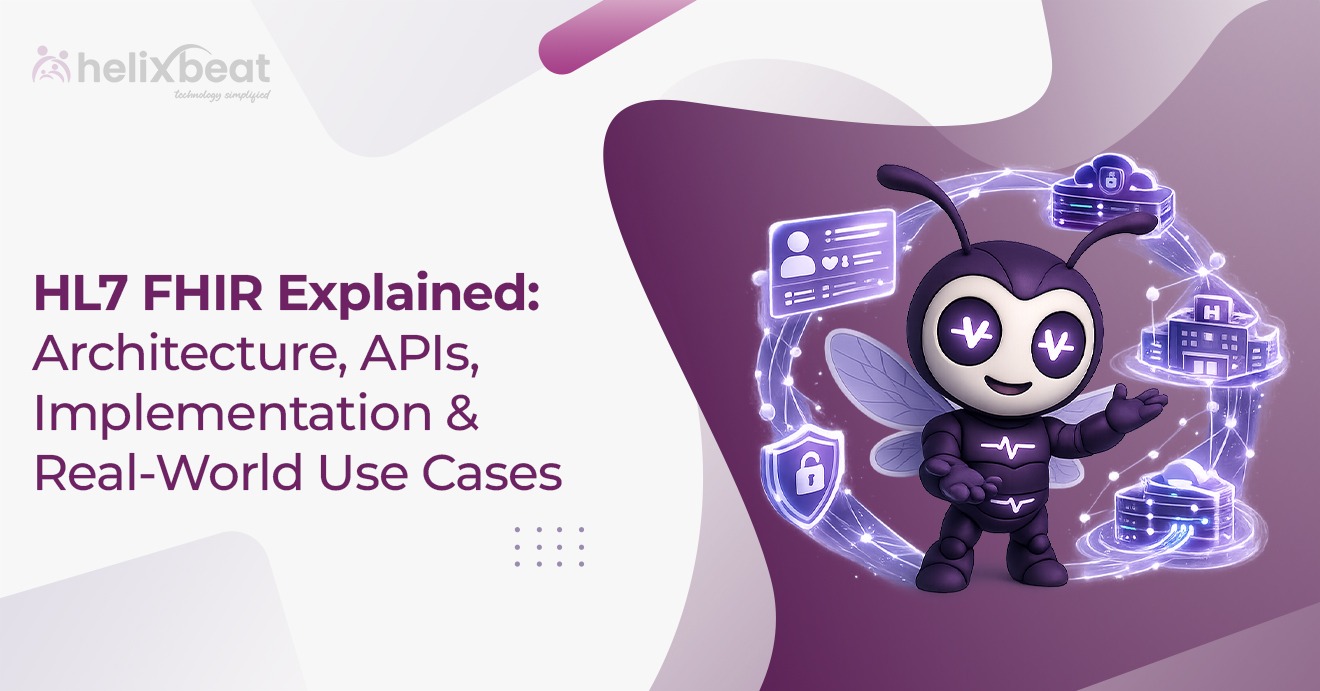
Healthcare interoperability has evolved significantly over the past decade. At the center of this transformation is HL7 FHIR (Fast Healthcare Interoperability Resources) — a modern standard designed to simplify and accelerate healthcare data exchange across systems.
If you’re working in healthcare IT, digital health, EHR integration, or interoperability strategy, understanding HL7 FHIR is no longer optional. In this guide, we explain what HL7 FHIR is, how it works, how it differs from earlier HL7 standards, and how organizations can implement it effectively.
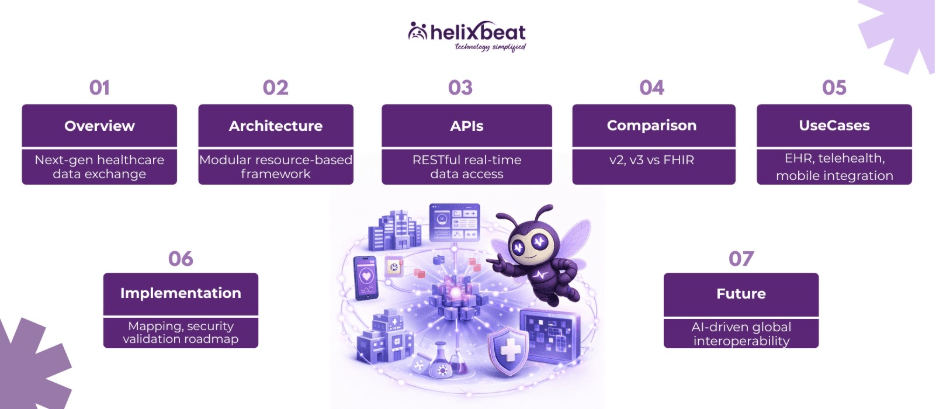
Table of Contents
What Is HL7 FHIR?
HL7 (Health Level Seven International) is a global standards development organization that creates frameworks for exchanging healthcare data.
FHIR (Fast Healthcare Interoperability Resources) is a next-generation interoperability standard developed by HL7. It combines:
- The best features of HL7 v2 and v3
- Modern web standards (RESTful APIs)
- JSON and XML data formats
- Modular, resource-based architecture
FHIR was created to solve long-standing healthcare data exchange challenges, such as:
- Complex integration workflows
- Vendor-specific interfaces
- Limited API capabilities
- Poor scalability
Today, HL7 FHIR is widely adopted in electronic health record (EHR) systems, patient apps, health information exchanges, and national digital health programs.
Why HL7 FHIR Is Critical for Healthcare Interoperability?
Healthcare systems generate massive volumes of structured and unstructured data. Historically, exchanging this data required custom integrations, HL7 v2 messaging, or CDA documents.
FHIR introduced:
- API-driven interoperability
- Real-time data access
- Standardized resource models
- Easier mobile and cloud integration
Regulatory frameworks like the U.S. ONC Interoperability Rule and global digital health initiatives have accelerated FHIR adoption. Many EHR vendors now expose FHIR APIs as standard functionality.
HL7 FHIR Architecture Deep Dive
To understand why FHIR is powerful, you must understand its architecture.
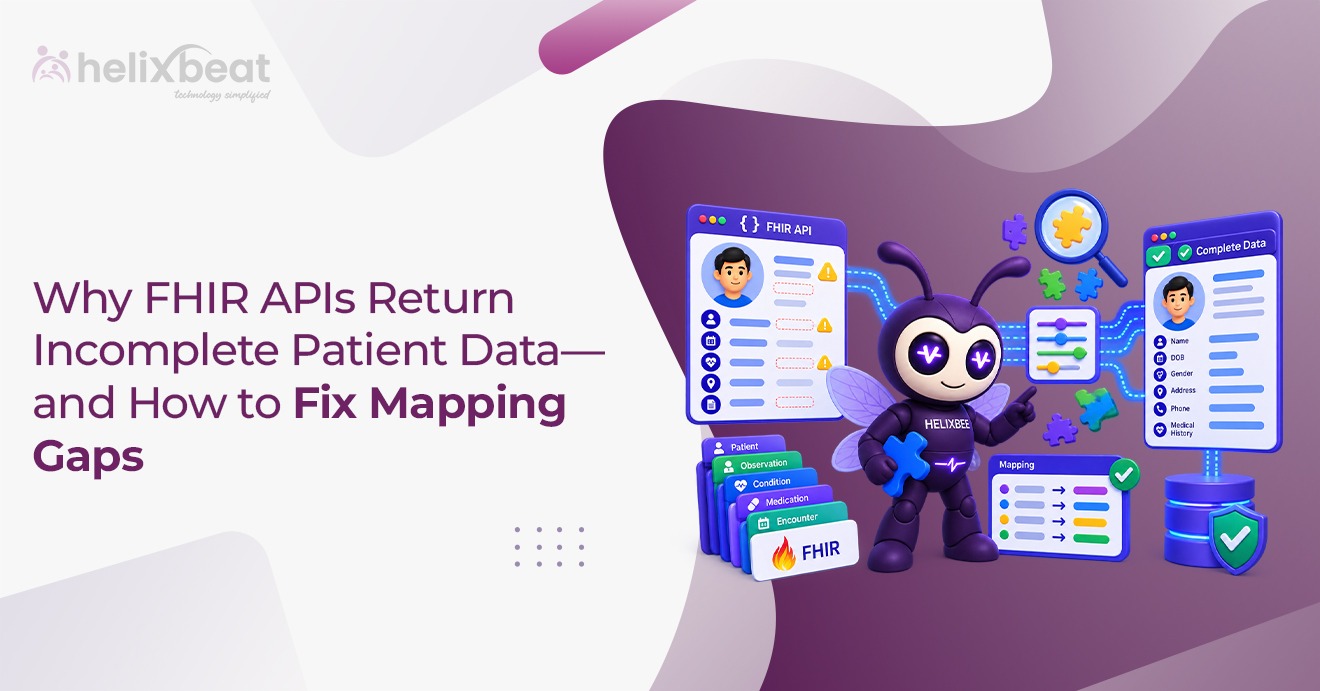
1. FHIR Resources
The core building blocks of FHIR are Resources. Each resource represents a specific healthcare concept.
Common examples:
- Patient – Demographic information
- Observation – Lab results, vitals
- Encounter – Visit details
- Condition – Diagnoses
- Medication – Prescription details
Each resource:
- Has a defined structure
- Uses standard data types
- Includes unique identifiers
- Supports extensions when needed
Resources can be combined into bundles for transactions.
2. RESTful API Framework
FHIR is built on REST architecture. This makes it developer-friendly and compatible with modern web systems.
Common HTTP methods:
- GET – Retrieve data
- POST – Create new resource
- PUT – Update resource
- DELETE – Remove resource
Example API call:
GET /Patient/123
Example JSON response:
{
“resourceType”: “Patient”,
“id”: “123”,
“name”: [{
“family”: “Sharma”,
“given”: [“Amit”]
}],
“gender”: “male”,
“birthDate”: “1985-04-12”
}
FHIR supports:
- JSON
- XML
- RDF (less common)
3. Profiles & Implementation Guides
FHIR allows customization through:
- Profiles – Constraints on resources
- Extensions – Additional fields
- Implementation Guides (IGs) – Country or use-case-specific specifications
For example:
- US Core Implementation Guide
- National digital health frameworks in multiple countries
This flexibility makes FHIR globally adaptable.
HL7 v2 vs HL7 v3 vs HL7 FHIR
Here is a simplified comparison:
| Feature | HL7 v2 | HL7 v3 | HL7 FHIR |
| Architecture | Messaging | XML-based | RESTful APIs |
| Data Format | Pipe-delimited | XML | JSON/XML |
| Implementation Complexity | Moderate | High | Lower |
| Web Compatibility | Limited | Limited | Native |
| Developer Friendliness | Low | Low | High |
HL7 v2 remains widely used for internal hospital messaging. However, FHIR is increasingly used for:
- API integrations
- Patient-facing applications
- Cloud interoperability
FHIR does not fully replace v2 in all environments, but complements it.
Real-World Use Cases of HL7 FHIR
FHIR is not theoretical — it powers many real healthcare workflows.
1. EHR Integration
Hospitals use FHIR APIs to:
- Retrieve patient demographics
- Share lab results
- Exchange encounter data
2. Patient Mobile Applications
Apps connect to EHR systems via FHIR APIs to:
- Display medical history
- Access prescriptions
- Show lab reports
3. Telehealth Systems
Telemedicine platforms retrieve patient data in real time using FHIR.
4. Clinical Decision Support
FHIR enables structured data exchange between EHRs and decision-support tools.
5. Health Information Exchanges (HIEs)
Regional and national HIEs use FHIR for standardized data exchange across providers.
How to Implement HL7 FHIR in Healthcare Systems
Implementation requires planning. Below is a structured roadmap.
Step 1: Define Interoperability Goals
Clarify:
- Internal integration?
- External API exposure?
- Regulatory compliance?
Step 2: Data Mapping
Map legacy data (HL7 v2, custom schemas) to FHIR resources.
This step requires:
- Data normalization
- Terminology mapping (SNOMED, LOINC, ICD)
Step 3: Security & Authentication
FHIR commonly uses:
- OAuth 2.0
- OpenID Connect
- SMART on FHIR framework
Security is critical for protecting patient data.
Step 4: Testing & Validation
Use:
- FHIR validators
- Conformance testing tools
- Sandbox environments
Testing helps verify compatibility and compliance.
How AERIS Revolutionizes Interoperability with FHIR APIs?
Imagine a world where your healthcare organization thrives with seamless, secure, and real-time data exchange. That’s the power of AERIS by Helixbeat, a game-changing platform designed to transform how you connect, collaborate, and care. Built for healthcare providers, clinics, hospitals, and cross-industry partners like pharmacies and insurers, AERIS harnesses FHIR APIs to break down data silos, streamline operations, and put patient care first.
Ready to cut delays by 50%, double your ROI, and empower your team with instant access to critical data? Let’s dive into why AERIS is the solution you’ve been waiting for.
Why AERIS is Your Key to Healthcare Innovation?
At Helixbeat, we know your challenges: fragmented systems, delayed data, and rising costs. AERIS is here to change that, offering a personalized, scalable, and secure platform that fits your unique needs. Whether you’re a small clinic or a sprawling hospital network, AERIS delivers measurable results that elevate patient outcomes and boost your bottom line.
- 20+ Years of Expertise: Our team brings decades of healthcare IT experience to ensure AERIS works for you.
- 50+ IT Professionals: A dedicated crew powers AERIS, delivering unmatched support and innovation.
- 1,000+ Customers: Join a thriving community of healthcare leaders already transforming with AERIS.
- 10,000+ Projects Completed: Proven success across countless integrations and workflows.
- 95% Returning Customers: Our clients trust AERIS to deliver, time and time again.
Providers adopting AERIS report faster diagnoses, lower costs, and improved outcomes, positioning it as the go-to tool for future-proof HIE.
Your Benefits, Amplified
- 50% Fewer Delays: Real-time data means critical information is always at your fingertips, turning hours into seconds.
- 100% Faster ROI: Plug-and-play integration maximizes your investment without expensive system replacements.
- 30% Cost Savings, 90% Fewer Errors: Automation eliminates waste, saving resources and ensuring accuracy.
SMART on FHIR: Extending the Ecosystem
SMART on FHIR builds on FHIR to enable secure healthcare app integration.
It provides:
- Authentication standards
- App launch framework
- Authorization scopes
Many vendors today support SMART on FHIR for third-party app integration.
Future of HL7 FHIR in Global Healthcare
FHIR continues to evolve.
Emerging trends include:
- AI-driven clinical insights powered by FHIR APIs
- Real-time interoperability
- Cross-border health data exchange
- Remote patient monitoring integration
FHIR R5 introduces additional refinements to resource definitions and workflow capabilities.
As digital health ecosystems expand, HL7 FHIR is likely to remain central to global interoperability strategies.
Final Thoughts
HL7 FHIR represents a major shift in healthcare interoperability. By combining modular resources, RESTful APIs, and global implementation guides, it bridges the gap between traditional healthcare messaging systems and modern digital platforms.
AERIS leverages FHIR APIs to enable secure, real-time data exchange across healthcare systems. As a powerful interoperability solution, AERIS helps organizations seamlessly connect EHRs, applications, and clinical platforms — transforming fragmented data into actionable insights. Connect with Helixbeat today to modernize your interoperability strategy and power truly connected healthcare.
FAQs
- Is HL7 FHIR replacing HL7 v2?
FHIR complements HL7 v2. Many systems still use v2 internally, while FHIR supports modern API-based exchange.
- What does FHIR stand for?
Fast Healthcare Interoperability Resources.
- Is FHIR mandatory?
In some regulatory environments, API access based on FHIR is required for certified EHR systems.
- What programming languages support FHIR?
FHIR APIs can be implemented using Java, .NET, Python, JavaScript, and others.
- What is the latest FHIR version?
FHIR R4 is widely implemented. R5 introduces newer enhancements.
- Is HL7 FHIR secure?
FHIR uses industry-standard security protocols such as OAuth 2.0 and TLS encryption.