

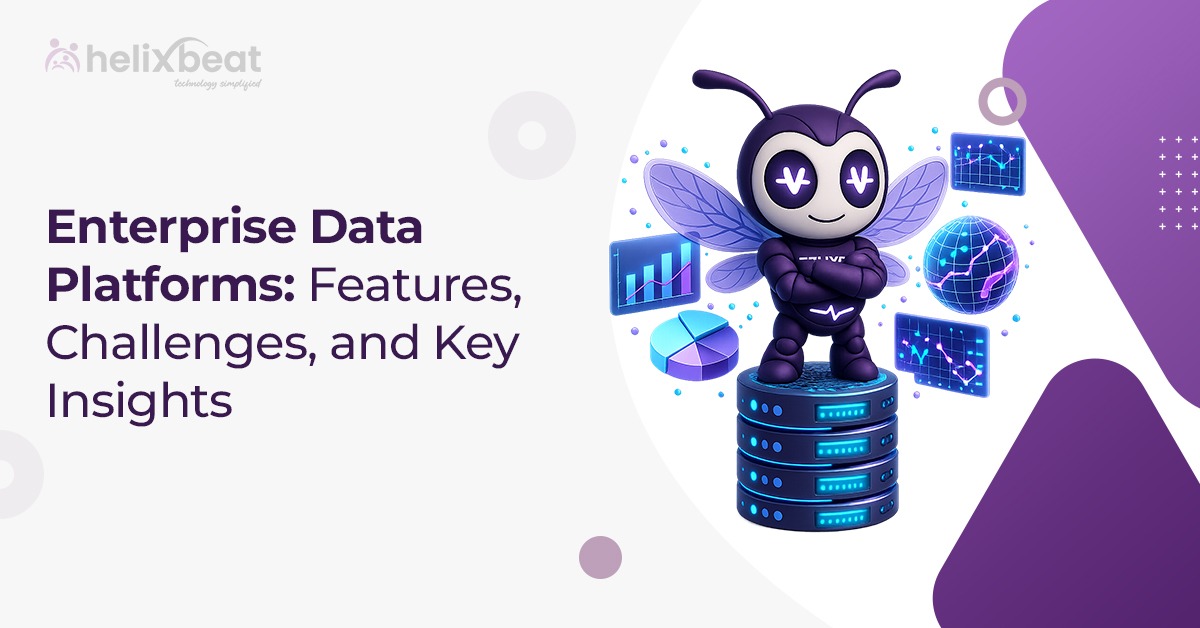
Nearly 78% of enterprises are increasing their investments in enterprise data cloud strategies to manage the growing volumes of structured and unstructured data effectively. However, many organizations continue to struggle with integration gaps, unclear enterprise data cloud pricing models, and governance risks, which often slow down digital transformation initiatives.
Helixbeat Daas is designed to simplify how enterprises unify, manage, and activate their data ecosystems without adding operational complexity. While modern enterprise data cloud platforms offer real-time analytics, compliance control, and scalable infrastructure, implementation challenges can still delay progress. Therefore, understanding both the features and potential risks becomes critical before adoption.
This blog explains enterprise data platform capabilities, pricing structures, technical barriers, and the key insights decision-makers must evaluate carefully.
Table of Contents
64% of Enterprises Move to a Unified Enterprise Data Cloud for Faster Decisions
Data growth is no longer gradual. Enterprises today generate data from HRMS systems, ERP platforms, IoT devices, finance applications, marketing automation tools, and customer portals. When these systems operate in isolation, reporting becomes inconsistent, and decision-making slows down.
A unified enterprise data cloud eliminates silos by integrating multiple data sources into a centralized architecture.
Businesses that consolidate their data environments experience:
- 40% faster reporting cycles
- 35% improvement in data accuracy
- 30% reduction in duplicate storage costs
- Faster regulatory audit preparation
Platforms such as enterprise data cloud pure storage solutions are gaining popularity because they support high-speed analytics workloads without performance bottlenecks.
Without centralization, enterprises often rely on manual reconciliation processes that increase compliance risk and delay strategic planning. A unified platform supports real-time dashboards, predictive modeling, and advanced analytics, allowing leadership teams to act based on consistent and reliable insights.
Core Features That Define a Scalable Enterprise Data Platform
Modern enterprise data cloud platforms must go beyond simple storage. They should support integration, governance, analytics, automation, and compliance management within one unified architecture.
Below is a breakdown of critical features enterprises evaluate:
| Feature | Why It Matters for Enterprises | Risk If Missing |
| Data Integration Framework | Connects ERP, CRM, HR, and finance systems | Fragmented reporting |
| Metadata Management | Tracks data lineage and ownership | Compliance failures |
| Real-Time Analytics | Supports predictive and operational insights | Delayed decisions |
| Role-Based Access Control | Protects sensitive business data | Security breaches |
| API & Microservices Support | Enables third-party integration | Limited scalability |
| Automated Data Governance | Maintains regulatory compliance | Audit complications |
| Scalable Cloud Infrastructure | Handles exponential data growth | Performance degradation |
Enterprises comparing solutions such as dbt cloud enterprise or Oracle Enterprise Data Management Cloud assess these features carefully before finalizing their technology stack. A scalable architecture ensures that business expansion does not require a complete redesign of the data infrastructure.
Enterprise Data Cloud Pricing vs Long-Term Business Value: What Leaders Must Evaluate
One of the biggest concerns for CIOs and CFOs is enterprise data cloud pricing. While subscription-based models appear affordable initially, hidden costs often arise during scaling and integration phases.
Here’s how pricing structures typically compare:
| Pricing Model | Cost Structure | Hidden Challenges | Long-Term Impact |
| Subscription-Based | Fixed monthly tiers | Extra fees for storage expansion | Budget pressure during growth |
| Usage-Based | Pay per data volume | Unpredictable billing cycles | Difficult financial forecasting |
| Hybrid Model | Custom enterprise contracts | Complex vendor agreements | Longer procurement cycles |
| On-Premise | Upfront licensing | High maintenance & upgrades | Limited scalability |
| Managed Data-as-a-Service | Bundled integration & governance | Vendor dependency | Faster deployment |
When evaluating dbt cloud enterprise pricing, enterprises must also consider integration costs, compliance modules, and data migration expenses. Similarly, solutions such as Oracle Enterprise Data Management Cloud may require additional governance layers, which can increase operational budgets.
The real value of enterprise data cloud investments lies not only in storage but also in improved productivity, faster insights, and reduced risk exposure.
Why 35% of Enterprise Data Platform Implementations Face Major Challenges
Despite advances in technology, many enterprise data platform implementations continue to encounter significant obstacles. Research shows that nearly 35% of enterprise data transformation projects either fail or exceed timelines due to structural and operational gaps. Several factors contribute to these challenges, which organizations must address proactively to achieve a successful digital transformation.
1. Legacy System Integration Complexity
Older ERP, financial, or operational systems often lack native API compatibility. Integrating them with modern enterprise data cloud platforms requires custom connectors, extended development timelines, and careful planning. Without this, organizations may experience delays, incomplete data ingestion, or operational disruptions during deployment.
2. Poor Data Governance Planning
Many organizations adopt technology before defining governance protocols. Without metadata tracking, ownership clarity, and standardized workflows, maintaining compliance becomes complicated. Automated governance embedded within the data pipeline can reduce human error and simplify audit processes, particularly in industries with stringent regulatory frameworks.
3. Data Migration Risks
Migrating terabytes of historical data introduces potential risks such as corruption, duplication, or loss. Weak validation mechanisms can reduce analytics accuracy, compromising decision-making. Platforms like dbt cloud enterprise provide tools to streamline data transformation and migration, reducing risk and improving reliability.
4. Vendor Lock-In
Selecting rigid platforms may restrict future scalability and integration flexibility. Enterprises must evaluate options like dbt cloud enterprise or enterprise data cloud pure storage solutions carefully, ensuring long-term adaptability and avoiding costly transitions in the future.
5. Skill Gaps in Data Teams
Advanced enterprise data platforms require skilled data engineers, architects, and governance specialists. Lack of expertise often delays optimization, creates operational inefficiencies, and reduces the platform’s strategic value. Continuous training and external support can mitigate these challenges.
6. Security and Compliance Pressures
Industries such as healthcare and finance face strict regulatory requirements. Enterprise data cloud solutions must incorporate end-to-end encryption, multi-factor authentication, data lineage tracking, real-time anomaly detection, and automated audit logging. Without these measures, organizations risk data breaches, ransomware attacks, and regulatory penalties.
Security, Compliance, and Governance in Enterprise Data Cloud Adoption
As enterprises centralize data, the cybersecurity and compliance landscape becomes increasingly complex. Enterprise data cloud platforms must integrate security into their architecture and provide mechanisms for automated governance.
Key governance requirements include:
- End-to-end encryption across all data pipelines
- Multi-factor authentication for all access points
- Data lineage tracking to maintain visibility across systems
- Real-time anomaly detection to proactively address threats
- Automated audit logging for compliance efficiency
Enterprise data cloud pure storage solutions and oracle enterprise data management cloud platforms embed governance workflows directly within the pipeline, reducing manual intervention and human error while facilitating audits and regulatory reporting.
How Helixbeat Daas Simplifies Enterprise Data Platform Deployment
Helixbeat Daas addresses both technical and operational challenges of enterprise data platform adoption. Its capabilities include:
- Unified data ingestion framework for seamless integration
- Automated compliance mapping to simplify audits
- Real-time synchronization across departments
- Transparent enterprise data cloud pricing models
- Metadata-driven governance architecture
- Reduced dependency on manual ETL processes
By providing pre-configured connectors and scalable cloud infrastructure, Helixbeat Daas accelerates integration timelines. Organizations adopting this solution report faster implementation cycles, improved reporting consistency, reduced integration overhead, and enhanced compliance readiness. By combining data management, analytics readiness, and governance automation, Helixbeat Daas significantly reduces the risk factors that often derail enterprise data platform projects.
Key Insights Enterprises Must Consider Before Selecting a Platform
Selecting an enterprise data platform requires strategic evaluation beyond technical specifications. Key considerations include:
- Scalability Alignment – Can the platform support projected 5–10 year data growth?
- Transparent Pricing – Is enterprise data cloud pricing predictable and aligned with operational budgets?
- Integration Compatibility – Can it integrate seamlessly with ERP, CRM, HRMS, IoT, and analytics systems?
- Governance Automation – Does it support automated compliance reporting to reduce manual effort?
- Vendor Ecosystem Support – Does the vendor provide long-term updates and integration with other platforms?
- Migration Roadmap – Is there a clear strategy for transitioning data with validation checkpoints?
Enterprises evaluating dbt cloud enterprise, oracle enterprise data management cloud, or enterprise data cloud pure storage must ensure the platform supports not only analytics but also strategic growth, regulatory resilience, and operational agility.
Wrapping Up
Enterprise data platforms are central to modern digital transformation strategies. While enterprise data cloud solutions deliver scalability, real-time insights, and operational efficiency, challenges around integration, governance, and pricing require careful planning. Helixbeat Daas offers a structured, automated approach to overcome these challenges, helping organizations build resilient, compliant, and scalable data ecosystems.
FAQs
1. What is an enterprise data platform?
An enterprise data platform is a centralized system that integrates, manages, and governs business data across departments and applications.
2. Why do enterprise data projects fail?
Common reasons include poor governance planning, integration complexity, legacy system constraints, and lack of skilled resources.
3. How does enterprise data cloud pricing typically work?
Pricing models include subscription-based, usage-based, hybrid, or managed services, each with different scalability and cost implications.
4. What role does Helixbeat Daas play in enterprise data management?
Helixbeat Daas simplifies integration, governance automation, and compliance tracking within enterprise environments.
5. Is dbt cloud enterprise suitable for large organizations?
Yes, but its success depends on internal workflow alignment and infrastructure readiness.
6. How does oracle enterprise data management cloud support governance?
It provides enterprise-wide metadata management and compliance frameworks.
7. What is enterprise data cloud pure storage architecture?
It refers to scalable storage infrastructure optimized for high-performance analytics workloads.