

Most businesses today treat their cloud based data warehouse merely as a query engine — a place to run SQL and generate reports. However, this represents only the starting point, because the global cloud data warehouse market, valued at $23.1 billion in 2024 and projected to reach $183 billion by 2035, is expanding rapidly.
This surge is driven not by basic reporting, but by organizations leveraging the full capabilities of cloud computing data warehouses — from powering AI models and detecting fraud instantly to enable seamless enterprise-wide data sharing. Helixbeat helps organizations move beyond simple querying to unlock these transformational opportunities.
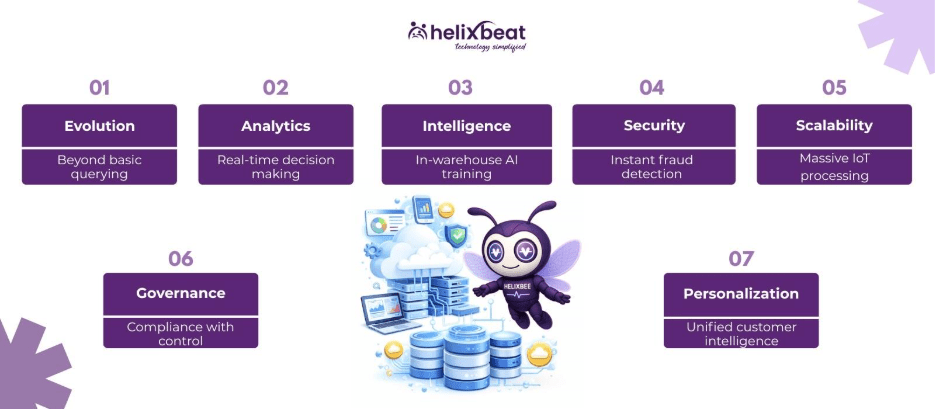
Table of Contents
Top 7 Advanced Use Cases of Cloud Based Data Warehouses That You Should Know
A cloud based data warehouse today is far more than a centralized repository. It is an intelligent, elastic platform that fuels advanced analytics, machine learning, compliance automation, and real-time business decisions at scale.
| Use Case | What It Replaces | Business Outcome |
| Real-Time Analytics | Batch reporting (hours of lag) | Sub-second decisions during peak traffic |
| ML Model Training | Separate data lakes needing ETL exports | Faster time-to-production for AI models |
| Data Sharing | Manual file transfers and extracts | Zero-copy live access across partners |
| Fraud Detection | Rule-based legacy systems | 50–100ms transaction evaluation |
| IoT Analytics | On-prem servers with capacity limits | Petabyte-scale ingestion without downtime |
| Compliance Reporting | Siloed systems requiring manual audits | Automated audit trails and policy enforcement |
| Customer 360 | Disconnected CRM, ERP, marketing stacks | Unified customer profile driving personalization |
1. Real-Time Analytics and Operational Intelligence
Most organizations built their reporting workflows around batch processing, where data would be collected, transformed, and made available hours later. That model is no longer competitive in today’s fast-moving business environment.
Modern cloud based data warehouse solutions support real-time ingestion via platforms like Apache Kafka, Amazon Kinesis, and Google Pub/Sub, enabling businesses to act on data the moment it arrives.
Why This Matters for Business Leaders
Companies leveraging real-time inventory visibility through a cloud based data warehouse have measurably reduced stock-outs during peak shopping seasons, because faster data access directly drives smarter replenishment decisions.
Executives no longer wait days for reports to refresh, and organizations that adopt a cloud computing data warehouse consistently cut reporting delays by more than half. That improvement enables quicker, more confident responses to shifting market conditions, giving leadership teams a clear and measurable competitive edge.
What Enables This Capability
- Decoupled compute and storage allow parallel query execution without performance degradation
- Streaming ingestion pipelines handle high-velocity data from apps, sensors, and customer interactions
- Cloud-native warehouses process billions of queries daily, reflecting how deeply embedded this infrastructure has become
2. Machine Learning Model Training and AI-Powered Forecasting
One of the most underutilized capabilities of a cloud based data warehouse is its role as a direct environment for machine learning model development. Rather than exporting data to a separate platform, data scientists can train and deploy ML models directly inside the warehouse, which drastically reduces data movement latency.
This shift accelerates time-to-production for AI-driven business features and keeps teams focused on building rather than moving data.
What Industry Experience Shows
A growing number of enterprises now integrate cloud based data warehouse services with ML pipelines, because keeping data and models within a unified environment delivers clear operational advantages.
Financial analytics firms process millions of data points per second for algorithmic trading by leveraging a cloud computing data warehouse, while marketing teams run real-time sentiment analysis on hundreds of millions of records daily.
Both examples demonstrate how in-warehouse ML eliminates costly data transfers and speeds up decision-making at scale.
Use Case Applications
- Demand forecasting in retail and supply chain
- Predictive maintenance in manufacturing
- Customer churn prediction in telecommunications and SaaS
- Clinical outcome modeling in healthcare
3. Real-Time Fraud Detection and Financial Security
Financial services firms face constant pressure to detect fraudulent transactions before they complete, and legacy rule-based systems are too slow and too rigid to keep pace with today’s sophisticated fraud patterns.
Cloud based data warehouse services have changed this reality entirely, giving fraud teams the speed and computational depth they need to respond at machine scale.
How Speed Translates to Protection
Fraud-detection engines built on cloud computing data warehouse infrastructure now evaluate card transactions within 50 to 100 milliseconds, which is a latency window that batch-based warehouses simply cannot meet.
Banking, financial services, and insurance sectors represent one of the largest segments driving active data warehousing adoption worldwide, because the cost of delayed fraud detection is simply too high to tolerate. That urgency is precisely why a cloud based data warehouse has become mission-critical for protecting both consumers and financial institutions alike.
Capabilities Driving This Use Case
- In-warehouse Python and SQL execution for real-time anomaly detection
- Integration with streaming sources for continuous transaction monitoring
- AI-driven pattern recognition that evolves continuously alongside emerging fraud vectors
4. IoT Data Management and Industrial Analytics
The proliferation of connected devices — from factory sensors to smart city infrastructure — has created data volumes that overwhelm traditional systems. A cloud based data warehouse built for the modern enterprise handles this challenge with elastic scalability and intelligent ingestion pipelines.
Organizations that delay adopting this infrastructure risk falling behind competitors who are already making real-time decisions from device-level data.
The Scale of the IoT Data Challenge
Connected devices worldwide now generate data at a scale that legacy on-premises systems simply cannot absorb or process efficiently. Monthly data ingestion volumes in sectors like retail and finance frequently exceed multiple petabytes, and IoT rollouts, clickstream telemetry, and high-resolution media assets are pushing corporate datasets to exabyte scale.
A cloud computing data warehouse addresses this challenge directly, because it scales elastically with demand rather than requiring costly hardware upgrades.
Industrial Applications
- Predictive maintenance using equipment sensor data in oil, gas, and manufacturing
- Smart grid energy optimization using real-time consumption analytics
- Logistics route optimization driven by GPS and traffic feed ingestion
- Healthcare patient monitoring using connected medical device data
5. Data Sharing and Cross-Enterprise Collaboration
One of the most transformative capabilities of modern data warehouse and cloud computing platforms is governed data sharing, yet it remains one of the least discussed. Organizations no longer need to physically transfer data to enable collaboration, because live read-only access can be granted to partners, suppliers, or departments without ever moving a byte. This capability fundamentally changes how enterprises work together across organizational boundaries.
What Zero-Copy Data Sharing Enables
A growing majority of organizations now enable cross-departmental access through secure data sharing features built into cloud based data warehouse solutions. Pharmaceutical companies share clinical trial data with regulators in real time; retailers give suppliers live inventory visibility, and financial institutions enable seamless partner analytics without compliance risk.
These outcomes are only possible because cloud based data warehouse services eliminate the friction of traditional file-based data transfers entirely.
Governance That Makes It Safe
- Role-based access control restricts visibility at the row and column level
- Audit trails capture every access event for compliance purposes
- Policy-driven routing ensures data sovereignty requirements are met
6. Regulatory Compliance and Automated Data Governance
US enterprises — especially in healthcare, finance, and defense — operate under some of the most demanding data compliance requirements in the world. Manual compliance processes are slow, error-prone, and expensive, which is why cloud based data warehouse solutions have emerged as a foundational tool for automating compliance at scale.
Organizations that modernize their compliance infrastructure reduce both regulatory risk and operational overhead simultaneously.
Compliance Automation in Action
In the US, HIPAA, SOC 2, and sector-specific mandates require audit-ready data environments that can respond to regulatory inquiries quickly and accurately. Healthcare and life sciences are among the fastest-growing segments in data warehousing adoption, largely driven by interoperability mandates requiring millisecond-latency analytics.
A cloud computing data warehouse meets these demands by automating policy enforcement and maintaining continuous audit trails across every data access event.
How Cloud Warehouses Automate Compliance
- Automated policy enforcement across all data access events
- Data lineage tracking that maps every transformation from source to report
- Encryption at rest and in transit with continuous key rotation
- Centralized metadata management through integrated data catalogs
7. Customer 360 and Personalization at Scale
Customer data is scattered across CRMs, ERPs, e-commerce platforms, marketing automation tools, and customer support systems, making a unified view nearly impossible without the right infrastructure.
Bringing it all together into a single, reliable profile is one of the highest-value applications of modern cloud based data warehouse services. Organizations that achieve this unified view consistently outperform competitors in both conversion rates and customer retention.
Why Unified Customer Data Drives Revenue
Marketing and product teams that use cloud based data warehouse solutions to analyze customer journeys, segmentation, and engagement patterns see direct improvements in conversion rates and long-term retention.
Organizations that migrate to a modern cloud computing data warehouse report significantly faster reporting cycles, because consolidated data pipelines eliminate the delays caused by disconnected source systems. That speed translates directly into more timely, personalized customer experiences that drive measurable revenue growth.
What a True Customer 360 Looks Like
- Real-time profile enrichment as customers interact with products and services
- Behavioral segmentation models that update dynamically with new interactions
- Personalized recommendation engines powered by in-warehouse ML scoring
- Churn risk scoring integrated with CRM systems for proactive retention
How Helixbeat Turns These Advanced Use Cases into Business Reality
Understanding advanced use cases is one thing but implementing them at enterprise scale is another challenge entirely. This is where Helixbeat’s cloud based data warehouse solutions make a tangible difference for US enterprises across industries.
Helixbeat brings together cloud-native architecture, end-to-end ETL/ELT pipeline development, AI/ML integration, and compliance-first security design under one roof.
| Capability | Technology Stack | Industry Served |
| Cloud-Native Architecture | AWS, Azure, GCP, Snowflake, Redshift, BigQuery | Healthcare, Finance, Retail, Manufacturing |
| Real-Time ETL/ELT Pipelines | Apache Kafka, Airflow, AWS Glue, Databricks | BFSI, E-commerce, Logistics |
| AI/ML Integration | Python, Spark, TensorFlow, Scikit-learn | Forecasting, Fraud Detection, Churn Prediction |
| BI and Visualization | Power BI, Tableau, Looker, Qlik | Enterprise Reporting, Executive Dashboards |
| Security and Compliance | SOC 2 Type II, HIPAA, ISO 27001, ISO 9001 | Healthcare, Legal, Government |
| Multi-Cloud Deployments | Hybrid AWS + Azure + GCP architectures | Large Enterprise, Cross-Border Operations |
End-to-End Ownership
Unlike vendors offering only partial solutions, Helixbeat provides fully integrated cloud based data warehouse solutions that cover architecture design, pipeline development, analytics, governance, and continuous optimization.
This eliminates the inefficiencies of stitching together multiple vendors and accelerates time-to-value significantly. Organizations get a single accountable partner across every layer of their data infrastructure.
Compliance Built into the Foundation
Helixbeat’s cloud based data warehouse services maintain compliance with HIPAA, SOC 2 Type II, ISO 27001, and ISO 9001, making it the right choice for regulated US industries. A data breach or compliance failure carries serious legal and financial consequences, and Helixbeat’s infrastructure is designed to prevent both proactively. Compliance is not an add-on here — it is embedded into the architecture from day one.
Multi-Cloud Flexibility
Helixbeat delivers cloud based data warehouse solutions across AWS, Azure, GCP, or hybrid platforms, which avoids vendor lock-in while providing scalable infrastructure for growing businesses.
Organizations can run Snowflake, Databricks, Redshift, or BigQuery — whichever architecture best fits their workload profile and cost requirements. That flexibility ensures the solution grows alongside the business without forcing disruptive migrations.
AI-Native from Day One
Helixbeat implements end-to-end ETL/ELT pipelines using Apache Kafka, Apache Airflow, AWS Glue, and Databricks, and integrates AI/ML models for forecasting, anomaly detection, segmentation, and decision modeling.
All of these capabilities operate directly within the data warehouse and cloud computing environment, rather than in a separate disconnected system. This unified approach eliminates data latency and gives teams faster, more reliable AI-driven insights.
Wrapping Up
A cloud based data warehouse is no longer just a query engine — it is the central nervous system of a modern data-driven enterprise. From real-time fraud detection and IoT analytics to ML model training and regulatory automation, the advanced use cases are vast, and the business impact is measurable. Helixbeat’s cloud based data warehouse services give US organizations the architecture, expertise, and compliance foundation needed to turn data into their most powerful competitive advantage.
Don’t let outdated infrastructure hold your business back.
Connect with Helixbeat today and build a cloud based data warehouse strategy that drives growth
FAQs
1. What makes a cloud based data warehouse different from a traditional data warehouse for advanced use cases?
Unlike traditional warehouses limited to batch processing and fixed hardware, a cloud based data warehouse scales elastically, supports real-time streaming, and integrates natively with AI/ML tools — enabling use cases that on-premises systems simply cannot support.
2. How does a cloud computing data warehouse support real-time fraud detection?
A cloud computing data warehouse ingests live transaction streams and evaluates each one against AI-driven fraud models in 50–100 milliseconds, enabling financial institutions to block suspicious activity before a transaction completes.
3. Can a cloud based data warehouse handle IoT data at a petabyte scale?
Yes — cloud based data warehouse solutions scale compute and storage independently, handling monthly ingestion volumes that regularly exceed 2 petabytes without performance degradation.
4. What compliance standards do enterprise cloud based data warehouse services typically support?
Enterprise cloud based data warehouse services like Helixbeat’s support HIPAA, SOC 2 Type II, ISO 27001, and ISO 9001, keeping sensitive data governed, encrypted, and audit-ready at all times.
5. How does data sharing work in a cloud based data warehouse without physically moving data?
Zero-copy data sharing grants partners or departments live, read-only access to specific datasets directly within the warehouse — no data movement, no duplication, full governance.
6. How does Helixbeat’s approach to cloud based data warehouse solutions differ from generic cloud providers?
Helixbeat goes beyond infrastructure by delivering end-to-end cloud based data warehouse services — from architecture and pipeline engineering to AI/ML integration and compliance management — all tailored to each client’s industry and goals.
7. What is the first step for an enterprise that wants to move beyond basic querying in its data warehouse?
Start with a data architecture assessment to map existing sources and identify the highest-value use cases — Helixbeat offers consultations to help US organizations build that roadmap.