

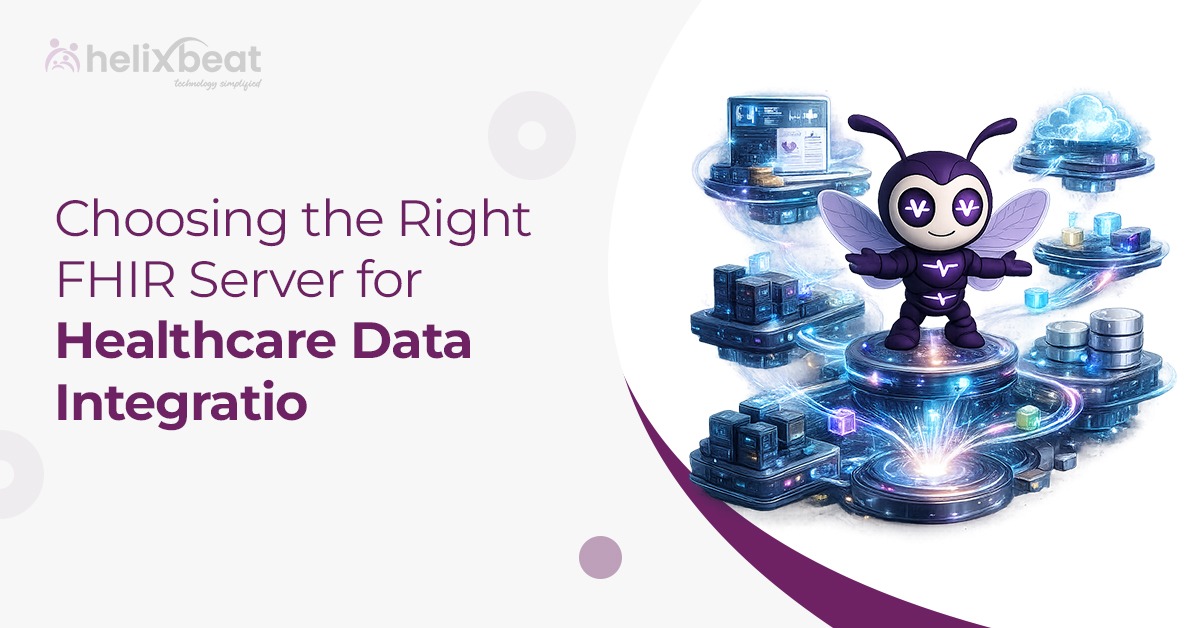
Today, global healthcare organizations are revolutionizing their data management strategies to meet modern digital demands. With the increasing need for interoperability, data exchange, and secure access to patient records, modern healthcare systems require robust platforms that make data flow seamless. At the heart of this exchange is a reliable FHIR server.
In this blog, we explore how to choose the right FHIR server for healthcare data integration.
Table of Contents
What Is a FHIR Server
A FHIR server is a software system that stores, manages, retrieves, and shares healthcare data using the FHIR standard. It provides a standardized interface (usually RESTful APIs) through which applications can query, create, update, or delete these resources. The benefit is consistent access to data from diverse systems like Electronic Health Records (EHRs), imaging systems, laboratory platforms, and patient apps.
FHIR servers can handle:
- Structured health records (e.g., patient demographics)
- Clinical data (e.g., lab results, allergies)
- Administrative information (e.g., appointments, billing)
- Metadata and terminology systems
In simple terms, an effective FHIR server for healthcare acts as both a central repository and a gateway, allowing disparate systems to speak the same language.
Why Healthcare Data Integration
Healthcare involves numerous stakeholders — hospitals, clinics, labs, pharmacies, payers, and patients. Each of these systems generates and consumes data, but historically, many have used different formats and standards. This fragmentation makes it difficult for healthcare professionals to get a complete, real‑time view of a patient’s clinical history.
Healthcare data integration solves this problem by bringing together information from various systems into a unified model. A FHIR server plays a key role in:
- Improving care coordination
- Reducing redundant testing
- Supporting population health analytics
- Streamlining administrative workflows
- Enhancing patient engagement
Additionally, modern regulatory frameworks like the 21st Century Cures Act emphasize open APIs and interoperability, pushing healthcare organizations to adopt standards like FHIR.
Core Capabilities of an Effective FHIR Server
Choosing a FHIR server for healthcare requires careful consideration of its core capabilities.
Support for FHIR Versions
FHIR evolves over time. The most widely used versions are FHIR R4 (Release 4) and FHIR STU3 (Standard for Trial Use 3). R4 is considered normative for many resources, meaning they are stable for production use. A strong FHIR server should support multiple versions and provide clear migration paths.
RESTful API Compliance
A FHIR server for healthcare should expose standard REST endpoints. This means it should allow clients to:
- GET resources (read/query)
- POST new resources (create)
- PUT updated resources
- DELETE resources
This compliance guarantees compatibility with tools, applications, and middleware that expect standard HTTP interactions.
Search and Query Functionality
Healthcare data is diverse and complex. A robust FHIR server must support powerful search features based on standard parameters such as patient ID, date ranges, or clinical attributes. Advanced filters, sorting, pagination, and chaining searches are important for performance and usability.
Transaction and Batch Support
Many integration scenarios require processing multiple operations in a single request. For example, submitting a new patient record along with associated observations and medication data. By utilizing transactions and batches, these workflows achieve both high reliability and atomic completion.
Versioning and History
Healthcare data is dynamic. Therefore, a robust FHIR server must maintain comprehensive resource versioning to support seamless historical data retrieval. This is critical for audit trails, analytics, and clinical review.
Terminology Services
FHIR references medical vocabularies such as SNOMED CT, LOINC, and ICD‑10. The best FHIR servers provide integrated terminology services or easy hooks to external terminology stores to support coding, validation, and mapping.
Key Evaluation Criteria for Choosing a FHIR Server
Now that we’ve covered core capabilities, let’s look at specific criteria you can use to evaluate different FHIR servers:
Interoperability
A FHIR server for healthcare must be interoperable with existing systems and standards. In addition to FHIR, support for standards like HL7 v2, CDA, and DICOM can expand integration possibilities.
Performance and Throughput
Healthcare environments generate intense request volumes, ranging from real-time clinical updates to bulk data exports. Therefore, evaluating server performance, specifically latency, throughput, and stability under load, is critical to maintaining system integrity.
Data Consistency and Integrity
Clinical accuracy is critical. The server must handle concurrent requests without compromising data integrity. Transactional guarantees, conflict resolution, and error handling are important factors.
Scalability
As your organization grows, the FHIR server should scale horizontally (adding more nodes) and vertically (handling larger datasets). Cloud native designs, containerization, and microservices architectures help support scalability.
Security
Protecting patient data is non‑negotiable. We’ll discuss security in detail later, but the server must support strong authentication (OAuth 2.0), authorization (SMART on FHIR profiles), encryption, auditing, and logging.
Custom Extensions
FHIR allows extensions when standard resources don’t cover specific needs. Therefore, a strong server should support extensions while maintaining interoperability.
Technical Considerations and Architecture
Understanding the technical architecture of a FHIR server for healthcare helps you choose the right fit.
Deployment Models
You have several deployment options:
- On‑Premises: Traditional model where the server runs within your own data centers.
- Cloud Hosted: Using FHIR services on cloud platforms like FUSION by Helixeat.
- Hybrid: Core data on‑premises with auxiliary services in the cloud.
Data Storage
FHIR resources are often stored in document stores (like MongoDB) or relational databases optimized for JSON. A good FHIR server abstracts this layer so developers can interact via APIs without worrying about storage format.
Integration Layer
Most healthcare environments use integration engines between the data sources and the FHIR server. Solutions like AERIS can translate legacy formats (e.g., HL7 v2) into FHIR resources.
Security and Compliance Requirements
HIPAA mandates strict handling of protected health information (PHI). Therefore, choosing a FHIR server for healthcare means adopting strong safeguards.
Authentication and Authorization
Modern FHIR servers implement industry standards like:
- OAuth 2.0: For secure token‑based authentication
- OpenID Connect: For identity assertions
- SMART on FHIR: An authorization profile that supports granular access control
These standards allow users and systems to authenticate securely and access only necessary data.
Encryption
Data should be encrypted both:
- At rest: Database encryption
- In transit: TLS/SSL communication
Encryption helps mitigate risks if data is intercepted or storage is compromised.
Audit Logging
A FHIR server must log access and actions in a tamper‑resistant format. Audit logs help with forensic analysis, compliance reporting, and incident response.
Consent Management
Patient consent preferences must be respected. FHIR supports resources like Consent that allow systems to represent permissions and restrictions. A strong FHIR server for healthcare enables enforcement of these policies.
FHIR Server Implementation Best Practices
Implementing a FHIR server for healthcare successfully takes planning and coordination.
Define Clear Use Cases
Document the specific data workflows you want to support — patient access, analytics, system integrations, or mobile apps. Clear goals help prioritize capabilities.
Start with a Pilot
Before scaling across the organization, launch a pilot project to validate integration approaches, data quality, and performance.
Use Standard Profiles and Implementation Guides
FHIR provides implementation guides for specific domains. Using standard profiles reduces custom work and improves interoperability.
Monitor and Optimize
Continuous monitoring of API usage, performance metrics, and error patterns helps keep the FHIR server reliable and responsive.
Engage Stakeholders Early
Clinicians, IT teams, security officers, and business leaders should be involved from the start. Their input improves design and adoption.
Unlock Seamless Healthcare Interoperability with FUSION
Built by Helixbeat, FHIR server FUSION leverages RESTful APIs for seamless connectivity with legacy systems, modern EHRs, and emerging tools like wearable devices and telehealth platforms. This isn’t just compliance, it’s acceleration.
Organizations using FUSION report up to 70% faster data sharing, slashing referral delays by 60% and reducing redundant tests by 25%. That’s not hype; it’s a measurable impact, with providers saving $1,000 – $2,000 per patient annually through streamlined claims and operations.
Certified Excellence
FUSION is officially certified by the Drummond Group for FHIR-based interoperability, validating its conformance with healthcare data exchange standards HL7, FHIR, and SMART on FHIR. This certification demonstrates that FUSION meets industry-recognized benchmarks for secure, standardized data exchange.
Final Thoughts
Choosing the right FHIR server for healthcare is a strategic decision that influences your organization’s ability to share, manage, and act on clinical data. By understanding what a FHIR server does, how it fits into your existing architecture, and what capabilities you need, you can make an informed choice.
FUSION, an enterprise-grade FHIR server, is designed to simplify interoperability, reduce IT costs, and accelerate application deployment. Connect your EHRs, labs, and billing systems effortlessly, and access real-time patient data securely. Get Started with FUSION!
FAQs
1. Why do healthcare organizations need a FHIR server?
Healthcare organizations use a FHIR server to integrate data from multiple systems, improve interoperability, support clinical decision-making, and provide patients with secure access to their health information.
2. What are the core capabilities of a FHIR server for healthcare?
Core capabilities include RESTful API support, search and query functionality, versioning and history tracking, terminology services, batch processing, and support for FHIR standards like R4 or STU3.
3. How does a FHIR server improve patient care?
A FHIR server for healthcare allows clinicians to access a unified view of patient data from multiple sources. This reduces redundant tests, enhances care coordination, and supports faster clinical decision-making.
4. Can FHIR servers integrate with legacy healthcare systems?
Yes, a FHIR server for healthcare can integrate with legacy systems using solutions like AERIS that convert HL7 v2, CDA, or other proprietary formats into FHIR resources.