

Organisations generate massive volumes of structured and unstructured information daily; however, nearly 65% of enterprise data remains underutilized because it is poorly stored or fragmented. Data warehouse solutions address this gap by structuring, integrating, and optimizing enterprise data for faster analytics and smarter decision-making.
With platforms such as Helixbeat DaaS, businesses can transform raw and scattered information into a centralized, high-performance system that supports real-time insights. Optimizing data storage is not only about reducing infrastructure costs, but it also directly impacts reporting speed, accuracy, and scalability.
When cloud-based data warehouse solutions are implemented strategically, companies unlock measurable efficiency improvements across operations, finance, marketing, and supply chain processes.
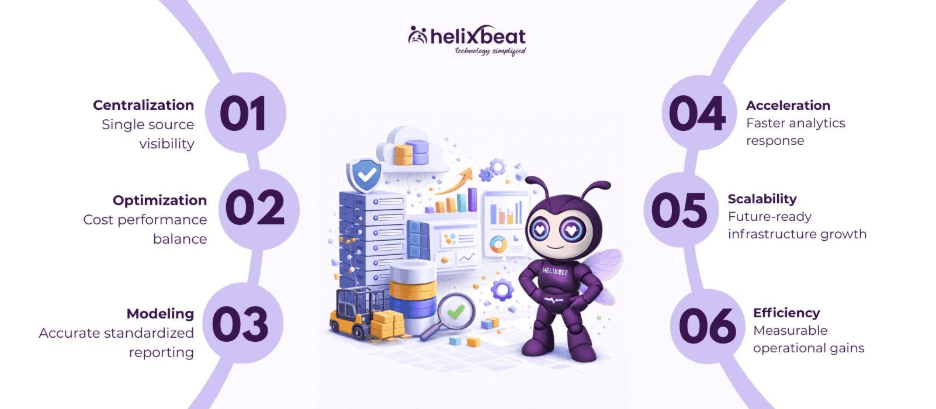
Table of Contents
Centralized Data Warehouse Solutions Reduce Retrieval Time and Accelerate Decision-Making
Efficiency begins with accessibility. When data is scattered across departments, teams spend valuable time searching, validating, and reconciling information. By implementing data warehouse solutions, organizations create a single source of truth, reducing retrieval time by up to 50% and enabling faster, data-backed decisions that enhance operational agility.
Centralization improves efficiency by:
- Eliminating redundant datasets
- Standardizing formats across departments
- Enabling faster SQL query processing
- Supporting unified reporting dashboards
When retrieval time decreases, executives can make informed decisions quickly, directly boosting overall business responsiveness.
Optimized Storage Architecture Lowers Infrastructure Costs While Improving Performance
Inefficient storage often results in overprovisioned servers and underutilized systems, increasing maintenance costs and slowing performance as data volumes grow.
Cloud data warehouse solutions provide dynamic scalability, allowing businesses to pay only for what they use. Organizations leveraging cloud-based data warehouse services report:
- 30–40% reduction in infrastructure costs
- 60% faster analytics processing
- Lower downtime during peak workloads
Optimized storage architecture ensures workloads are distributed efficiently, maintaining consistent performance even as data expands. This cost-performance balance is crucial for long-term operational efficiency.
Structured Data Modeling Improves Accuracy and Reduces Rework Across Teams
Unstructured storage leads to inconsistent reporting, making decision-making unreliable. Different departments using varying data definitions often result in duplicated effort and errors.
The best data warehouse solutions apply structured data modeling techniques such as star schemas and normalization to improve data integrity.
Efficiency gains include:
- 40% reduction in reporting errors
- Standardized KPIs across departments
- Reduced manual reconciliation efforts
- Improved compliance tracking
When teams trust the accuracy of stored data, productivity increases because fewer resources are spent correcting errors, allowing employees to focus on strategic initiatives.
Operational Efficiency Comparison Before and After Storage Optimization
The impact of optimizing data storage becomes evident when performance metrics are compared:
| Metric | Before Optimization | After Optimization |
| Data Retrieval Time | 18 Minutes | 4 Minutes |
| Reporting Cycle Duration | 3–5 Days | Same Day |
| Data Redundancy Rate | High (25%) | Low (5%) |
| Manual Data Handling | Frequent | Minimal |
| Decision-Making Speed | Delayed | Real-Time |
These improvements directly translate into faster operations, improved customer response times, and increased revenue opportunities.
How Real-Time Analytics Through Cloud Data Warehouse Solutions Drives 5x Faster Business Response
Market conditions change rapidly, and without optimized storage systems, analytics often become more reactive rather than proactive.
Cloud data warehouse solutions enable:
- Real-time ingestion of transactional data
- Automated transformation pipelines
- Instant dashboard updates
- AI-driven predictive modeling
Organizations leveraging modern best data warehouse solutions can respond to operational challenges up to five times faster than those relying on traditional storage models. Real-time analytics enhances supply chain forecasting, customer engagement strategies, and financial planning, allowing businesses to make timely, data-backed decisions.
Helixbeat DaaS: Enabling Scalable Storage and High-Performance Data Warehousing
Helixbeat DaaS optimizes enterprise storage architecture with scalable, cloud-driven frameworks. It integrates structured and semi-structured data sources into a unified warehouse environment, ensuring consistency and accessibility across departments.
With Helixbeat DaaS, businesses experience:
- 60% faster query execution
- 35% reduction in storage costs
- Improved data governance and access control
- Seamless integration with enterprise systems
| Efficiency Indicator | Traditional Storage | Helixbeat DaaS |
| Query Performance | Moderate | High |
| Storage Scalability | Limited | Dynamic |
| Reporting Accuracy | 75% | 95% |
| Infrastructure Maintenance | High Cost | Optimized |
| Downtime During Scaling | Frequent | Minimal |
By aligning cloud-based data warehouse services with business objectives, Helixbeat DaaS maximizes storage utilization while maintaining stable performance.
How Scalable Data Warehouse Technologies Support Long-Term Business Growth
Efficiency extends beyond current performance; it is about sustainability and future readiness.
Scalable data warehouse technologies allow organizations to:
- Adapt to growing data volumes
- Support advanced analytics and machine learning
- Improve compliance monitoring
- Enable multi-department collaboration
Companies using scalable data warehouse solutions report higher productivity due to reduced bottlenecks and improved workflow automation. When storage is optimized strategically, businesses can shift from reactive problem-solving to proactive growth planning.
Optimizing Data Storage Is the Foundation of Maximum Enterprise Efficiency
Every department relies on reliable and accessible data. Without optimized storage, analytics slows, errors multiply, and operational costs rise.
Data warehouse solutions provide:
- Structured storage architecture
- Unified data visibility
- Faster processing speeds
- Lower operational overhead
When combined with cloud data warehouse solutions, cloud-based data warehouse services, and platforms like Helixbeat DaaS, organizations create a high-performance ecosystem that converts raw data into measurable efficiency gains. Efficiency becomes not just an outcome but a continuous operational advantage.
Wrapping Up
Optimizing data storage with modern data warehouse solutions directly drives enterprise efficiency. By centralizing, structuring, and scaling storage through cloud data warehouse solutions, cloud-based data warehouse services, and Helixbeat DaaS, businesses reduce costs, accelerate analytics, and improve decision-making speed.
FAQs
1. How do data warehouse solutions maximize efficiency?
They centralize and structure enterprise data, reducing retrieval time and improving reporting speed.
2. What makes cloud data warehouse solutions more efficient than traditional storage?
They provide scalability, faster processing, and lower infrastructure costs.
3. How does Helixbeat DaaS improve storage performance?
It enhances query speed, reduces redundancy, and supports scalable cloud integration.
4. Can optimized storage reduce operational costs?
Yes, organizations often see 30–40% lower infrastructure and maintenance expenses.
5. Are data warehouse technologies suitable for large enterprises?
Yes, they are built to handle high data volumes and complex integrations.
6. How do best data warehouse solutions improve reporting accuracy?
They standardize data models and eliminate inconsistencies across systems.
7. Is storage optimization a one-time process?
No, it requires continuous monitoring and scalable architecture adjustments for sustained efficiency.