


Today, healthcare data sharing is rapidly evolving through digital innovation. At the core of this shift is the FHIR API: a modern, web-driven framework for exchanging healthcare data.
However, building a FHIR API that is not only functional but also scalable, secure, and high-performing requires careful architectural planning. In this blog, we explore how to design scalable healthcare APIs using FHIR architecture, covering principles, best practices, and practical strategies that align with modern healthcare demands.
Table of Contents
Understanding the Core Components of a FHIR API
Before diving into scalability, it’s important to understand the foundational elements of a FHIR API.
1. Resources
FHIR organizes healthcare data into “resources,” which represent real-world entities such as:
- Patient
- Observation
- Medication
- Appointment
Each resource has a defined structure and can be extended when needed.
2. RESTful Endpoints
FHIR APIs follow REST principles:
- GET /Patient/{id} → Retrieve patient data
- POST /Observation → Create a new observation
- PUT /Patient/{id} → Update patient details
- DELETE /Appointment/{id} → Remove an appointment
3. Interoperability Layers
FHIR supports:
- REST APIs
- Messaging
- Documents
- Bulk data (Flat FHIR)
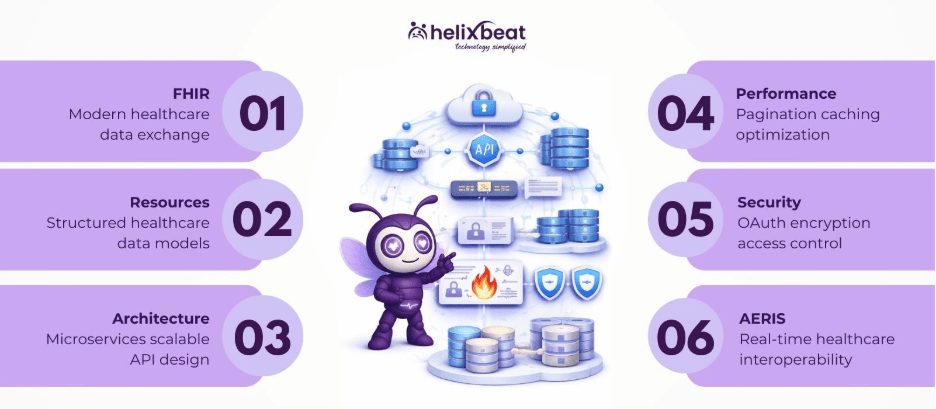
Principles for Designing a Scalable FHIR API
1. Adopt a Microservices Architecture
Instead of building a monolithic system, break your application into smaller, independent services.
Benefits:
- Independent scaling of services
- Faster deployment cycles
- Improved fault isolation
For example:
- Patient Service
- Appointment Service
- Billing Service
Each service can expose its own FHIR API endpoints.
2. Use Stateless API Design
A stateless FHIR API does not store client session data on the server.
Why it matters:
- Easier horizontal scaling
- Better load balancing
- Reduced server overhead
Therefore, all necessary information should be included in each API request.
3. Implement Efficient Data Storage Strategies
FHIR resources can be stored in:
- Relational databases
- NoSQL databases
- Dedicated FHIR servers
Best Practices:
- Index frequently queried fields
- Use partitioning for large datasets
- Optimize schema for read-heavy workloads
4. Optimize API Performance
Performance optimization plays a critical role in scalability.
Techniques:
- Pagination (_count, _page)
- Filtering (?name=John)
- Sparse fieldsets (_elements)
- Compression (gzip)
These reduce payload size and improve response times.
5. Enable Caching Mechanisms
Caching reduces repeated database calls and improves performance.
Types of caching:
- Client-side caching
- Server-side caching
- CDN-based caching
Use HTTP headers like:
- Cache-Control
- ETag
- Last-Modified
6. Support Bulk Data Access
FHIR supports bulk data export using the Flat FHIR specification.
Use cases:
- Population health analytics
- Data migration
- Machine learning pipelines
Bulk endpoints like:
GET /Patient/$export
allow asynchronous data retrieval for large datasets.
Designing for High Availability
A scalable FHIR API must also be highly available.
Strategies:
1. Load Balancing
Distribute incoming requests across multiple servers to prevent overload.
2. Auto-Scaling
Automatically scale infrastructure based on traffic demand.
3. Redundancy
Deploy multiple instances across regions to avoid single points of failure.
Key Security Measures in FHIR APIs
1. OAuth 2.0 and OpenID Connect
Used for authentication and authorization in a FHIR API.
2. Role-Based Access Control (RBAC)
Restrict access based on user roles (e.g., doctor, admin, patient).
3. Data Encryption
- Encryption in transit (HTTPS)
- Encryption at rest
4. Audit Logging
Track all access and modifications to healthcare data.
Versioning Your FHIR API
Healthcare systems evolve, and your API must adapt without breaking existing integrations.
Versioning Approaches:
- URI versioning (/v1/Patient)
- Header-based versioning
- FHIR version alignment (e.g., R4, R5)
Maintaining backward compatibility is critical for long-term scalability.
Handling Large-Scale Data Interoperability
FHIR is designed for interoperability, but real-world implementations require additional planning.
Strategies:
1. Data Normalization
Standardize incoming data to match FHIR resource structures.
2. Terminology Services
Use standardized code systems like:
- SNOMED CT
- LOINC
- ICD
3. API Gateways
Manage traffic, authentication, and routing through a centralized gateway like AERIS.
Testing and Validation of FHIR APIs
A scalable FHIR API must be thoroughly tested.
Types of Testing:
- Unit testing
- Integration testing
- Load testing
- Security testing
Validation Tools:
- FHIR validators
- Schema validation
- Conformance testing
Testing helps identify bottlenecks before they impact production systems.
Monitoring and Observability
To maintain scalability, continuous monitoring is non-negotiable.
Key Metrics:
- API response time
- Error rates
- Throughput
- Resource utilization
Tools:
- Logging systems (ELK stack)
- Metrics platforms (Prometheus, Grafana)
- Distributed tracing (Jaeger)
Common Pitfalls to Avoid
Even well-designed systems can fail if certain issues are overlooked.
1. Overfetching Data
Returning unnecessary data increases payload size and slows performance.
2. Ignoring Pagination
Fetching large datasets in a single request can overwhelm systems.
3. Poor Error Handling
Unclear error messages make debugging difficult.
4. Lack of Standardization
Inconsistent implementation of FHIR resources reduces interoperability.
Step-by-Step Approach to Building a Scalable FHIR API
Step 1: Define Use Cases
Identify what your API needs to support.
Step 2: Choose FHIR Version
Select a stable version like R4 for production.
Step 3: Design Resource Models
Map your data to FHIR resources.
Step 4: Build RESTful Endpoints
Follow FHIR API standards.
Step 5: Implement Security
Use OAuth 2.0 and RBAC.
Step 6: Optimize Performance
Add caching, pagination, and filtering.
Step 7: Test and Validate
Conduct rigorous testing.
Step 8: Deploy and Monitor
Use cloud infrastructure and monitoring tools.
How AERIS Revolutionizes Interoperability with FHIR APIs?
Designing a scalable FHIR API is only one part of the equation; the real impact comes from how effectively it is implemented in real-world healthcare environments. This is where AERIS by Helixbeat stands out as a powerful interoperability platform.
AERIS is designed to help healthcare organizations move beyond fragmented systems and adopt a connected, API-driven ecosystem. By leveraging a robust FHIR API framework, it enables seamless, secure, and real-time data exchange across providers, clinics, hospitals, pharmacies, and insurers.
With AERIS, organizations can:
- Break down data silos by enabling standardized data exchange across systems
- Streamline workflows through real-time access to patient information
- Enhance care coordination with unified, up-to-date health records
- Support cross-industry collaboration between healthcare providers and external partners
By aligning with FHIR standards, AERIS creates a consistent data layer that simplifies integration and accelerates digital transformation initiatives.
Why AERIS is Your Key to Healthcare Innovation?
- 20+ Years of Expertise: Our team brings decades of healthcare IT experience to ensure AERIS works for you.
- 50+ IT Professionals: A dedicated crew powers AERIS, delivering unmatched support and innovation.
- 1,000+ Customers: Join a thriving community of healthcare leaders already transforming with AERIS.
- 10,000+ Projects Completed: Proven success across countless integrations and workflows.
- 95% Returning Customers: Our clients trust AERIS to deliver, time and time again.
Providers adopting AERIS report faster diagnoses, lower costs, and improved outcomes, positioning it as the go-to tool for future-proof HIE.
Your Benefits, Amplified
- 50% Fewer Delays: Real-time data means critical information is always at your fingertips, turning hours into seconds.
- 100% Faster ROI: Plug-and-play integration maximizes your investment without expensive system replacements.
- 30% Cost Savings, 90% Fewer Errors: Automation eliminates waste, saving resources and ensuring accuracy.
Final Thoughts
Designing a scalable FHIR API is a strategic investment in the future of healthcare interoperability. As healthcare ecosystems expand and data exchange becomes more complex, scalable API architecture plays a vital role in maintaining performance, reliability, and seamless integration across platforms.
Ready to take your interoperability strategy to the next level?
AERIS empowers healthcare organizations to unlock the full potential of a scalable FHIR API with seamless integration, real-time data exchange, and high-performance architecture. Connect with Helixbeat today!
FAQs
1. What is a FHIR API?
A FHIR API is a RESTful interface based on the Fast Healthcare Interoperability Resources (FHIR) standard, used to exchange healthcare data between systems in a structured and interoperable format.
2. Why is scalability important in a FHIR API?
Scalability allows a FHIR API to handle increasing data volumes, user traffic, and system integrations without performance degradation.
3. Which FHIR version should I use for production?
FHIR R4 is widely adopted and considered stable for most production environments.
4. How does a FHIR API support interoperability?
A FHIR API uses standardized resource structures and data formats like JSON and XML, allowing different healthcare systems to communicate seamlessly.
5. What are FHIR resources?
FHIR resources are modular data components representing healthcare entities such as patients, medications, observations, and appointments.