

Enterprise data management (EDM) is no longer optional for modern businesses—it has become essential. Every day, companies generate massive volumes of data, and managing this data efficiently is critical for accurate reporting, regulatory compliance, and informed strategic decision-making.
Helixbeat DaaS offers a cloud-based solution that simplifies enterprise data management by automating workflows, monitoring data in real time, and integrating seamlessly with systems like Oracle Enterprise Data Management. By leveraging enterprise data management software and tools, businesses can eliminate data silos, enhance cross-team collaboration, and derive actionable insights faster.
In this blog, we will explore what EDM entails, how it functions, and how Helixbeat DaaS transforms raw data into a strategic business asset.
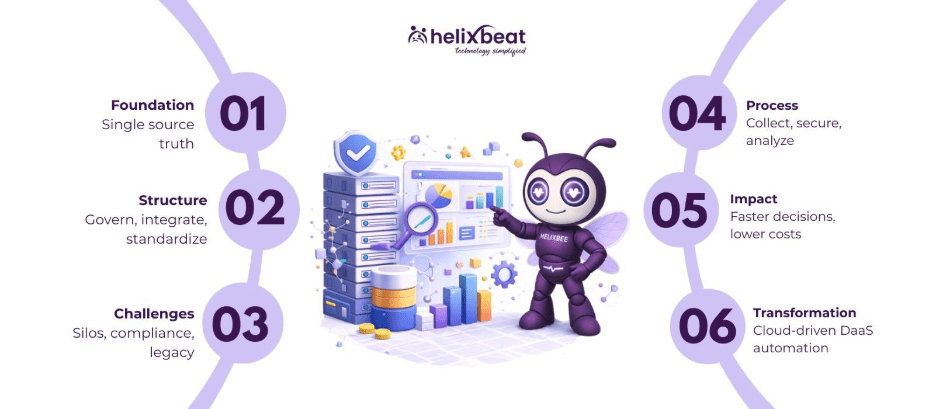
Table of Contents
What Enterprise Data Management Is and Why It Matters
Enterprise data management is the structured approach of collecting, organizing, and maintaining a company’s critical data across multiple systems. By implementing enterprise data management, organizations create a single source of truth that ensures information is accurate, accessible, and consistent across all departments.
Key components of enterprise data management include:
- Data Governance: Establishes policies and procedures to maintain data quality, security, and regulatory compliance.
- Data Integration: Consolidates information from ERP, CRM, and enterprise data management Oracle systems into unified platforms.
- Data Quality Management: Detects and corrects errors in real-time, maintaining reliable information for decision-making.
- Master Data Management (MDM): Develops authoritative data records for core business entities such as customers, products, and suppliers.
- Metadata Management: Documents the meaning, origin, and usage of data for clear understanding and transparency.
By leveraging enterprise data management software and services, companies can improve operational efficiency, reduce costs, and enhance strategic planning, ultimately turning raw data into actionable insights that drive business growth.
Common Challenges Organizations Face in Enterprise Data Management
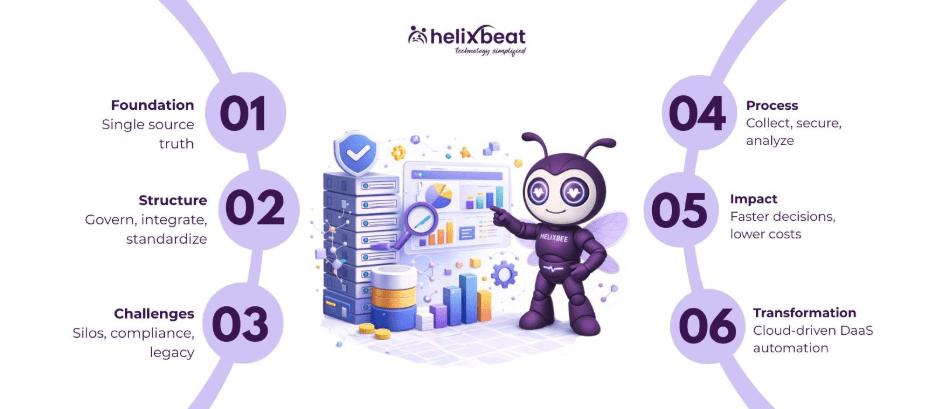
While enterprise data management offers significant advantages, many organizations face obstacles during implementation. Common challenges include fragmented systems, inconsistent data quality, and regulatory compliance pressures.
| Challenge | Impact on Business | Enterprise Data Management Solution |
| Data Silos | Departments operate with inconsistent data, causing misalignment | Integrate systems using enterprise data management software to centralize information |
| Low Data Accuracy | Leads to flawed reports and poor decisions | Apply data cleansing and validation processes |
| Compliance Issues | Risk of GDPR, HIPAA, or SOX violations | Implement strong governance frameworks through enterprise data management services |
| Legacy Systems | ERP or Oracle systems complicate integration | Use enterprise data management Oracle tools for seamless integration |
| Scalability Constraints | High data volumes overwhelm systems | Adopt cloud-based EDM solutions like Helixbeat DaaS for flexible scaling |
Addressing these challenges proactively with enterprise data management services ensures operational efficiency, reliable reporting, and a solid foundation for strategic growth.
How Enterprise Data Management Works – Step-by-Step
Enterprise data management operates through structured processes that convert raw information into valuable insights.
Step 1: Data Collection
Organizations gather structured and unstructured data from multiple sources, including ERP, CRM, IoT devices, and third-party vendors.
Step 2: Data Classification
Data is categorized according to relevance, sensitivity, and type, allowing critical information to receive priority attention.
Step 3: Data Standardization
Standard formats, units, and terminologies are applied across all datasets, promoting consistency and reducing errors.
Step 4: Data Integration
Disparate sources, including enterprise data management Oracle systems, are consolidated into a central platform for streamlined access and usability.
Step 5: Data Governance & Security
Data is continuously monitored to comply with internal policies and external regulations. Encryption, access controls, and audit trails protect sensitive information at every stage.
Step 6: Reporting and Analytics
Advanced analytics, KPIs, and dashboards provide real-time insights to support timely, data-driven decision-making.
Step 7: Continuous Improvement
Enterprise data management is iterative. Organizations continuously correct errors, upgrade systems, and refine strategies to meet evolving business needs.
By following these steps with Helixbeat enterprise data management software and services, companies can eliminate inefficiencies, prevent redundancies, and unlock the full potential of their data.
Benefits and Measurable Impact of Enterprise Data Management
Investing in enterprise data management delivers tangible operational and financial advantages that directly impact organizational performance. By adopting structured EDM practices, companies can transform raw information into actionable insights, fostering better decision-making and stronger business outcomes.
| Benefit | Real-World Impact | Example Metric |
| Faster Decision-Making | Reliable, consolidated data accelerates strategy | 35% faster reporting cycles |
| Cost Efficiency | Automation reduces manual data entry errors | 20% reduction in operational costs |
| Regulatory Compliance | Minimizes risk of fines or audits | Zero compliance violations |
| Improved Collaboration | Unified data enhances interdepartmental efficiency | 25% more efficient project execution |
| Enhanced Customer Insights | Clean, consistent data supports personalized marketing | 15% increase in customer retention |
The adoption of enterprise data management software, especially cloud-based solutions like Helixbeat DaaS, amplifies these benefits by providing real-time monitoring, automation, and seamless Oracle enterprise data management integration. When combined with expert enterprise data management services, organizations can streamline processes, reduce operational complexity, and focus on deriving strategic value from their data.
Helixbeat DaaS – Transforming Enterprise Data Management
Helixbeat DaaS (Data-as-a-Service) offers a modern, cloud-first approach to enterprise data management. It resolves common EDM challenges and empowers organizations to treat data as a strategic asset.
Key Features
- Real-Time Access: Data is instantly accessible across departments and locations.
- Automation: Routine tasks, including data cleansing, validation, and reporting, are automated.
- Seamless Oracle Integration: Works efficiently with Oracle enterprise data management systems.
- Scalability: Manages large and growing volumes of data with ease.
- Enhanced Security: Encryption and role-based access safeguard sensitive information.
How Helixbeat DaaS Works
| Helixbeat DaaS Component | Functionality | Business Benefit |
| Cloud Storage | Centralizes structured and unstructured data | Eliminates silos, supports real-time access |
| Data Automation Tools | Cleans, validates, and standardizes data | Reduces human error and operational costs |
| Integration Layer | Connects ERP, CRM, and Oracle systems | Ensures seamless data flow across platforms |
| Analytics & Reporting | Generates dashboards and KPI reports | Supports faster, informed decision-making |
With Helixbeat DaaS, businesses can focus on leveraging insights instead of managing data complexity, making EDM a driver of growth rather than just a technical function.
Selecting the Right Enterprise Data Management Software
Choosing the right software is crucial to the success of any EDM initiative. Organizations should consider the following criteria:
- Integration Capabilities: Must connect seamlessly with ERP, CRM, and Oracle enterprise data management systems.
- User-Friendly Interface: Enables teams without technical expertise to manage data effectively.
- Security & Compliance: Encryption, role-based access, and audit logs protect sensitive information.
- Automation & Scalability: Handles growing data volumes while maintaining performance.
- Vendor Support & Updates: Guarantees long-term functionality and adherence to evolving regulations.
By selecting the right enterprise data management tools and leveraging expert enterprise data management services, organizations can simplify complex workflows, reduce costs, and maintain high data accuracy across all departments.
Best Practices for Effective Enterprise Data Management
Successful EDM requires strategic planning, organizational alignment, and consistent execution. Recommended best practices include:
- Strong Data Governance: Define clear policies for data access, ownership, and lifecycle management.
- Regular Audits & Monitoring: Proactively detect and resolve inconsistencies.
- Employee Training: Equip teams with knowledge of EDM tools, including Helixbeat DaaS.
- Automation: Reduce manual errors by leveraging cloud-based automation solutions.
- Performance Metrics: Monitor indicators like data quality, report accuracy, and system uptime.
- Cross-Functional Collaboration: Encourage departments to share data for a unified organizational view.
Following these practices ensures that enterprise data management is not only implemented but also sustainable and delivers measurable impact.
Wrapping Up
Enterprise data management is a critical driver for operational efficiency, strategic planning, and business growth. By implementing structured EDM practices with Helixbeat DaaS, enterprise data management tools, and Oracle enterprise data management solutions, organizations can consolidate, automate, and secure their data.
FAQs
1. What is enterprise data management (EDM)?
EDM centralizes, organizes, and governs company data for accuracy, accessibility, and compliance.
2. How does Helixbeat DaaS improve EDM?
Helixbeat DaaS offers real-time access, automation, and seamless Oracle system integration.
3. Why is data quality critical in EDM?
Low-quality data leads to errors in reporting, poor decisions, and compliance risks.
4. What are the popular EDM tools?
Helixbeat DaaS, Oracle Enterprise Data Management, and other integration and governance platforms.
5. Can small businesses benefit from EDM?
Yes, structured data management improves efficiency and decision-making regardless of company size.
6. How often should EDM processes be audited?
Audits should be conducted monthly or quarterly to maintain data integrity.
7. What are the advantages of cloud-based EDM?
Cloud EDM provides scalability, automation, remote access, and reduced IT overhead.