

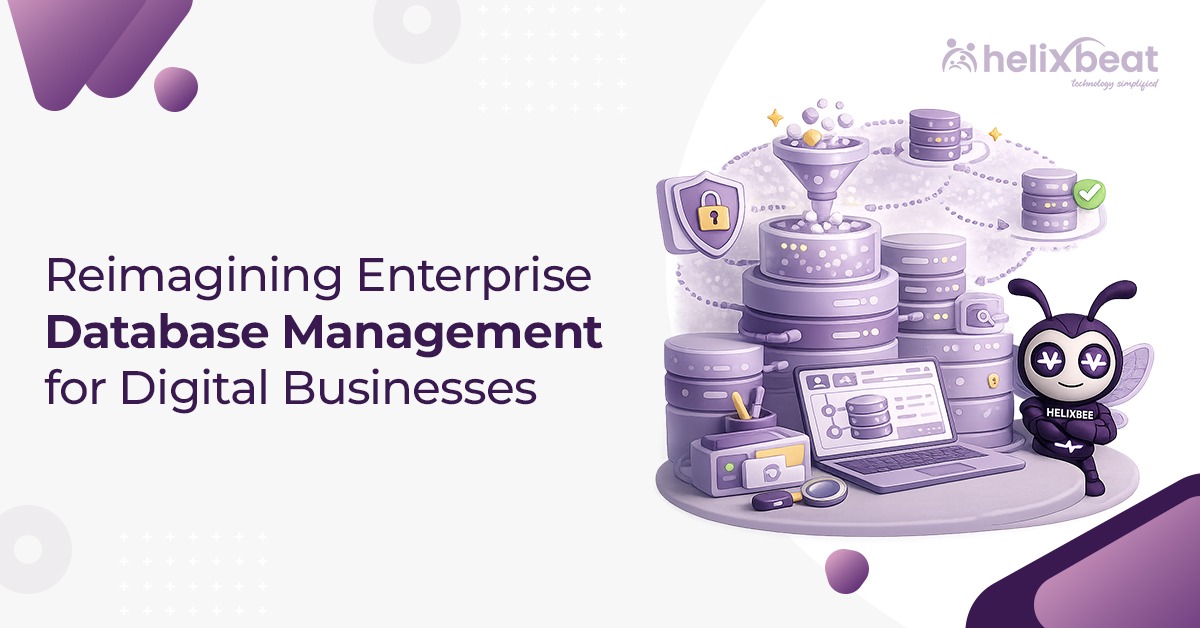
Enterprise database management has evolved from a behind-the-scenes operation into a strategic driver for US businesses seeking digital growth. With rapidly expanding data, complex IT infrastructures, and stringent compliance demands, companies require robust solutions to secure, manage, and leverage information effectively.
Helixbeat empowers organizations to streamline operations, mitigate risks, and make faster, data-driven decisions. Across industries—from healthcare and finance to retail and manufacturing—modern enterprise database management tools enable businesses to remain agile, scalable, and competitive.
In today’s digital economy, adopting an effective enterprise database management strategy is crucial for long-term operational excellence and business success.
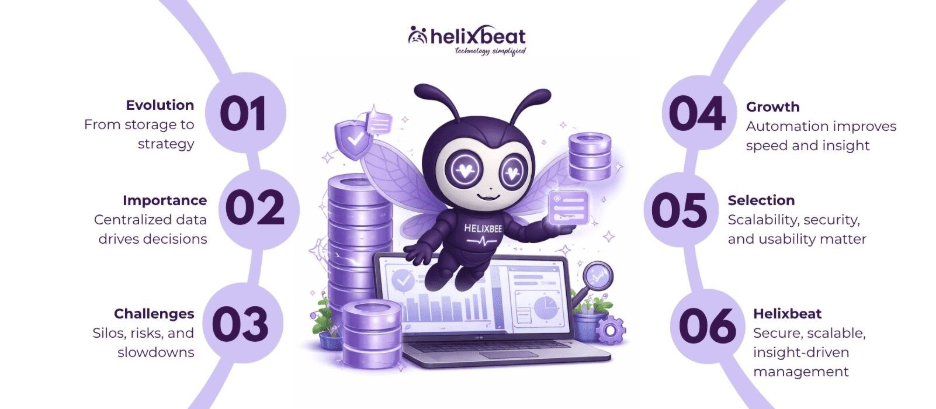
Table of Contents
Understanding the True Value of Enterprise Database Management
Enterprise database management is not just about storing information—it is about leveraging data to create actionable insights that drive business strategy and operational excellence.
Why Businesses Need It
- Centralized control over critical business information minimizes duplication and inconsistencies.
- Enhanced data quality supports smarter strategic decisions.
- Automated processes reduce operational errors and labor-intensive manual tasks.
Benefits Across Industries
| Industry | Key Benefit | Impact |
| Healthcare | Patient data integrity | Enhances treatment accuracy and reduces medical errors |
| Finance | Real-time analytics | Improves fraud detection and risk management |
| Retail | Customer insights | Drives personalized marketing and increases conversion |
| Manufacturing | Supply chain visibility | Optimizes production efficiency and reduces downtime |
Modern enterprise database management systems are essential for organizations handling large volumes of sensitive information. Effective use of an enterprise data management tool allows US businesses to maximize data accuracy, streamline operations, and improve decision-making efficiency.
Common Challenges in Enterprise Database Management
Many US businesses face difficulties managing large-scale data, which impacts decision-making and operational performance.
Data Silos and Fragmentation
Fragmented information across departments creates inefficiencies and slows down responses. Without a unified enterprise database management system, critical insights may be missed.
Security and Compliance Risks
Businesses face growing cybersecurity threats and must comply with regulations such as HIPAA or international data laws. Weak enterprise database management practices increase the risk of breaches.
Performance Bottlenecks
Legacy databases and unoptimized systems often lead to slow transactions, downtime, and operational delays, which affect customer satisfaction and business agility.
Scaling for Growth
As companies expand, traditional databases struggle with increased volume, complexity, and diverse data formats. Cloud-enabled enterprise database management software offers scalable solutions to meet evolving business needs.
How Enterprise Database Management Software Drives Growth
Modern enterprise database management software enhances operational efficiency, analytics, and customer engagement, enabling businesses to compete effectively in a digital economy.
Automation and Efficiency
Automating routine database tasks reduces errors, improves speed, and allows IT teams to focus on strategic initiatives rather than repetitive operations.
Real-Time Analytics
Organizations can access actionable insights instantly, enabling faster decision-making. Retailers, for instance, can monitor customer behavior in real time and adjust campaigns or inventory dynamically.
Customer-Centric Strategies
With accurate and timely data, US businesses can design personalized experiences, predict customer preferences, and boost retention. Data-driven strategies enhance revenue potential and strengthen brand loyalty.
Competitive Advantage
Companies adopting an enterprise database management system gain a strategic edge by leveraging data intelligence, optimizing internal processes, and responding proactively to market trends.
Evaluating Enterprise Database Management Systems
Choosing the right enterprise database management software ensures a business can meet current and future requirements effectively.
| Feature | Importance | Benefit |
| Scalability | High | Handles growing data volume without performance loss |
| Security | Critical | Protects sensitive business and customer information |
| Integration | Medium | Works seamlessly with existing applications and workflows |
| User Experience | High | Simplifies database operations for IT and business teams |
| Reporting & Analytics | High | Supports strategic, data-driven decision-making |
When evaluating systems, businesses should prioritize solutions that combine robust analytics, high security, and ease of use. This allows teams to manage enterprise data efficiently while focusing on enterprise database marketing and overall growth strategies.
Helixbeat: Revolutionizing Enterprise Database Management
Helixbeat is transforming the way digital businesses approach enterprise database management, combining automation, security, and analytics in one comprehensive platform.
Key Features of Helixbeat
- Unified dashboards provide clear visibility into database performance across teams.
- Automated backup and recovery protect critical data from loss or disruption.
- Advanced analytics and reporting tools support strategic, data-driven decision-making.
- Scalable architecture allows businesses to grow without technical bottlenecks or downtime.
Business Impact
Companies integrating Helixbeat experience faster query times, improved operational efficiency, and reduced downtime. By leveraging Helixbeat, digital businesses can make better decisions quickly and streamline enterprise database management.
Why Choose Helixbeat
Helixbeat offers modern enterprises a secure, scalable, and user-friendly enterprise database management software solution. By combining automation, analytics, and operational efficiency, it empowers businesses across industries to manage data effectively and drive growth.
Request a demo of Helixbeat and see real-time database improvements.
Leveraging Data Management in Healthcare
Healthcare is one of the most data-intensive industries, where precise data management in healthcare directly impacts patient care and operational efficiency.
Streamlined Patient Data
Enterprise database management systems ensure accurate storage and access to electronic health records (EHRs), supporting diagnosis, treatment, and compliance reporting.
Compliance and Security
Healthcare organizations face strict regulatory requirements, such as HIPAA. Modern enterprise database management software simplifies compliance while safeguarding data integrity and privacy.
Outcome Improvements
Hospitals using advanced database management systems report faster decision-making, fewer errors, and improved patient satisfaction. Predictive analytics enabled by these tools can also flag potential health risks before they escalate.
Data-Driven Insights
| Application | Benefit | Example |
| Patient history analysis | Enhances treatment plans | Clinicians predict disease progression |
| Resource allocation | Optimizes hospital operations | Reduces wait times and improves staffing |
| Clinical research | Supports innovation | Accelerates medical studies and trials |
Future Trends in Enterprise Database Marketing
Data-driven strategies are reshaping how businesses connect with and retain customers, emphasizing efficiency, personalization, and measurable ROI.
Predictive Analytics
Modern enterprise database management tools leverage AI to anticipate customer behavior and preferences, enabling proactive and highly effective marketing campaigns.
Personalization at Scale
With centralized enterprise data, businesses can deliver personalized offers to millions of customers simultaneously, improving engagement, conversions, and long-term loyalty.
Integration with CRM Systems
Data from enterprise database management software integrates directly into customer relationship management systems, enhancing communication, retention, and overall customer lifetime value.
Measuring ROI
Analyzing marketing data through enterprise database management systems allows businesses to quantify returns, make informed decisions, and optimize campaigns strategically.
Wrapping Up
Reimagining enterprise database management is crucial for US businesses aiming for growth, efficiency, and security. Helixbeat equips companies with advanced tools to manage, analyze, and leverage data effectively. By adopting modern enterprise database management software and database management services, organizations remain agile, data-driven, and future-ready.
Get started with Helixbeat today and transform your enterprise database management strategy.
FAQs
1. What is enterprise database management?
It is the practice of organizing, securing, and managing business data for efficiency, accuracy, and decision-making.
2. How does Helixbeat improve enterprise database management?
Helixbeat centralizes operations, provides analytics, automate tasks, and ensures secure, scalable database management.
3. Why is data security crucial in enterprise database systems?
It prevents breaches, maintains regulatory compliance, and protects customers and business information.
4. Which industries benefit most from enterprise database management software?
Healthcare, finance, retail, and manufacturing see significant improvements in efficiency and decision-making.
5. How does database management impact marketing strategies?
It enables predictive analytics, targeted campaigns, and improved customer engagement.
6. Can Helixbeat integrate with existing enterprise software?
Yes, Helixbeat is designed to integrate seamlessly with most enterprise applications and CRM systems.
7. What is the future of enterprise database management?
Automation, AI-driven insights, predictive analytics, and cloud scalability will continue to define the next generation of database management.