


The U.S. healthcare system has been undergoing a major transformation over the last decade. Traditional payment systems that rewarded providers for the volume of services delivered are gradually being replaced by models that prioritize quality, outcomes, and efficiency. This shift is largely driven by the growing adoption of healthcare value based reimbursement, a model designed to improve patient outcomes while controlling rising healthcare costs.
However, while healthcare value based reimbursement offers tremendous opportunities for healthcare providers, it also introduces financial uncertainties and operational challenges. Hospitals, clinics, and physician groups must now balance improved care delivery with the financial risks tied to performance-based contracts.
In this blog, we’ll explore how healthcare value based reimbursement evolved, the financial rewards and risks associated with it, and how modern payment solutions like PayNova help providers navigate this changing healthcare economy.
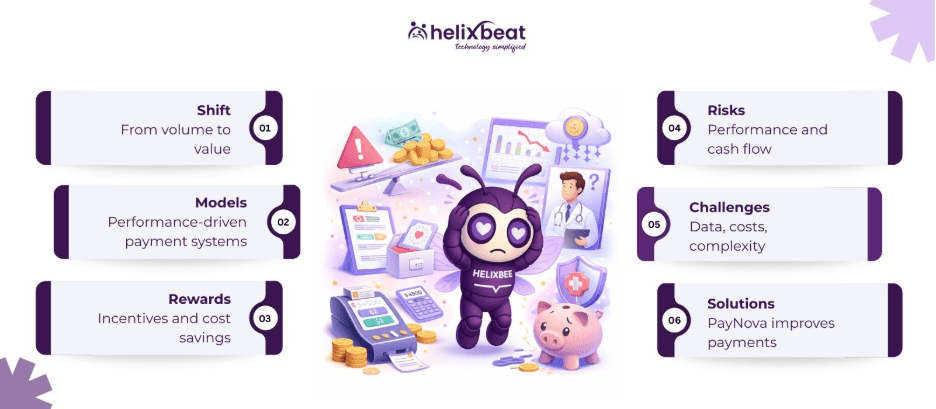
Table of Contents
The Evolution of Value-Based Healthcare Payments
To understand healthcare value based reimbursement, we first need to look at how healthcare payments worked historically.
For decades, the U.S. healthcare system relied on a fee-for-service (FFS) model. In this system, providers were paid for each consultation, procedure, diagnostic test, or treatment delivered. While this model ensured providers were compensated for services rendered, it often incentivized higher service volumes rather than better outcomes.
Rising healthcare costs soon became a major concern. According to the Centers for Medicare & Medicaid Services (CMS), U.S. healthcare spending reached $4.5 trillion in 2022, accounting for nearly 17.3% of the country’s GDP. Policymakers began exploring alternative payment approaches that could control costs while improving patient outcomes.
This is where value based reimbursement models in healthcare began to emerge. These models reward providers for delivering high-quality care, improving patient outcomes, and reducing unnecessary medical expenses.
Programs like:
- Medicare Shared Savings Program (MSSP)
- Accountable Care Organizations (ACOs)
- Bundled Payment for Care Improvement (BPCI)
all represent examples of value based care reimbursement models designed to transform how providers are paid.
Today, healthcare value based reimbursement continues to expand across private insurance plans, government programs, and healthcare networks.
Understanding Healthcare Value-Based Reimbursement
At its core, healthcare value based reimbursement focuses on paying healthcare providers based on performance and patient outcomes rather than the number of services delivered.
In value based reimbursement in healthcare, providers may receive:
- Incentives for meeting quality benchmarks
- Shared savings for reducing healthcare costs
- Performance bonuses for improving patient outcomes
- Penalties for failing to meet care standards
This approach encourages healthcare organizations to deliver coordinated, patient-centered care.
Several value based reimbursement models in healthcare are currently used across the industry.
Pay-for-Performance (P4P)
In this model, providers receive bonuses when they achieve specific quality targets such as lower hospital readmission rates or improved patient satisfaction scores.
Bundled Payments
Bundled payments provide a single payment for an entire treatment episode. Providers must coordinate services efficiently to stay within the payment bundle.
Shared Savings Programs
Under shared savings arrangements, providers can earn additional revenue if they reduce overall healthcare spending while maintaining care quality.
Capitation
Providers receive a fixed amount per patient regardless of how many services are delivered, encouraging preventive care and proactive patient management.
Each of these value based care reimbursement models introduces new financial opportunities—but also financial risks.
Financial Rewards of Value-Based Healthcare Contracts
For healthcare organizations that successfully adopt healthcare value based reimbursement, the financial rewards can be significant.
1. Performance-Based Incentives
Providers participating in value based reimbursement in healthcare contracts can earn bonuses for meeting quality benchmarks.
For example, reducing hospital readmissions or improving chronic disease management can lead to additional payments from insurers or government programs.
2. Cost Efficiency Gains
Efficient care coordination and preventive medicine can significantly reduce unnecessary treatments. Organizations that lower costs while maintaining care quality often benefit financially under value based reimbursement health care contracts.
3. Improved Patient Retention
High-quality patient outcomes and improved experiences help providers build stronger reputations. Providers performing well in value based reimbursement models in healthcare often attract more patients and partnerships with insurers.
4. Predictable Revenue Streams
Certain value based care reimbursement models, such as capitation or shared savings programs, provide predictable payment structures that help healthcare organizations plan long-term financial strategies.
As a result, many providers see healthcare value based reimbursement as an opportunity to achieve both financial sustainability and improved patient outcomes.
Financial Risks in Value-Based Healthcare Contracts
While the rewards are appealing, healthcare value based reimbursement also introduces financial challenges that providers must carefully manage.
1. Performance Risk
Unlike fee-for-service models, value based reimbursement in healthcare ties payments to performance metrics. Providers who fail to meet quality standards may face financial penalties.
This creates significant pressure on healthcare organizations to maintain consistent care quality.
2. Data and Reporting Requirements
Participating in value based reimbursement models in healthcare requires extensive data tracking, reporting, and analytics. Providers must collect accurate patient outcome data to demonstrate compliance with performance metrics.
This often requires investments in advanced healthcare technology and analytics platforms.
3. Upfront Infrastructure Costs
Transitioning to value based care reimbursement models may require healthcare providers to invest in:
- Care coordination teams
- Data analytics tools
- Population health management systems
- Integrated billing systems
These upfront costs can strain budgets, especially for smaller practices.
4. Cash Flow Challenges
Healthcare organizations participating in value based reimbursement health care contracts may face delayed reimbursements while performance data is evaluated.
Payment delays can disrupt cash flow and operational stability.
5. Patient Population Complexity
Providers serving high-risk populations may find it harder to meet performance targets due to social determinants of health such as income inequality, housing instability, or limited access to preventive care.
This adds additional financial uncertainty under healthcare value based reimbursement programs.
The Role of Technology in Managing Value-Based Payments
Successfully navigating healthcare value based reimbursement requires more than just clinical improvements. Providers must also streamline financial workflows, automate payment processes, and improve billing accuracy.
This is where modern healthcare payment solutions become essential.
Platforms like PayNova help healthcare providers manage the financial complexities associated with value based reimbursement in healthcare contracts.
How PayNova Supports Value-Based Healthcare Payments
PayNova is a dedicated healthcare payment gateway designed to simplify complex healthcare billing systems and support providers operating within value based reimbursement models in healthcare.
Streamlined Payment Processing
PayNova centralizes patient payments, insurance reimbursements, and third-party billing in a single system. This reduces administrative overhead and ensures faster payment processing.
For organizations participating in value based care reimbursement models, streamlined payment workflows are critical to maintaining financial stability.
Faster Insurance Reimbursements
Delayed payments are one of the biggest challenges in value based reimbursement health care contracts.
PayNova automates insurance verification, claims submission, and payment processing to accelerate reimbursements and improve provider cash flow.
Flexible Patient Payment Options
Patients in healthcare value based reimbursement environments often face out-of-pocket costs related to deductibles or uncovered services.
PayNova allows patients to pay using multiple payment methods, including:
- Credit and debit cards
- Digital wallets
- ACH transfers
- Recurring payment plans
This flexibility helps reduce unpaid balances and improves patient satisfaction.
Secure and Compliant Transactions
Healthcare providers must comply with strict data protection regulations.
PayNova ensures full HIPAA and PCI-DSS compliance, protecting both financial transactions and patient data while supporting organizations operating within value based reimbursement models in healthcare.
Real-Time Financial Insights
Providers need clear financial visibility when operating under value based care reimbursement models.
PayNova offers advanced reporting tools that track payments, outstanding balances, insurance reimbursements, and revenue performance.
This data helps providers make informed financial decisions and optimize their healthcare value based reimbursement strategies.
Preparing for the Future of Value-Based Healthcare
The shift toward healthcare value based reimbursement is expected to accelerate in the coming years.
According to industry research from the Health Care Payment Learning & Action Network, nearly 60% of U.S. healthcare payments are now tied to value-based care models.
As these models continue to evolve, providers must adapt both clinically and financially.
Healthcare organizations that successfully integrate:
- care coordination strategies
- advanced data analytics
- automated payment systems
will be better positioned to succeed in value based reimbursement in healthcare environments.
Solutions like PayNova play a key role in enabling providers to manage financial complexity while focusing on what matters most—delivering high-quality patient care.
Conclusion
The transition toward healthcare value based reimbursement represents one of the most significant changes in the modern healthcare economy.
While value based reimbursement models in healthcare offer major financial rewards through improved outcomes and cost efficiency, they also introduce new risks related to performance metrics, payment delays, and operational complexity.
Healthcare providers must balance these risks with the opportunities created by value based care reimbursement models.
By leveraging advanced financial infrastructure like PayNova, healthcare organizations can streamline billing, accelerate reimbursements, improve patient payment experiences, and maintain financial stability under value based reimbursement health care contracts.
As the healthcare industry continues its shift toward outcome-driven care, the combination of innovative payment technology and high-quality clinical delivery will define the future success of healthcare providers.
FAQs
1. What is healthcare value based reimbursement?
Healthcare value based reimbursement is a payment model where providers are paid based on the quality of care and patient outcomes rather than the number of services delivered.
2. What are value based reimbursement models in healthcare?
Common value based reimbursement models in healthcare include pay-for-performance, bundled payments, shared savings programs, and capitation.
3. What challenges exist in value based reimbursement in healthcare?
Providers may face risks such as delayed payments, performance penalties, complex reporting requirements, and high implementation costs.
4. How does PayNova support value based care reimbursement models?
PayNova simplifies billing, accelerates insurance reimbursements, enables flexible patient payments, and provides real-time financial insights.