

Struggling to turn your growing data into actionable business insights?
You’re not alone.
As data volumes expand, traditional data warehousing approaches often struggle to keep up with the demands of speed, scalability, and real-time analysis. Today’s businesses require smarter, faster, and more adaptable solutions. That’s why the future of data warehousing is shifting—cloud technologies, AI, and real-time analytics are shaping the way organizations manage and leverage their data.
In this blog, we explore how modern data warehousing systems are evolving, why they are essential for business growth, and how Helixbeat’s DaaS can help you unlock smarter, faster, and more efficient decision-making.
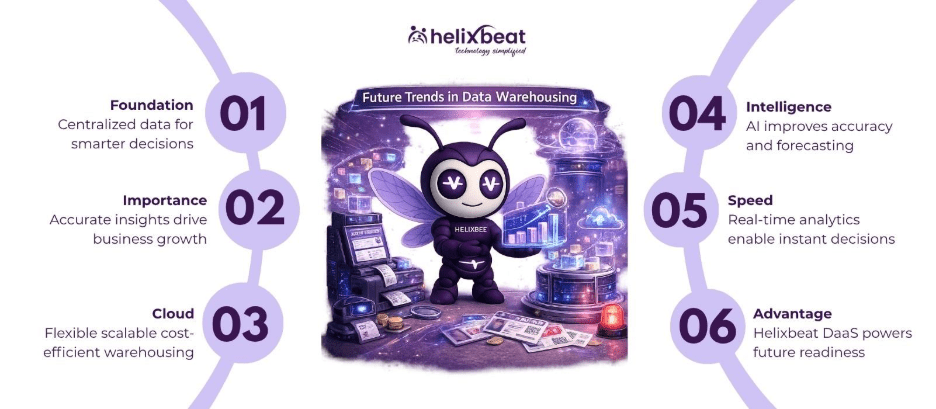
Table of Contents
What Actually is Data Warehousing?
Data warehousing is the process of collecting, storing, and managing large volumes of structured data to enable analysis and better business decision-making.
In simple terms, it acts as a centralized system where data from multiple sources is stored and organized. Businesses use data analytics and data warehousing together to uncover insights, identify trends, and improve operations.
From sales reports to customer behavior analysis, data warehouse and data warehousing play a critical role in turning raw data into actionable intelligence.
Why is Data Warehousing Important?
Data warehousing is essential because it helps businesses make faster, data-driven decisions using accurate and consolidated information.
Key Benefits
- Better Decision-Making- With organized data, teams can quickly analyze performance and make informed choices without guesswork.
- Improved Data Accuracy- A centralized system reduces inconsistencies, ensuring reliable insights across departments.
- Faster Reporting and Analytics- Modern data warehouse systems enable quick queries, saving time and improving productivity.
Learn how Helixbeat’s cloud data warehousing accelerates reporting and insights—Schedule a Demo.
How Does Data Warehousing Work?
Data warehousing works by collecting data from multiple sources, transforming it, and storing it in a structured format for analysis.
Step-by-Step Process
Step 1: Data Collection
Data is gathered from different sources like CRM systems, apps, and databases.
Step 2: Data Transformation (ETL/ELT)
The data is cleaned, formatted, and prepared for storage.
Step 3: Data Storage
Processed data is stored in a centralized data warehouse system for easy access.
Step 4: Data Analysis
Businesses use tools for data analytics and data warehousing to generate insights and reports.
Key Features / Components of Data Warehousing
| Feature | What It Does | Why It Matters |
| Data Integration | Combines data from multiple sources | Provides a unified view of business data |
| Data Storage | Stores large volumes of structured data | Enables scalability and long-term analysis |
| Query Processing | Allows fast data retrieval | Speeds up decision-making |
| Data Transformation | Cleans and organizes data | Ensures accuracy and consistency |
| Analytics Tools | Enables reporting and insights | Supports strategic planning |
Future Trends in Data Warehousing
As businesses handle growing volumes of data, traditional approaches are no longer enough. Modern solutions in data warehousing are evolving to provide smarter, faster, and more scalable systems. Here’s what you need to prepare for.
1. Cloud Data Warehousing
Cloud data warehousing is replacing traditional on-premises systems by offering flexible, secure, and cost-effective storage solutions.
Why it matters
- Scalable storage to match business growth
- Cost-effective infrastructure without heavy upfront investment
- Remote accessibility for distributed teams
By leveraging cloud data warehousing, businesses can dynamically scale resources based on demand, making it ideal for fast-growing organizations.
2. AI-Powered Data Warehousing
Artificial Intelligence is reshaping how organizations process and analyze data.
Key advantages
- Automated data cleaning for higher accuracy
- Predictive analytics for better forecasting
- Intelligent insights for faster decision-making
AI significantly enhances data warehousing and management by reducing manual work and enabling smarter, data-driven strategies.
3. Real-Time Analytics
Businesses now expect insights instantly. Real-time analytics allows organizations to make faster, more informed decisions.
What’s changing
- Instant data processing for up-to-date reporting
- Live dashboards for team visibility
- Faster decision-making for critical business operations
Industries like healthcare, finance, and e-commerce benefit most from real-time capabilities integrated with data warehousing.
4. Data Warehouse Automation
Automation in data warehousing is simplifying complex tasks such as ETL, data integration, and reporting.
Impact
- Reduced human error and manual effort
- Faster deployment and improved operational efficiency
- Consistent and accurate data for all departments
Automation allows organizations to focus more on strategic decision-making rather than repetitive tasks.
5. Integration with Warehouse Management Analytics
Modern systems are now combining warehouse management analytics with data warehousing to optimize operations and supply chain efficiency.
Why it matters
- Streamlined logistics and inventory tracking
- Better forecasting and resource planning
- Real-time operational insights
This integration is particularly valuable for businesses that rely on supply chain precision.
Integrate analytics with Helixbeat’s advanced data warehousing services.
Common Challenges Without Data Warehousing
Without an effective system, managing data becomes fragmented and inefficient.
Problems Businesses Face
- Data Silos: Departments operate independently, creating inconsistent insights.
- Slow Reporting: Manual data handling delays critical reporting.
- Inaccurate Insights: Unstructured or poorly managed data leads to errors affecting strategy.
These challenges reinforce the importance of strong data warehousing and management systems for businesses of all sizes.
How to Choose the Right Data Warehousing Solution
Selecting the right solution is key to achieving business agility and growth.
Consider these factors
- Scalability: Ensure your solution grows with your business needs.
- Integration Capabilities: Choose systems that connect seamlessly with existing tools.
- Real-Time Processing: Enable faster, informed decisions.
- Security and Compliance: Always protect sensitive data.
- Cost Efficiency: Achieve maximum value without unnecessary expenditure.
Helixbeat DaaS as the Right Solution
At Helixbeat, we understand that managing data isn’t just about storage—it’s about transforming it into actionable intelligence.
Our Data-as-a-Service (DaaS) solutions simplify data warehousing, making it smarter, faster, and ready for the future.
What We Solve
- Fragmented data systems slowing operations
- Delayed analytics and reporting processes
- Lack of real-time insights
Key Advantages
- Scalable cloud data warehousing solutions
- AI-driven analytics for smarter business decisions
- Seamless integration with existing systems
- Real-time data processing and reporting
Why We Stand Out
We don’t just provide tools—we deliver end-to-end data warehouse systems tailored to your business needs. Our expertise in data warehousing and management ensures businesses gain clarity, speed, and efficiency.
Wrapping Up
Data is no longer just an asset—it’s a competitive advantage. The future of data warehousing lies in cloud scalability, AI-driven intelligence, and real-time analytics.
Key Takeaways
- Cloud solutions redefine scalability and reduce infrastructure complexity
- AI-powered analytics make data smarter and more actionable
- Real-time insights are essential for faster, data-driven decisions
- Integration of warehouse management analytics optimizes operations and boosts efficiency
The sooner you adapt, the faster your business grows.
Schedule your consultation with Helixbeat today and modernize your data strategy.
FAQs
1. What is cloud data warehousing?
Cloud data warehousing is a modern approach where data is stored and managed on cloud platforms, offering scalability, flexibility, and cost efficiency.
2. Why is data warehousing important for businesses?
It helps businesses make faster decisions, improve data accuracy, and gain insights that drive growth and efficiency.
3. What are data warehouse systems?
Data warehouse systems are platforms that store and manage structured data, enabling analytics, reporting, and business intelligence.
4. What is the difference between data analytics and data warehousing?
Data warehousing focuses on storing and organizing data, while data analytics involves analyzing that data to extract meaningful insights.
5. Who should use data warehousing solutions?
Businesses of all sizes—especially those dealing with large data volumes—should use data warehousing to improve decision-making and efficiency.