


When businesses decide to hire MongoDB developer talent, the objective goes beyond basic database management—it focuses on faster performance, seamless scalability, and fewer system failures. Although optimized MongoDB architectures can significantly improve query speed, many applications fail to reach their full potential. This is where Helixbeat makes a meaningful difference.
At Helixbeat, we help organizations hire MongoDB developers who understand real-world performance challenges, not just database fundamentals. Whether you’re facing slow queries, rising infrastructure costs, or scaling pressures, our MongoDB experts deliver measurable performance improvements that directly support business growth.
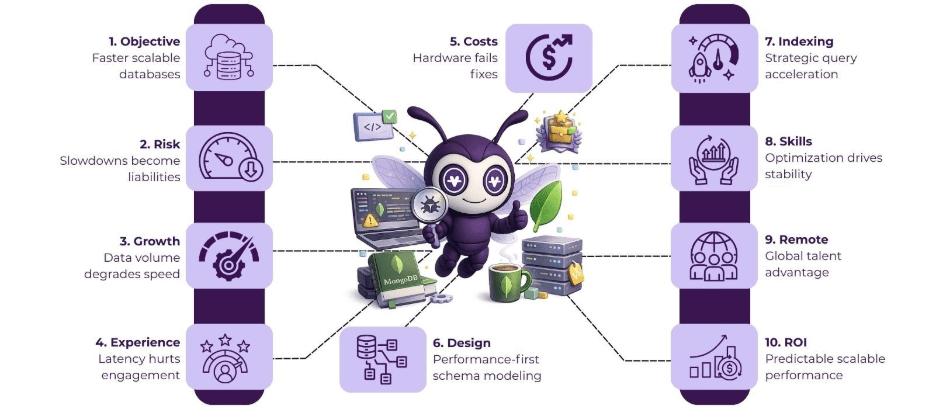
Table of Contents
Poor MongoDB Performance Becomes a Business Risk Over Time
What starts as a technical slowdown often evolves into a measurable business risk. When organizations delay the decision to hire MongoDB developer expertise, performance issues quietly compound across systems and teams.
Growing Data Volumes Quietly Degrade Performance
MongoDB is built to handle scale; however, poorly designed databases struggle as collections grow. Applications that begin with acceptable response times often slow down by 30–50% as data volumes multiply, and this degradation usually happens gradually until users finally feel the impact.
Customer Experience Suffers Before Teams Notice
Slow API responses, delayed dashboards, and inconsistent application behavior frustrate users. Even a one-second delay in response time can significantly reduce engagement and increase bounce rates, thereby turning database inefficiency into a direct revenue concern.
Infrastructure Costs Rise Without Solving Root Issues
Many teams attempt to fix performance problems by increasing server capacity. However, more than 70% of MongoDB performance issues stem from schema and query inefficiencies rather than hardware limits, so costs rise while performance shows minimal improvement.
Hiring MongoDB database developers early helps prevent performance debt from becoming a long-term business liability.
What Changes When You Hire MongoDB Developers with Performance Expertise
When businesses hire MongoDB developer talent with performance expertise, database optimization becomes proactive instead of reactive. This shift replaces uncertainty with predictable, scalable performance.
Performance-First Schema Design Replaces Trial-and-Error
Experienced MongoDB developers design schemas around access patterns rather than convenience. As a result, document bloat and unnecessary joins are reduced, improving read and write efficiency by up to 40% in high-traffic environments.
Indexing Becomes Strategic, Not Experimental
Instead of over-indexing or missing critical indexes, skilled developers analyze query frequency and usage patterns. Strategic indexing can reduce query execution time by 50–60%, particularly in read-heavy workloads.
Aggregation Pipelines Stop Becoming Bottlenecks
Complex aggregations often trigger MongoDB slowdowns. Performance-focused developers restructure pipelines, reduce memory usage, and remove unnecessary stages, enabling faster analytics without disrupting production workloads.
When you hire MongoDB developers with performance expertise, database behavior becomes predictable, scalable, and aligned with business goals. This is especially valuable for organizations that choose to Hire Remote MongoDB Developers to support distributed teams and global applications.
The MongoDB Developer Skills That Directly Impact Database Speed
Not all database expertise delivers the same results. Specific MongoDB developer skills have a direct and measurable effect on speed, stability, and scalability.
Schema Modeling That Supports Scale
Strong MongoDB developer skills include knowing when to embed, reference, or denormalize data. Poor modeling increases document size and query cost, whereas optimized schemas maintain consistent performance as data grows.
Query Optimization and Profiling
Skilled MongoDB developers actively profile slow queries and refine execution paths. Effective query tuning can reduce CPU usage by 25–35%, which improves overall application responsiveness.
Index Lifecycle Management
Indexes accelerate performance but consume memory. Developers who understand index lifecycle management remove unused indexes, lowering memory overhead while preserving query speed.
Replication, Sharding, and High Availability
Advanced MongoDB developer skills include designing fault-tolerant architectures. Proper sharding strategies support horizontal scaling and maintain performance even during sudden traffic spikes.
| Skill Area | Performance Impact | Business Benefit |
| Schema Optimization | Smaller documents, faster reads | Better UX |
| Index Strategy | Reduced query latency | Lower compute costs |
| Aggregation Tuning | Faster reporting | Real-time insights |
| Sharding Design | Horizontal scalability | High availability |
| Monitoring & Profiling | Early bottleneck detection | Reduced downtime |
These MongoDB developer skills directly influence database speed, operational stability, and long-term scalability—making the right hiring decision a strategic advantage, not just a technical one.
Why Hire Remote MongoDB Developers Without Compromising Quality
Accessing top MongoDB talent doesn’t have to be limited by location. Remote hiring gives businesses the flexibility to tap into highly specialized skills without sacrificing quality or results.
Access to Specialized Performance Talent
Local hiring often restricts access to niche MongoDB expertise. When you Hire Remote MongoDB Developers, you gain professionals who specialize in performance tuning, scaling, and high-availability systems.
Faster Hiring and Flexible Scaling
Remote hiring shortens recruitment cycles by 30–40%, enabling teams to respond quickly to performance challenges. This flexibility is especially valuable during rapid growth or platform migrations.
Cost Efficiency Without Performance Trade-Offs
Companies hiring remote MongoDB developers report cost savings of up to 35% while maintaining equal or better performance outcomes. Structured onboarding and clear accountability ensure results.
Hire Remote MongoDB Developers now and accelerate your database performance!
When Does It Make Sense to Hire MongoDB Database Developers Instead of Scaling Hardware
Infrastructure upgrades alone rarely solve deep-rooted performance issues. Knowing when to hire MongoDB database developers is key to sustainable performance and growth.
Performance Plateaus Despite Infrastructure Upgrades
If adding servers doesn’t improve response times, the bottleneck is architectural. Skilled MongoDB developers identify inefficiencies that hardware alone cannot fix.
Storage Costs Grow Faster Than Data
Inefficient schemas and unused indexes increase storage demands. Optimized databases can cut storage consumption by 20–30% without data loss.
Traffic Spikes Cause Unpredictable Failures
Applications that crash during peak loads often lack proper sharding and replication. Hire MongoDB Database Developers to design systems that scale proactively, avoiding reactive failures.
How Helixbeat Helps You Hire MongoDB Developers Who Deliver Measurable Results
Finding the right developer is critical. Helixbeat ensures that you hire MongoDB developer talent with proven performance expertise and real-world skills.
Performance-Centric Talent Vetting
Our MongoDB developers are tested on practical optimization scenarios, not just theory, ensuring outcome-driven expertise and reliable results.
Flexible Staff Augmentation Models
Helixbeat’s staff augmentation services let you hire MongoDB developers on-demand—full-time, part-time, or project-based—without long-term commitments.
Proven Performance Improvements
Organizations partnering with Helixbeat experience database efficiency gains of up to 35% within the first quarter through query optimization, indexing refinement, and schema redesign.
What ROI Looks Like After You Hire MongoDB Developers Strategically
Strategic hiring turns database optimization into a long-term competitive advantage. The right MongoDB developers deliver both measurable cost savings and performance improvements.
Reduced Infrastructure and Operational Costs
Optimized MongoDB systems need fewer compute resources, reducing cloud and infrastructure spend by 20–30% over time.
Faster Applications That Convert Better
Improved database performance accelerates page loads and API responses, directly boosting customer engagement and conversion rates.
Predictable Scaling Without Disruption
When MongoDB developers plan for growth, businesses avoid costly re-architecture later and achieve high availability during traffic spikes.
Wrapping Up
To Hire MongoDB developer talent is to invest in performance, scalability, and reliability. With Helixbeat, businesses gain experts who solve real performance challenges, reduce operational costs, and build databases designed to scale confidently with growth.
Start hiring your MongoDB experts with Helixbeat today!
FAQs
1. Why should I hire MongoDB developers instead of relying on general backend engineers?
MongoDB developers specialize in performance optimization, schema design, and scaling strategies that generalists often overlook.
2. How do MongoDB developer skills affect application speed?
Strong skills improve indexing, query execution, and data modeling, significantly reducing latency and system load.
3. Is hiring remote MongoDB developers suitable for enterprise systems?
Yes, when properly vetted and integrated, remote MongoDB developers deliver enterprise-grade performance improvements.
4. Can MongoDB developers reduce database-related downtime?
Yes, optimized replication, monitoring, and failover strategies greatly reduce downtime risks.
5. How soon can I see performance improvements after hiring MongoDB database developers?
Most performance gains appear within weeks, especially after query and index optimization.
6. What makes Helixbeat’s MongoDB developers different?
Helixbeat focuses on performance-driven outcomes, not just database maintenance.
7. Can MongoDB developers help future-proof database architecture?
Absolutely. Skilled MongoDB developers design systems that scale smoothly as data and user demand grow.