

Table of Contents
Introduction: Inside a Hospital Lobby – The Real Workflow Challenge
Step into a hospital lobby during peak hours in India, and you’ll immediately see the pressure points.
A patient walks in. The receptionist hands over a form. It takes 10–15 minutes to fill. Meanwhile, more patients and visitors enter. Tokens are issued. People are asked to wait. Some stand, some sit, many keep asking, “How long will it take?”
At the same time:
- Visitors enter without proper verification
- The lobby becomes crowded and noisy
- Staff struggle to track who is inside
- There is no clarity on waiting time or queue status
Now imagine this: a doctor suddenly asks for last month’s visitor data. The receptionist has no quick answer.
This is not a system—it’s a struggle.
And this is exactly where a Hospital Visitor Management System becomes critical.
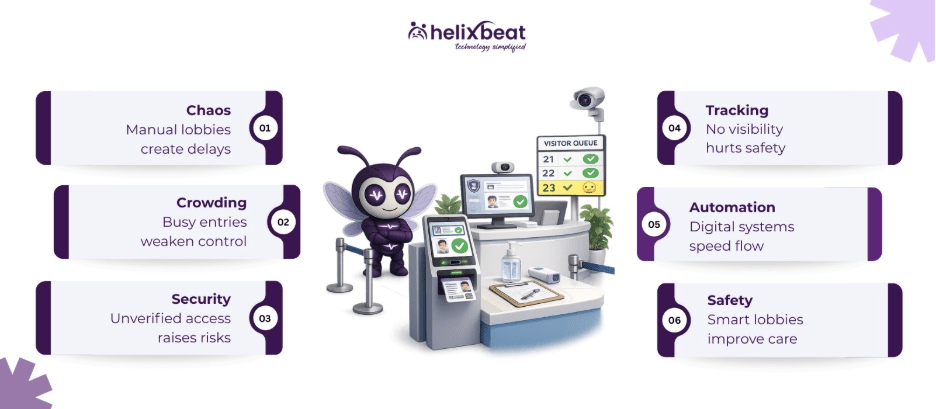
The Reality of Reception Workflow Challenges
1. Time-Consuming Registration Process
The first interaction itself creates delay:
- Manual form filling takes 10–15 minutes
- Patients struggle with details
- Staff must verify everything manually
A Hospital Visitor Management System replaces this with faster digital workflows.
2. No Queue Visibility for Patients
Patients sitting in the lobby don’t know:
- How many people are ahead
- How long they need to wait
This creates anxiety and constant pressure on staff.
Without proper patient and visitor tracking, managing queues becomes guesswork.
3. Overcrowding and Congestion
In Indian hospitals:
- One patient often brings multiple attendants
- Walk-ins and appointments mix together
This leads to:
- Congested waiting areas
- Increased stress
- Reduced efficiency
Poor hospital lobby security becomes visible when crowd control fails.
4. Unauthorized Entry and Security Risks
With no structured entry system:
- Anyone can walk in
- No proper verification happens
This creates serious risks, making advanced healthcare security solutions essential for hospitals.
5. No Real-Time Tracking of Visitors
Reception teams cannot answer simple questions:
- Who is inside the hospital right now?
- Who is visiting which patient?
Without structured patient and visitor tracking, hospitals operate without visibility.
6. Data Retrieval Becomes a Nightmare
Imagine a doctor asking:
- “Give me last month’s visitor details”
What happens?
- Staff checks registers
- Data is incomplete
- It takes hours or days
This clearly shows the importance of visitor tracking in hospitals for patient safety.
Why These Problems Are Increasing
Hospitals today are dealing with:
- Higher patient volumes
- Increased security expectations
- Need for better compliance
Manual systems simply cannot keep up.
They:
- Break during peak hours
- Depend too much on staff
- Offer no insights
This is why hospitals are moving toward structured healthcare access control systems.
The Core Issue: Lack of System, Not Lack of Staff
Many hospitals think:
“We need more staff”
But the real issue is:
No system to manage visitor flow
Without a Hospital Visitor Management System, even experienced teams struggle to maintain control.
The Bigger Risk: Safety Starts at the Lobby
Most hospitals focus on:
- Doctors
- Equipment
- Treatment quality
But ignore the first touchpoint—the lobby.
Weak hospital lobby security leads to:
- Unauthorized access
- Poor patient experience
- Operational inefficiencies
And in critical situations, this can directly impact patient safety.
Transition: From Problem to Solution
The challenges are clear:
- Long wait times
- No tracking
- Security gaps
- Data inefficiency
So the question is:
How can hospitals fix this without increasing workload?
The answer lies in adopting a Hospital Visitor Management System—a structured approach that transforms lobby operations completely.
The Solution – How Visitor Management Systems Transform Hospital Lobbies
From Chaos to Control: The Shift Hospitals Need
In Part 1, we saw the reality:
- Long queues
- No tracking
- Overcrowded lobbies
- Security risks
The solution is not adding more staff.
The solution is implementing a Hospital Visitor Management System that brings structure, visibility, and control into hospital lobbies.
How a Hospital Visitor Management System Solves Lobby Challenges
1. Instant and Contactless Check-In
Instead of manual forms:
- Visitors can pre-register
- Use QR codes at entry
- Complete check-in within seconds
This creates a digital visitor check-in system for healthcare facilities, reducing waiting time drastically.
A Hospital Visitor Management System ensures faster entry without compromising accuracy.
2. Real-Time Patient and Visitor Tracking
Hospitals gain complete visibility:
- Who entered
- Who exited
- Who is currently inside
This level of patient and visitor tracking allows hospitals to operate with control instead of assumptions.
It also highlights the importance of visitor tracking in hospitals for patient safety, especially during emergencies.
3. Stronger Hospital Lobby Security
With structured systems:
- Every visitor is verified
- Entry is recorded
- Unauthorized access is restricted
This directly improves hospital lobby security and reduces risks significantly.
Hospitals can also integrate advanced healthcare access control systems to restrict access to sensitive areas.
4. Controlled Access to Critical Zones
Not every visitor should access every area.
A Hospital Visitor Management System ensures:
- ICU access is limited
- Sensitive zones are protected
- Entry is approval-based
These are practical ways to reduce security risks in hospital lobbies.
5. Automated Notifications and Approvals
When a visitor arrives:
- The doctor or staff receives an instant alert
- Approval can be given digitally
This removes confusion and delays.
It also improves coordination between reception and medical staff.
6. Reduced Overcrowding and Better Flow
With structured entry:
- Visitor numbers can be controlled
- Waiting areas become less congested
This improves both safety and experience.
Such healthcare security solutions help hospitals manage high footfall effectively.
7. Centralized Dashboard and Instant Reports
A Hospital Visitor Management System provides:
- Real-time dashboards
- Daily, weekly, monthly reports
- Visitor analytics
Now, if a doctor asks:
“Give last month’s visitor data”
You can answer instantly.
This is how how visitor management systems improve hospital lobby security—by turning data into actionable insights.
The Rise of Contactless Hospital Experiences
Modern hospitals are moving toward:
- Touchless systems
- QR-based entry
- Automated workflows
These contactless visitor management solutions for hospitals improve hygiene, reduce delays, and enhance trust.
Real Impact on Hospital Operations
Implementing a Hospital Visitor Management System leads to measurable improvements:
Faster Entry
From 15 minutes → 3 Seconds
Better Data Accuracy
No manual errors or missing records
Improved Security
Stronger hospital lobby security
Enhanced Experience
Less waiting, less confusion
Choosing the Right System for 2026
Hospitals must think long-term.
Selecting the best visitor management system for hospitals in 2026 means choosing a solution that offers:
- Automation
- Real-time tracking
- Integration with existing systems
A scalable hospital visitor management system ensures future-ready operations.
From Manual Chaos to Smart Management
| Without System | With Hospital Visitor Management System |
| Manual forms | Digital check-in |
| Long queues | Fast entry |
| No tracking | Real-time tracking |
| Overcrowding | Controlled flow |
| Security risks | Verified access |
Enabling Smarter Hospital Lobbies
Solutions like VISTA are designed to handle real hospital challenges—from faster entry to real-time tracking—without increasing staff workload.
They bring structure to unorganized lobby environments and help hospitals move toward smarter operations.
Conclusion: Safety Starts Before Treatment
Hospital safety doesn’t begin in the ICU—it begins at the entrance.
A Hospital Visitor Management System ensures:
- Every visitor is verified
- Every movement is tracked
- Every decision is backed by data
In today’s healthcare environment, platforms like VISTA help hospitals strengthen healthcare security solutions, improve patient and visitor tracking, and build reliable hospital lobby security systems.
If your hospital is still managing visitors manually, it’s time to upgrade. With VISTA, you can implement a powerful Hospital Visitor Management System, reduce risks, improve efficiency, and deliver a seamless experience for every patient and visitor.
FAQs
1. What is a Hospital Visitor Management System?
A Hospital Visitor Management System is a digital solution that manages visitor entry, tracking, approvals, and security in hospital lobbies efficiently.
2. How does a hospital visitor management system improve security?
A hospital visitor management system improves hospital lobby security by verifying visitor identity, restricting unauthorized access, and enabling real-time patient and visitor tracking.
3. Why is visitor tracking important in hospitals?
The importance of visitor tracking in hospitals for patient safety lies in knowing who is inside the facility at all times, which helps during emergencies and improves accountability.
4. Can visitor management systems reduce waiting time in hospitals?
Yes, a Hospital Visitor Management System enables faster check-ins using QR codes and pre-registration, reducing waiting time significantly.
5. What features should the best visitor management system for hospitals in 2026 have?
The best visitor management system for hospitals in 2026 should include contactless entry, real-time dashboards, healthcare access control systems, and advanced reporting.