

Table of Contents
How Healthcare Payments Companies Handle HIPAA Compliance: Behind the Scenes
When you think about healthcare, your mind probably goes straight to doctors, hospitals, prescriptions, and lab reports. Payments? Not so much. Yet, every appointment, insurance claim, co-pay, and online bill payment involves something far more sensitive than just moneyit involves patient data.
That’s where healthcare payments companies step in.
Behind every smooth healthcare payment experience is a complex system quietly working to protect patient information, meet strict regulations, and still make payments fast and convenient. One of the biggest responsibilities these companies shoulder is HIPAA compliance—and it’s not just a checklist or a one-time setup. It’s an ongoing commitment.
Let’s pull back the curtain and see how healthcare payments companies actually handle HIPAA compliance behind the scenes.
First, What Does HIPAA Really Mean for Payments?
HIPAA (Health Insurance Portability and Accountability Act) isn’t just about medical records. It covers Protected Health Information (PHI)—any data that can identify a patient and is linked to their healthcare services.
In the payments world, PHI can show up in places like:
- Patient names linked to billing details
- Insurance information
- Treatment-related billing codes
- Payment histories tied to medical services
For healthcare payments companies, this means that financial data and healthcare data often overlap. Also that overlap must be handled with extreme care.
HIPAA requires companies to:
- Protect patient data from breaches
- Limit who can access sensitive information
- Track how data is used and shared
- Respond quickly if something goes wrong
Sounds intense? It is. And that’s exactly why HIPAA compliance is baked into every layer of modern healthcare payment systems.
Technical Safeguards: How Data Is Protected at the Core
Data Encryption and Tokenization
One of the first questions providers ask is: What happens if data is intercepted?
The short answer: it’s useless to attackers.
Healthcare payments companies rely on multiple layers of encryption and tokenization to ensure data is unreadable if intercepted.
Point-to-Point Encryption (P2PE)
With Point-to-Point Encryption, payment data is encrypted immediately at the point of interaction—the moment a card is swiped, dipped, or entered online.
- Data is encrypted before it ever touches a network
- It stays encrypted while traveling
- It can only be decrypted inside the secure payment gateway
Even if someone intercepts it mid-transfer, they can’t read it.
Tokenization
Instead of storing actual card numbers, healthcare payments companies use tokenization.
- The real card number is replaced with a random, meaningless token
- That token can be stored safely for future use
- Recurring payments, partial payments, and refunds work without exposing real card data
This dramatically reduces both HIPAA and PCI compliance scope, because sensitive card data simply isn’t stored.
Encryption at Rest and in Transit
Whether data is:
- Sitting on a server
- Moving between systems
- Being processed in real time
It’s encrypted using secure protocols like TLS.
Patients never see this—but it’s one of the biggest reasons digital healthcare payments are safer today than ever before.
Business Associate Agreements (BAAs): The Legal Backbone
Because healthcare payments companies handle PHI, they are classified as Business Associates under HIPAA.
That means they must sign Business Associate Agreements (BAAs) with healthcare providers (the Covered Entities).
These agreements:
- Legally bind the payment company to HIPAA rules
- Define how PHI can be used and protected
- Establish breach notification responsibilities
Subcontractor Management
Behind the scenes, payment platforms often rely on third parties—cloud providers, data centers, or analytics tools.
HIPAA doesn’t stop at the first vendor.
Healthcare payments companies must ensure:
- BAAs are in place with every subcontractor
- Security standards are enforced throughout the chain
No weak links allowed.
Liability Allocation
BAAs also clearly define who is responsible if something goes wrong.
If PHI is breached within the payment system, the payment processor is directly accountable—not the provider alone. That’s why platforms like PayNova take compliance so seriously.
Administrative Safeguards: Controlling Access and Monitoring Activity
HIPAA’s “minimum necessary” rule means people should only see the data they absolutely need.
Healthcare payments companies enforce this through strict administrative controls.
Role-Based Access Control (RBAC)
Access is assigned based on job roles.
For example:
- A customer service agent may see only the last four digits of a card
- A billing manager may see transaction details, but not full PHI
- No one sees unencrypted data unless it’s essential
This limits exposure and reduces risk.
Audit Trails
Every interaction with sensitive data is logged.
Audit trails track:
- Who accessed data
- When they accessed it
- Where they accessed it from
These logs are critical for:
- HIPAA audits
- Internal reviews
- Incident investigations
Automatic Logoff
To prevent unauthorized access:
- Systems automatically log users out after inactivity
- Shared workstations are protected
- Idle sessions don’t become security gaps
Small controls like this make a big difference.
Physical Security and Infrastructure
Even in a cloud-first world, physical security still matters.
Healthcare payments companies rely on secure infrastructure that meets both HIPAA and PCI standards.
Secure Data Infrastructure
- Data is stored in secure, access-controlled environments
- Often in hardened, compliant cloud “vaults”
- Physical access is tightly restricted and monitored
Disaster Recovery and Business Continuity
HIPAA also requires data availability.
Behind the scenes, payment platforms maintain:
- Regular, encrypted backups
- Redundant systems
- Disaster recovery plans
Whether it’s a ransomware attack, hardware failure, or natural disaster, patient information must be recoverable—and protected.
Training and Compliance Audits: Tackling the Human Factor
Technology alone can’t prevent breaches. Human error is still the leading cause.
That’s why healthcare payments companies invest heavily in training and audits.
Staff Training
Employees undergo regular education on:
- HIPAA requirements
- Secure handling of PHI
- Phishing and social engineering awareness
- Incident reporting procedures
Compliance becomes part of daily work—not just an annual reminder.
Risk Assessments and Audits
Regular audits and third-party risk assessments help identify:
- Vulnerabilities in systems
- Process gaps
- Areas needing stronger controls
These audits aren’t about checking boxes—they’re about staying ahead of threats.
Balancing Compliance with Patient Convenience
Here’s the hardest part: patients want payments to be easy, fast, and digital.
HIPAA demands security. Patients demand simplicity.
Healthcare payments companies solve this by:
- Running security silently in the background
- Automating compliance-heavy processes
- Designing systems that protect data without slowing users down
When done right, patients never feel the complexity—and that’s the goal.
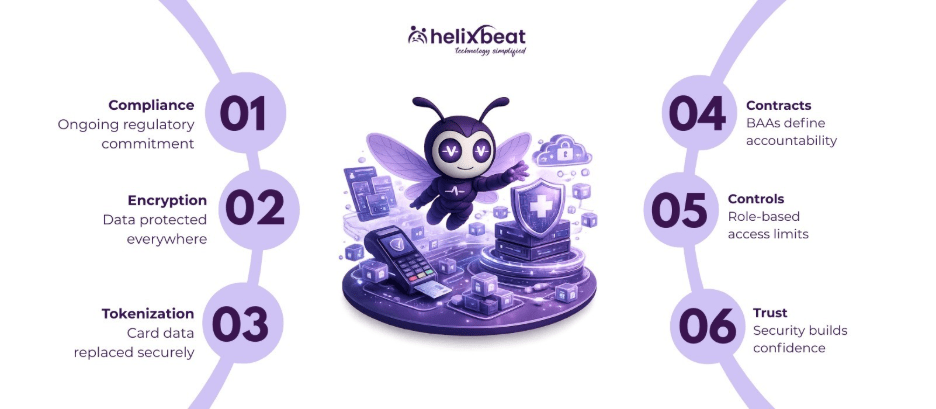
Summary: Key Components of HIPAA-Compliant Healthcare Payments
| Feature | Description |
| Tokenization | Replaces real card numbers with useless tokens |
| P2PE | Encrypts data instantly at the point of payment |
| BAA | Legal contract governing PHI handling |
| Audit Trails | Logs all access for accountability |
| RBAC | Restricts data access by role |
Together, these safeguards allow healthcare payments companies to protect patient data while delivering the seamless digital experience modern healthcare demands.
Why This Matters for Providers and Patients
For providers:
- Fewer compliance worries
- Reduced breach risk
- Stronger trust with patients
For patients:
- Safer payments
- Clear billing
- Confidence their data is protected
For companies like PayNova, HIPAA compliance isn’t just about regulation—it’s about responsibility.
Final Thoughts: Trust Is Built Where Patients Never Look
Most patients will never think about tokenization, encryption keys, or audit logs when paying a medical bill.
And that’s exactly how it should be.
Because when healthcare payments companies do their job right, security stays invisible—while trust stays visible.
HIPAA compliance isn’t a burden. It’s the quiet promise that every payment respects patient privacy, every time.
FAQs
1. Why is HIPAA compliance important for healthcare payments companies?
It protects patient payment data and PHI, reduces breach risk, and ensures healthcare payments companies meet legal and security requirements.
2. How do healthcare payments companies protect patient data?
They use encryption, point-to-point encryption (P2PE), and tokenization to keep payment and patient data secure.
3. What is a Business Associate Agreement (BAA)?
A BAA is a required contract that defines how healthcare payments companies handle and protect patient data under HIPAA.
4. How is access to sensitive data controlled?
Through role-based access, audit logs, and automatic logoff to limit exposure and track activity.
5. Can healthcare payments companies support digital and recurring payments securely?
Yes. Tokenization and secure gateways allow safe online, recurring, and contactless payments while staying HIPAA compliant.