

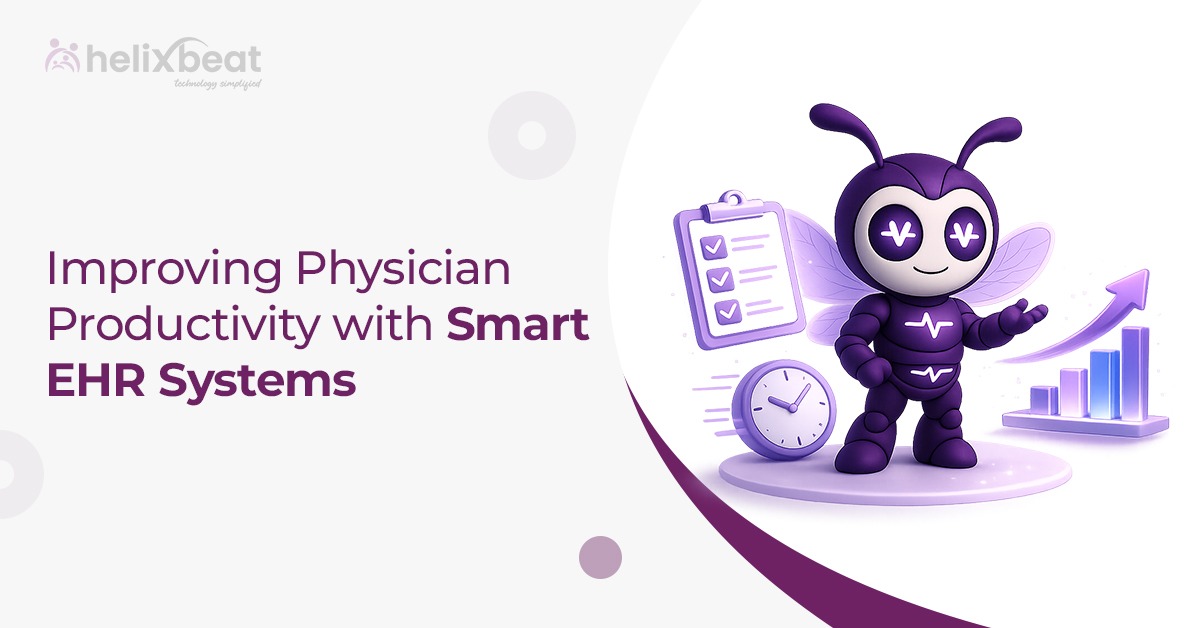
Physicians today face an increasing demand for efficiency, accurate documentation, and high-quality patient care. While traditional workflows often leave doctors overwhelmed with administrative tasks, smart EHR systems simplify documentation, facilitate seamless communication, and deliver real-time clinical data. These advanced platforms support physicians with intuitive interfaces, automated workflows, and actionable insights.
By leveraging smart EHR systems, healthcare providers can maximize their productivity, reduce burnout, and focus on delivering personalized care while staying compliant with regulatory standards.
Table of Contents
Understanding Physician Productivity Challenges
Physician productivity is influenced by several factors, many of which relate to inefficient workflows, administrative burden, and fragmented technology. Some common challenges include:
- Excessive Documentation: Physicians often spend up to half of their workday on EHR data entry.
- Fragmented Systems: Multiple software platforms lead to redundant tasks and inconsistent data.
- Communication Gaps: Delayed messaging between departments and staff slows clinical workflows.
- Limited Analytics Access: Physicians need timely insights to make informed decisions, which older systems may not provide.
- Regulatory Compliance: Tracking and maintaining accurate records for HIPAA and other regulations consumes additional time.
Smart EHR systems address these challenges by integrating multiple functions into a single platform, reducing redundant tasks, and providing real-time actionable data.
Key Features of Smart EHR Systems That Boost Productivity
Smart EHR systems offer tools and features designed to improve workflow efficiency and physician performance. Key features include:
| Feature | Benefit for Physicians |
| Intuitive User Interface | Simplifies navigation, reduces learning curve, and speeds up documentation. |
| Voice Recognition & Dictation | Allows hands-free documentation, saving time compared to manual typing. |
| Automated Templates | Pre-populated templates for common visits reduce repetitive entry tasks. |
| Clinical Decision Support | Provides alerts, reminders, and guidelines for evidence-based care. |
| Interoperability | Enables secure data exchange across systems, labs, and pharmacies. |
| Patient Portal Integration | Streamlines communication and appointment scheduling. |
| Analytics & Reporting | Offers insights into patient trends and operational efficiency. |
These features collectively reduce administrative burden, enhance patient care, and allow physicians to spend more time on direct clinical activities.
How Smart EHR Systems Improve Workflow Efficiency?
Workflow optimization is one of the most significant ways EHR systems increase physician productivity. Key strategies include:
- Task Automation: Automated reminders, lab orders, and follow-ups reduce repetitive tasks.
- Streamlined Charting: Integrated templates and quick-access patient data minimize the time spent on documentation.
- Role-Based Access: Staff can manage non-clinical tasks like scheduling or billing, letting physicians focus on patient care.
- Real-Time Collaboration: Teams can view and update patient information simultaneously, which reduces delays.
Studies indicate that physicians using advanced EHR platforms report a 20-30% reduction in administrative time, directly translating to higher productivity.
Enhancing Patient Management Through EHR Systems
Efficient patient management is important to improving physician workflow. Smart EHR systems contribute by:
- Centralizing Patient Records: All historical data, lab results, and medications are accessible in one location.
- Predictive Scheduling: Systems can optimize appointment timings based on patient complexity and physician availability.
- Remote Access & Telehealth Integration: Allows physicians to consult and monitor patients virtually, which reduces office congestion.
- Patient Engagement Tools: Automated reminders, test result notifications, and online forms streamline communication.
By improving patient management, physicians can reduce wait times, minimize missed appointments, and increase overall practice efficiency.
Data-Driven Decision Making
Smart EHR systems empower physicians with actionable data to improve clinical outcomes and productivity. This includes:
- Clinical Analytics: Identify patient risk factors, trends, and treatment efficacy.
- Performance Metrics: Track individual physician workflow and patient throughput.
- Population Health Insights: Support preventive care and chronic disease management by analyzing aggregated patient data.
Data-driven decision-making helps physicians prioritize cases, anticipate patient needs, and reduce unnecessary interventions.
Reducing Burnout Through Smart EHR Systems
Physician burnout is often linked to excessive administrative work and inefficient systems. Smart EHR systems reduce stress by:
- Minimizing repetitive data entry through automation.
- Providing clear dashboards that highlight pending tasks and priorities.
- Integrating seamlessly with existing hospital management systems.
- Supporting collaborative care, where responsibilities can be shared across staff.
According to research published in the Journal of the American Medical Informatics Association, optimized EHR systems improve physician satisfaction and reduce cognitive load, directly impacting productivity.
Security and Compliance Benefits
Maintaining compliance with regulations like HIPAA is important for physician productivity. Smart EHR systems support this by:
- Encrypting patient data to prevent breaches.
- Tracking access logs for accountability.
- Automating regulatory reporting and audits.
- Providing secure communication channels between staff and patients.
These capabilities reduce the time physicians spend on compliance tasks.
Training and Onboarding Efficiency
A common challenge with EHR adoption is the learning curve. Smart EHR systems facilitate productivity through:
- Role-Based Training Modules: Tailored instruction for physicians, nurses, and administrative staff.
- Simulation Environments: Practice workflows without affecting live patient data.
- Continuous Support: Access to tutorials, help centers, and vendor support reduces downtime.
Efficient training accelerates system adoption and ensures physicians can use all features effectively from day one.
Cost-Benefit Analysis of Smart EHR Systems
While initial investment in a smart EHR system can be significant, the productivity gains often outweigh costs. Consider the following comparison:
| Cost Factor | Traditional System | Smart EHR System |
| Administrative Hours/Week | 20+ | 10-12 |
| Documentation Errors | Moderate | Low |
| Patient Throughput | 15-20/day | 20-25/day |
| Physician Satisfaction | Moderate | High |
| ROI (3 Years) | 50% | 150% |
Reduced administrative workload, fewer errors, and improved patient flow lead to measurable returns on investment while supporting sustainable physician performance.
Case Studies: Smart EHR Systems in Action
Case Study 1: Multi-Specialty Clinic
A 10-physician clinic implemented a smart EHR platform with voice recognition and automated templates. Within six months:
- Documentation time decreased by 35%.
- Patient throughput increased by 18%.
- Physician satisfaction scores improved by 25%.
Case Study 2: Hospital Network
A regional hospital network adopted an interoperable EHR system across five facilities. Benefits observed:
- Real-time patient data sharing reduced diagnostic delays by 22%.
- Administrative staff hours reduced by 15 hours per week.
- Telehealth adoption grew by 40%, improving access for rural patients.
These examples demonstrate how targeted EHR features directly enhance productivity and patient outcomes.
How FHIR Servers Enhance EHR Productivity?
FHIR servers play a key role in modern EHR systems by standardizing the exchange of healthcare data. These servers provide a structured, consistent way to share patient information across multiple platforms, devices, and applications.
Key benefits of integrating a FHIR server into EHR systems include:
- Seamless Data Exchange: FHIR servers allow real-time sharing of patient records, lab results, and imaging reports between hospitals, labs, and specialist clinics.
- Reduced Administrative Burden: Physicians can access comprehensive patient data in a single interface without manually coordinating with multiple departments.
- Support for Telehealth and Mobile Access: FHIR servers enable secure data retrieval on mobile devices, so physicians can review patient information anytime, anywhere.
- Enhanced Clinical Decision Making: With standardized data formats, EHR systems can leverage predictive analytics, alerts, and clinical decision support more effectively.
Unlock Seamless Healthcare Interoperability with FUSION
Built by Helixbeat, FHIR server FUSION leverages RESTful APIs for plug-and-play integration, enabling seamless connectivity with legacy systems, modern EHRs, and emerging tools like wearable devices and telehealth platforms. This isn’t just compliance, it’s acceleration.
FUSION goes deeper by embedding critical medical coding systems like SNOMED CT, LOINC, and ICD-10 directly into its architecture. This built-in intelligence maintains data consistency and accuracy, transforming raw information into actionable insights ready for clinical decisions, regulatory reporting, and advanced analytics. No more wrestling with mismatched formats or manual mappings: FUSION handles the heavy lifting!
Organizations using FUSION report up to 70% faster data sharing, slashing referral delays by 60% and reducing redundant tests by 25%. That’s not hype; it’s a measurable impact, with providers saving $1,000–$2,000 per patient annually through streamlined claims and operations.
How FUSION Ignites Data-Driven Innovation?
The true magic of healthcare FHIR lies in its potential to fuel innovation, and FUSION amplifies this like no other. As a reliable engine for standardized data flows, it powers downstream applications that were once out of reach.
Take chronic disease management, for example. By integrating real-time data from wearables and EHRs, FUSION enables continuous monitoring and proactive interventions, potentially cutting hospital readmissions and optimizing therapies. Or, imagine a telehealth consultation that’s instantly better because the doctor has the patient’s full history right there. FUSION makes that happen, giving virtual care a huge boost in quality and making patients much happier.
Certified Excellence
FUSION is officially certified by the Drummond Group for FHIR-based interoperability, validating its conformance with healthcare data exchange standards HL7, FHIR, and SMART on FHIR. This certification demonstrates that FUSION meets industry-recognized benchmarks for secure, standardized data exchange — giving you the confidence to integrate seamlessly across systems.
What This Means for You?
In a complex healthcare ecosystem, FUSION simplifies connectivity and safeguards data integrity. With enterprise-grade uptime (99.99%) and secure authentication powered by OAuth2 and encrypted endpoints, it supports trusted, real-time collaboration between hospitals, labs, and payers.
Whether you’re mapping USCDI elements for regulatory reporting or automating data flows for public-health initiatives, FUSION keeps you compliant with current interoperability frameworks and ready for future mandates.
Final Thoughts
Smart EHR systems transform physician productivity by reducing administrative tasks, optimizing workflows, and providing actionable clinical insights. By embracing automation, analytics, and a FHIR server like FUSION, healthcare providers can focus on delivering high-quality patient care while maintaining operational efficiency. Get in touch with Helixbeat today!
FAQs
1. How do EHR systems reduce physician workload?
By automating documentation, integrating clinical data, and streamlining workflows, EHR systems reduce repetitive tasks.
2. Can smart EHR systems improve patient care?
Yes, they provide actionable insights, real-time patient data, and predictive analytics to support better clinical decisions.
3. How does EHR integration benefit multi-specialty clinics?
Integration allows seamless data sharing across departments, reducing delays and improving collaboration.
4. Are EHR systems compliant with healthcare regulations?
Modern EHR platforms include encryption, audit logs, and secure communication, which align with HIPAA standards.
5. What is the ROI of implementing a smart EHR system?
ROI is achieved through reduced administrative hours, increased patient throughput, fewer errors, and improved physician satisfaction.