


Healthcare organizations rely heavily on a hospital information system to manage clinical, administrative, and financial operations. From patient registration and billing to laboratory reporting and pharmacy management, a hospital information system acts as the digital backbone of modern healthcare delivery.
However, many hospitals still operate with fragmented IT ecosystems. Laboratory systems, radiology systems, electronic health records (EHRs), and billing platforms often communicate through outdated or custom-built interfaces. This creates data silos, delays in information exchange, and operational inefficiencies.
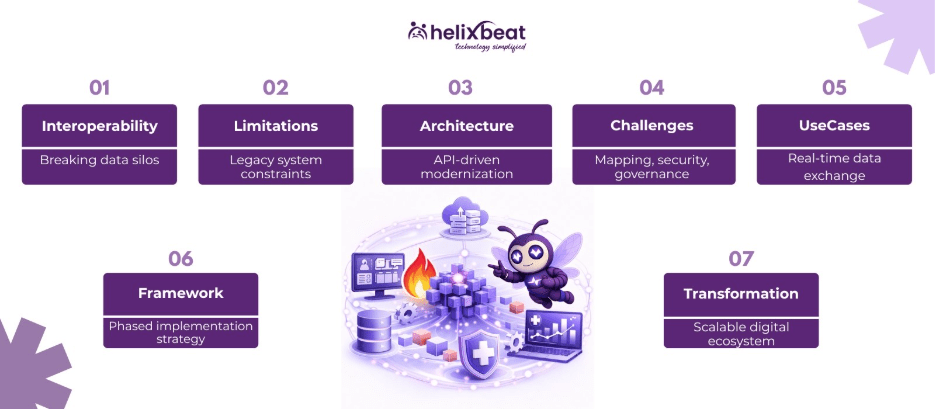
FHIR (Fast Healthcare Interoperability Resources) has emerged as a modern standard designed to solve these interoperability challenges. By integrating FHIR with a hospital information system, healthcare providers can enable standardized, API-driven data exchange across systems.
This blog explores:
- Why FHIR integration is necessary for a hospital information system
- The major challenges hospitals face
- Real-world use cases
- A practical implementation framework
Table of Contents
Why Traditional Hospital Information System Architectures Struggle with Interoperability?
Most legacy hospital information system platforms were built using monolithic architectures. Over time, hospitals added new modules such as:
- Laboratory Information Systems (LIS)
- Radiology Information Systems (RIS)
- Pharmacy systems
- Patient portals
- Billing and revenue cycle tools
Integration between these systems often relied on:
- HL7 v2 messaging
- Custom APIs
- Point-to-point interfaces
- Manual data exports
While HL7 v2 messaging is widely adopted, it was not originally designed for modern web-based interoperability. It depends on message-based transmission rather than flexible API queries. As hospitals expand digital services, this architecture becomes difficult to scale.
Common interoperability problems include:
- Duplicate patient records
- Delayed clinical updates
- Complex interface maintenance
- High integration costs
- Limited real-time data exchange
This is where FHIR changes the architecture of a hospital information system.
What FHIR Brings to a Hospital Information System?
FHIR is built on modern web technologies like RESTful APIs, JSON, and XML. Instead of transmitting entire messages, FHIR uses modular “resources” such as:
- Patient
- Observation
- Medication
- Encounter
- Practitioner
- Appointment
Each resource represents a specific healthcare concept and can be accessed individually through secure APIs.
When integrated properly, FHIR allows a hospital information system to:
- Retrieve patient records in real time
- Share lab results instantly
- Connect mobile apps to core hospital databases
- Support external data exchange
- Improve interoperability across departments
Rather than relying on rigid data pipelines, FHIR introduces flexible and scalable communication.
Key Challenges in Integrating FHIR with a Hospital Information System
Despite its advantages, FHIR integration is not simple. Hospitals face technical, operational, and governance-related challenges.
1. Legacy System Limitations
Many hospital information system platforms were not designed with APIs in mind. Their internal databases use proprietary schemas. Therefore, mapping these schemas to FHIR resources requires careful planning.
2. Data Mapping Complexity
Mapping involves translating existing database fields into FHIR resource structures. For example:
- HIS patient table → FHIR Patient resource
- Lab results table → FHIR Observation resource
- Admission records → FHIR Encounter resource
This process requires:
- Field-by-field mapping
- Terminology alignment
- Standard code adoption
Without accurate mapping, data inconsistencies can occur.
3. Terminology Standardization
FHIR encourages the use of standardized terminologies such as:
- SNOMED CT
- LOINC
- ICD codes
If a hospital information system uses local codes, conversion layers must be implemented.
4. Security and Access Control
FHIR APIs expose structured data. Therefore, strong security controls must be implemented, including:
- OAuth 2.0 authentication
- Role-based access
- Audit logging
- Encryption in transit
Hence, hospitals must align integration with regional healthcare data protection laws.
5. Change Management
Integration impacts workflows. Therefore, clinical teams may need training. IT teams must adapt to API-based monitoring instead of traditional interface engines.
Technology alone does not drive transformation. Operational readiness matters equally.
Real-World Use Cases of FHIR in a Hospital Information System
Integrating FHIR into a hospital information system creates measurable operational benefits.
1. Real-Time Patient Data Exchange
When a patient moves from emergency to inpatient care, FHIR APIs allow real-time sharing of:
- Clinical notes
- Diagnostic results
- Medication history
This reduces delays in treatment decisions.
2. HIS and EHR Interoperability
Some hospitals use separate EHR platforms alongside their core hospital information system. By enabling two-way data flow, FHIR minimizes transcription errors and manual data overhead.
3. Laboratory and Radiology Integration
Instead of batch file transfers, FHIR APIs allow immediate access to:
- Lab results
- Imaging reports
- Diagnostic observations
As a result, clinicians can view updated results without waiting for system synchronization.
4. Patient Portals and Mobile Applications
FHIR supports patient-facing apps that connect securely to a hospital information system. Therefore, patients can:
- View records
- Download prescriptions
- Schedule appointments
- Access lab reports
This improves engagement and transparency.
5. Clinical Decision Support Systems
FHIR allows external decision-support tools to retrieve patient data securely. These systems can analyze:
- Risk scores
- Medication interactions
- Chronic disease markers
As a result, the hospital information system becomes part of a broader intelligent ecosystem.
6. Multi-Hospital Network Integration
Healthcare networks with multiple facilities benefit from centralized FHIR APIs. A patient visiting different branches can have synchronized records across locations.
Implementation Framework: Integrating FHIR with a Hospital Information System
Below is a practical, phased framework for FHIR integration.
Phase 1: System Assessment and Readiness Evaluation
Start by analyzing:
- Current HIS architecture
- Existing integrations
- Database schema structure
- Terminology usage
- Security framework
Conduct a gap analysis comparing current capabilities with FHIR requirements.
Phase 2: Define Integration Scope
Avoid attempting a full transformation at once.
Start with high-impact modules such as:
- Patient registration
- Laboratory reporting
- Appointment scheduling
Define:
- Target FHIR resources
- Integration endpoints
- User groups
Phase 3: Data Mapping Strategy
Create detailed mapping documentation:
| HIS Database Field | FHIR Resource | FHIR Field |
| patient_id | Patient | identifier |
| first_name | Patient | name.given |
| last_name | Patient | name.family |
| admission_date | Encounter | period.start |
| discharge_date | Encounter | period.end |
Mapping must include:
- Terminology transformation
- Code standardization
- Validation rules
This is the most technical stage of integration.
Phase 4: API Layer Development
Deploy a FHIR middleware, like AERIS, that:
- Connects to the HIS database
- Translates data into FHIR format
- Exposes RESTful endpoints
Architecture may include:
- API gateway
- Authentication server
- Logging system
- Data transformation engine
This creates a bridge between legacy systems and modern applications.
Phase 5: Security and Compliance Configuration
Implement:
- OAuth 2.0
- Role-based permissions
- TLS encryption
- Audit tracking
Access policies must align with national healthcare regulations.
Security should be embedded into the architecture rather than added later.
Phase 6: Testing and Validation
Testing must cover:
- Data accuracy
- Performance under load
- API response times
- Access control enforcement
Simulate real-world workflows such as:
- Patient admission
- Lab result update
- Prescription changes
Clinical validation is important before production deployment.
Measuring Success After FHIR Integration
Integration should deliver measurable outcomes. Hospitals can track:
- Reduction in duplicate records
- Faster patient registration time
- Reduced manual data entry
- Improved reporting speed
- API uptime performance
Performance dashboards can monitor interoperability health continuously.
Future of the Hospital Information System with FHIR
As healthcare shifts toward digital ecosystems, a hospital information system must move beyond isolated modules.
Future directions include:
- AI-driven analytics using standardized FHIR data
- Remote monitoring integration
- Population health dashboards
- National health information exchanges
- Smart hospital infrastructure
FHIR acts as the foundational interoperability layer supporting these innovations.
Hospitals that modernize early gain architectural flexibility.
How AERIS Revolutionizes Interoperability with FHIR APIs?
Imagine a world where your healthcare organization thrives with seamless, secure, and real-time data exchange. That’s the power of AERIS by Helixbeat, a game-changing platform designed to transform how you connect, collaborate, and care. Built for healthcare providers, clinics, hospitals, and cross-industry partners like pharmacies and insurers, AERIS harnesses FHIR APIs to break down data silos, streamline operations, and put patient care first.
Ready to cut delays by 50%, double your ROI, and empower your team with instant access to critical data? Let’s dive into why AERIS is the solution you’ve been waiting for.
Why AERIS is Your Key to Healthcare Innovation?
At Helixbeat, we know your challenges: fragmented systems, delayed data, and rising costs. AERIS is here to change that, offering a personalized, scalable, and secure platform that fits your unique needs. Whether you’re a small clinic or a sprawling hospital network, AERIS delivers measurable results that elevate patient outcomes and boost your bottom line.
- 20+ Years of Expertise: Our team brings decades of healthcare IT experience to ensure AERIS works for you.
- 50+ IT Professionals: A dedicated crew powers AERIS, delivering unmatched support and innovation.
- 1,000+ Customers: Join a thriving community of healthcare leaders already transforming with AERIS.
- 10,000+ Projects Completed: Proven success across countless integrations and workflows.
- 95% Returning Customers: Our clients trust AERIS to deliver, time and time again.
Providers adopting AERIS report faster diagnoses, lower costs, and improved outcomes, positioning it as the go-to tool for future-proof HIE.
Your Benefits, Amplified
- 50% Fewer Delays: Real-time data means critical information is always at your fingertips, turning hours into seconds.
- 100% Faster ROI: Plug-and-play integration maximizes your investment without expensive system replacements.
- 30% Cost Savings, 90% Fewer Errors: Automation eliminates waste, saving resources and ensuring accuracy.
Final Thoughts
A modern hospital information system cannot function effectively in isolation. Interoperability has become a strategic priority as hospitals expand digital services, adopt analytics, and participate in health information exchanges.
Integrating FHIR into a hospital information system transforms static, siloed architectures into dynamic, API-driven ecosystems. While challenges exist, particularly around legacy infrastructure, data mapping, and governance, a structured implementation framework makes modernization achievable. As a powerful interoperability solution, AERIS helps organizations seamlessly connect HIS, EHR, and other platforms.
Ready to transform your hospital information system with FHIR? Book a demo with Helixbeat and take your hospital IT to the next level!
FAQs
1. What is the role of FHIR in a hospital information system?
FHIR enables standardized API-based communication between internal and external healthcare systems, improving interoperability and real-time data exchange.
2. Can legacy hospital information system platforms support FHIR?
Yes. Legacy systems can integrate FHIR using middleware layers or API gateways without replacing the core system.
3. Is FHIR replacing HL7?
FHIR builds on earlier standards but uses modern web technologies. Many hospitals operate hybrid environments.
4. How long does FHIR integration take?
Timeline depends on system complexity, data mapping requirements, and deployment scope.
5. Does FHIR improve patient care?
By enabling faster and more accurate data sharing, FHIR supports better clinical decision-making.