

Cloud computing data warehousing has become a cornerstone for US businesses aiming to transform data into actionable insights. As organizations move from on-premises systems to cloud-based infrastructure, they can seamlessly integrate multiple data sources, scale storage and compute resources independently, and enable real-time analytics.
These cloud computing data warehousing platforms streamline workflows while reducing infrastructure overhead, making analytics faster, more cost-effective, and highly efficient. Choosing the right cloud data warehouse and orchestration solution allows US businesses to optimize operations and improve decision-making.
In this guide, we will explore the leading cloud computing data warehousing tools, highlight their distinctive features, and demonstrate how Helixbeat orchestrates data warehousing and analytics to enable seamless business intelligence.
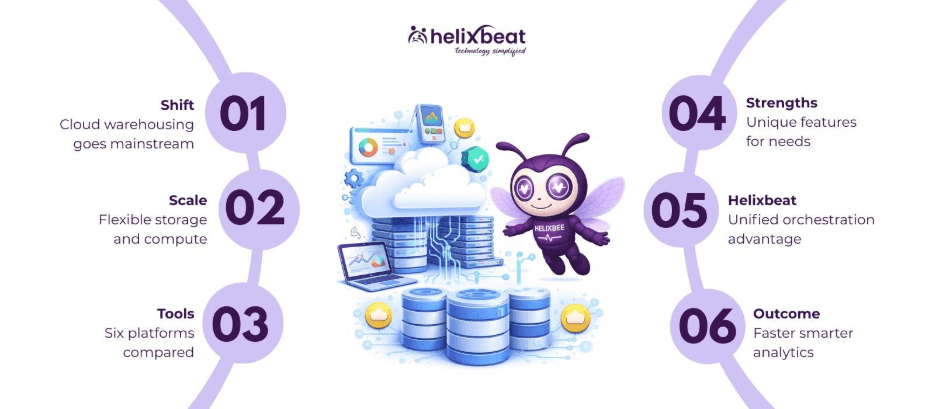
Table of Contents
Top 6 Cloud Computing Data Warehousing Tools
| Tool Name | Best For | Key Strength |
| Amazon Redshift | AWS-centric enterprises | High-performance parallel processing |
| Snowflake | Multi-cloud strategies | Decoupled storage and compute |
| Google BigQuery | Serverless analytics | Pay-per-query, fully managed |
| Microsoft Azure Synapse | Microsoft ecosystem | Integrated analytics with Azure tools |
| Oracle Autonomous Data Warehouse | Oracle users | Autonomous management & tuning |
| IBM Db2 Warehouse on Cloud | Hybrid workloads | AI-enabled analytics |
1. Amazon Redshift – Scalable Performance for Enterprise Analytics
Amazon Redshift is a top choice for US businesses requiring high-performance cloud computing data warehousing fully integrated within the AWS ecosystem.
Architecture and Query Processing
Redshift uses Massively Parallel Processing (MPP) to distribute queries across multiple nodes, delivering fast performance even for petabyte-scale datasets. Its Redshift Spectrum feature enables querying data stored directly in Amazon S3, eliminating time-consuming ETL processes. For businesses looking to optimize both data warehouse and cloud computing operations, Redshift provides a robust and reliable platform.
Integrations and Workflow Efficiency
Redshift integrates seamlessly with AWS Glue, QuickSight, and Lambda, streamlining automated data workflows. Enterprises that prioritize analytics performance and already leverage AWS cloud computing information tools benefit from faster reporting, simplified storage, and reduced operational overhead.
2. Snowflake – Simplifying Cloud Data Warehousing Across Clouds
Snowflake transforms cloud computing data warehousing by abstracting infrastructure complexity and enabling multi-cloud flexibility.
Decoupled Storage and Compute
By separating storage from compute, Snowflake allows organizations to scale resources independently. This ensures both cost efficiency and performance optimization for fluctuating workloads. Snowflake’s model aligns with storage as a service in cloud computing, giving businesses flexibility in managing compute and storage independently.
Multi-Cloud Compatibility and Collaboration
Running on AWS, Azure, and Google Cloud, Snowflake is ideal for hybrid and multi-cloud strategies. Its secure data-sharing capabilities allow seamless collaboration between internal teams and external partners. As one of the leading cloud data storage companies, Snowflake ensures reliable, accessible, and scalable data solutions.
3. Google BigQuery – Serverless Analytics with Simplicity
BigQuery provides a fully serverless cloud computing data warehousing experience, simplifying setup and scaling for analytics teams.
Serverless Architecture for Flexibility
Users do not need to provision infrastructure. BigQuery’s pay-per-query model minimizes idle resource costs, making analytics operations predictable and cost-effective. This is particularly beneficial for organizations exploring data warehouse and cloud computing integration without heavy upfront investments.
Machine Learning Integration
BigQuery ML allows teams to run machine learning models directly on warehouse data. This integration accelerates advanced analytics and supports in-database ML workflows, reducing the need to move data externally. US businesses aiming to harness AI and analytics together benefit significantly from this approach.
4. Microsoft Azure Synapse – Integrated Cloud Analytics for Enterprises
Azure Synapse combines cloud computing data warehousing with big data analytics into a single platform, providing a complete solution for modern enterprises.
Unified Data Analytics
Azure Synapse integrates data warehousing, data lakes, and analytics services, enabling users to query structured and unstructured data simultaneously. This unified approach supports faster decision-making and optimized reporting, especially for companies leveraging cloud computing information across departments.
Integration with Microsoft Tools
Organizations benefit from native integration with Power BI, Azure Machine Learning, and other Microsoft solutions, facilitating end-to-end cloud computing data warehousing workflows. Businesses seeking scalable solutions from cloud data storage companies can deploy Azure Synapse to consolidate their analytics ecosystem.
5. Oracle Autonomous Data Warehouse – Autonomous Management at Scale
Oracle ADW delivers self-driving, self-securing, and self-repairing cloud computing data warehousing solutions, allowing enterprises to streamline analytics at scale.
Autonomous Features for Efficiency
ADW automates patching, scaling, and performance tuning, reducing administrative overhead while maintaining consistent efficiency for large datasets. Its autonomous architecture ensures optimal resource utilization without manual intervention.
Optimized Analytics Workflows
With integrated analytics and machine learning capabilities, Oracle ADW accelerates deployment of advanced analytics. Enterprises already invested in Oracle ecosystems benefit from seamless integration, enabling reliable data warehouse and cloud computing operations.
6. IBM Db2 Warehouse on Cloud – AI-Enabled Hybrid Analytics
IBM Db2 Warehouse combines traditional and AI-driven analytics within a hybrid cloud computing information environment.
AI-Driven Analytics
Db2 Warehouse supports predictive modeling and in-database machine learning, enabling enterprises to generate actionable insights directly within the cloud warehouse. This empowers data teams to implement faster and more precise decision-making processes.
Hybrid Cloud Flexibility
Organizations can run workloads across private and public clouds, integrating seamlessly with existing infrastructure. This flexibility supports multi-cloud strategies, enhancing scalability and data accessibility.
Helixbeat – Leading Cloud Data Warehousing Orchestration
Helixbeat redefines cloud computing data warehousing by orchestrating analytics beyond Redshift, Snowflake, BigQuery, Azure Synapse, Oracle ADW, and IBM Db2 Cloud.
How Helixbeat Outperforms Other Tools
Unlike traditional cloud data storage companies or storage as a service in cloud computing, Helixbeat centralizes data pipelines, monitors workflows, and automates orchestration across multiple warehouses. Users gain full visibility into query performance, resource utilization, and workflow efficiency, delivering faster and more reliable analytics.
Enhanced Performance and Workflow Efficiency
Helixbeat allows US businesses to unify their data warehouse and cloud computing operations into a single interface. Teams can schedule jobs, track analytics, and optimize resource allocation in real time, outperforming standalone cloud computing data warehousing tools in operational efficiency.
Tangible Benefits for Users
Helixbeat empowers US businesses to unify their data warehouse and cloud computing operations into a single interface. Teams can schedule jobs, track analytics, optimize resource allocation, and generate actionable insights in real time. Businesses benefit from seamless multi-cloud integration and maximized operational efficiency.
Costs, Performance, and Ideal Use Cases- Comparison
| Tool | Cost Model | Performance Fit | Best For |
| Amazon Redshift | Reserved + On demand | High | AWS-centric enterprises |
| Google BigQuery | On demand | Excellent for burst workloads | Variable analytics & ML |
| Snowflake | Usage-based | Balanced for varying workloads | Multi-cloud strategies |
| Azure Synapse | Consumption + Reserved | High for Microsoft users | Enterprises leveraging Azure stack |
| Oracle ADW | Usage + Licensing | High | Large-scale enterprise analytics |
| IBM Db2 Cloud | Subscription | Balanced | Hybrid cloud deployments & AI analytics |
| Helixbeat | Subscription + Usage-based | Superior orchestration & workflow optimization | Enterprises needing multi-cloud orchestration, real-time analytics, and seamless scalability |
Wrapping Up
Top cloud computing data warehousing tools provide scalable, flexible, and powerful analytics solutions, but Helixbeat delivers unmatched orchestration and operational efficiency. With centralizing workflows and optimizing resource usage, businesses can streamline analytics, accelerate insights, and fully leverage multi-cloud environments for data-driven decision-making.
Key Takeaways
- Evaluate tools based on enterprise cloud strategy and workloads.
- Use Helixbeat to orchestrate and monitor workflows efficiently.
- Optimize storage and compute for cost-effectiveness.
- Enable multi-cloud or hybrid flexibility for scalability.
Ready to orchestrate your cloud computing data warehousing for maximum efficiency?
Start with Helixbeat today and transform your analytics workflow!
FAQs
1. What is cloud computing data warehousing?
A centralized cloud-based system for storing, managing, and analyzing data, enabling real-time analytics and scalable storage.
2. How does cloud data warehousing differ from traditional warehouses?
Traditional warehouses are on-premises, fixed-capacity systems, while cloud warehouses offer flexible, scalable, and managed solutions.
3. Which cloud data warehouse is best for multi-cloud strategies?
Helixbeat enables seamless orchestration across AWS, Azure, and Google Cloud, making it ideal for managing hybrid or multi-cloud data warehouse deployments efficiently.
4. Can Helixbeat improve analytics orchestration?
Yes. Helixbeat streamlines pipelines, monitors workflows, and optimizes query execution across cloud warehouses.
5. Are cloud data warehouses secure?
Leading platforms offer encryption, access controls, and compliance certifications to protect sensitive data.
6. How can businesses control costs in cloud data warehousing?
Monitoring workloads, optimizing storage and compute, and leveraging orchestration dashboards like Helixbeat ensures cost efficiency.
7. Is migration between cloud warehouses straightforward?
Migration requires planning, mapping, and orchestration. Helixbeat simplifies transitions by providing centralized workflow management and monitoring.