


Even the most innovative digital products fail when users encounter bugs, crashes, or slow performance. Studies show that fixing a defect after release can cost up to 30 times more than resolving it during the development phase. Missed defects, last-minute fixes, and poor test coverage often lead to delayed launches, negative reviews, and loss of customer trust – problems many businesses recognize only after the product is live.
Partnering with a software testing firm solves this problem by bringing structured quality checks, unbiased validation, and deep testing expertise into the development process. Instead of reacting to issues post-launch, businesses can identify risks early, ensure stability, and deliver a reliable product that meets user expectations and supports long-term success.
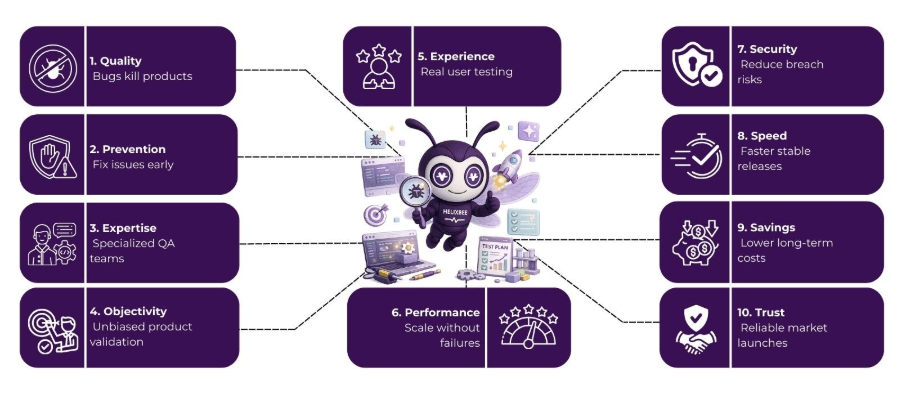
Table of Contents
What Is a Software Testing Firm?
A software testing firm is a specialized service provider focused exclusively on evaluating software quality, performance, security, and usability across different environments. These firms use proven testing frameworks, industry-standard tools, and experienced QA professionals to identify defects early and ensure the product meets business and user expectations. Their role goes beyond finding bugs—they help validate stability, scalability, and overall product readiness before release.
Unlike in-house testing, which often operates under time, resource, or familiarity constraints, a software testing firm offers independent and unbiased quality assessment. External testers approach the product with a fresh user perspective, follow structured testing methodologies, and can scale efforts quickly based on project needs, without adding long-term hiring or infrastructure costs.
Key Challenges Businesses Face Without a Testing Partner
Without a dedicated testing partner, product development CEOs often face hidden risks that silently undermine product quality and market success.
- Late-stage defect discovery – Issues are identified close to launch, forcing rushed fixes, release delays, or compromised features.
- Poor user experience – Undetected usability and compatibility issues lead to app crashes, negative reviews, and early user drop-offs.
- Increased security exposure – Lack of specialized security testing leaves products vulnerable to data breaches and compliance failures.
- Slower product scalability – Performance issues surface only after user growth, causing downtime during peak demand.
- Higher long-term costs – Post-release bug fixes, support escalations, and rework consume more budget than preventive testing.
For CEOs responsible for product vision and delivery, these challenges translate into lost trust, slower growth, and unnecessary business risk that structured testing partnerships are designed to prevent.
How a Software Testing Firm Directly Contributes to Product Success
Partnering with the right software testing experts directly influences how stable, secure, and scalable a product becomes in real-world usage.
1. Prevents Costly Failures Through Early Risk Detection
- Early validation by software testing service provider companies: These providers identify functional gaps, logic errors, and integration risks early in the development cycle—long before they impact release timelines.
- Predictable delivery for leadership teams: Partnering with experienced software QA companies reduces last-minute fixes and gives CEOs better control over cost, scope, and launch dates.
2. Improves Real-World User Experience, Not Just Feature Completion
- Independent user-focused testing: Unlike internal teams, software testing outsourcing companies evaluate the product from a real user’s perspective across devices, browsers, and operating systems.
- Higher adoption and retention: Addressing usability and flow issues early helps deliver smoother experiences that directly improve customer satisfaction and reduce churn.
3. Ensures Performance and Scalability Before Growth Hits
- Performance tested under real conditions: The best software testing companies conduct load, stress, and scalability testing to validate how products perform during peak usage.
- Growth-ready product foundations: This proactive approach ensures the product can scale smoothly as user demand and business operations expand.
4. Strengthens Security and Compliance Readiness
- Structured security testing by specialized QA firms: Leading software QA companies identify vulnerabilities, data exposure risks, and compliance gaps early in development.
- Reduced business and reputational risk: Early security validation protects products from breaches, penalties, and trust erosion that can stall growth.
5. Accelerates Time-to-Market Without Compromising Quality
- Faster releases with testing automation: Software testing service provider companies use automation and parallel testing to support frequent, stable releases.
- Speed with confidence: By working with reliable software testing outsourcing companies, product teams move faster without sacrificing product stability or quality.
For product development CEOs, working with experienced software testing service provider companies is no longer optional – it’s a strategic move to deliver high-quality products, faster and with lower business risk.
Types of Testing Services a Software Testing Firm Offers
A software testing firm offers a range of specialized testing services designed to ensure product stability, performance, and long-term reliability.
- Functional Testing – Ensures every feature works as expected according to business and user requirements.
- Automation Testing – Uses automated scripts to speed up repetitive tests and support faster, more reliable releases.
- Performance Testing – Evaluates application speed, stability, and scalability under different load conditions.
- Security Testing – Identifies vulnerabilities, data risks, and potential threats to protect the application from breaches.
- Regression Testing – Confirms that new updates or changes do not break existing functionalities.
Together, these testing services help businesses launch confident, user-ready products while minimizing risk and post-release issues.
Cost vs Value: Is Partnering with a Testing Firm Worth It?
| Aspect | Without a Testing Firm | With a Software Testing Firm | Business Value Created |
| Cost of Defects | Bugs are fixed after release, increasing rework and support costs | Issues are identified early in development | Lower overall development and maintenance costs |
| Time-to-Market | Delays due to last-minute fixes and rework | Parallel testing enables faster, stable releases | Faster launches without quality trade-offs |
| Resource Utilization | Internal teams are stretched across development and testing | Dedicated QA experts handle testing | Development teams stay focused on core features |
| Risk Exposure | Higher risk of security, performance, and usability failures | Structured testing reduces product risks | Improved brand trust and customer confidence |
| Long-Term ROI | Higher post-launch support and churn | Fewer defects and smoother user experience | Stronger retention and sustainable product growth |
Why Most Software Developers Choose Helixbeat for Testing
Most software developers choose Helixbeat because it understands real development challenges. Instead of testing only at the final stage, Helixbeat works closely with development teams from early phases to catch issues sooner. This helps developers avoid last-minute rework, reduce release delays, and ship more stable products with confidence.
Another reason developers trust Helixbeat is its clear communication and practical testing approach. The team focuses on real-world usage, performance, and security – not just finding bugs, but explaining them in a way that’s easy to fix.
This makes collaboration smoother, saves time, and helps teams deliver better software without unnecessary complexity. Book a free consultation now.
FAQ
1. Do startups need a software testing firm, or is it only for large companies?
Software testing firms are valuable for startups as well as large enterprises, especially when resources are limited and early product quality directly impacts user trust and growth.
2. Can a testing firm work with agile or fast-paced development teams?
Yes, most testing firms are experienced in agile and DevOps environments and can align testing cycles with frequent updates and short release sprints.
3. Will outsourcing testing slow down the development process?
When done correctly, outsourcing testing actually speeds up development by running testing in parallel and reducing rework caused by late-stage issues.
4. How do testing firms handle product knowledge without being part of the internal team?
Testing firms follow structured onboarding, documentation, and test case design to quickly understand product flows while maintaining an independent testing perspective.
5. Is it possible to scale testing efforts up or down during a project?
Yes, one of the key advantages of working with a testing firm is flexibility – testing efforts can be scaled based on release timelines, feature complexity, or business needs.