

Interoperability in healthcare has been a game-changer, making it much easier for different systems to share patient information. In this blog, we’ll discuss how Electronic Medical Records (EMRs), Health Information Exchanges (HIEs), and the Fast Healthcare Interoperability Resources (FHIR) standard collaborate to achieve interoperability in healthcare. By understanding these components, stakeholders can appreciate the mechanisms that support seamless data sharing in modern medicine.
Table of Contents
What Is Interoperability in Healthcare?
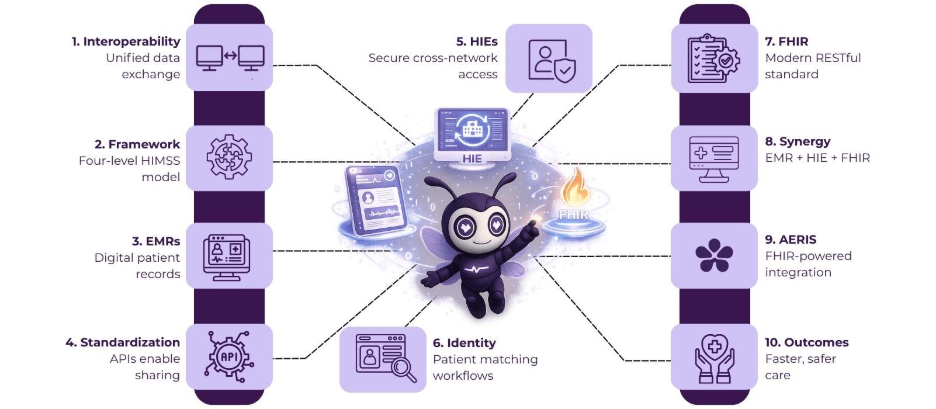
Interoperability in healthcare refers to the ability of diverse information systems and devices to exchange, interpret, and use data cohesively. The Healthcare Information and Management Systems Society (HIMSS) says it covers four main areas: foundational, structural, semantic, and organizational. Foundational interoperability handles basic data transfer, structural defines formats, semantic focuses on meaning, and organizational addresses policies and workflows.
This framework becomes vital as healthcare generates vast amounts of data daily. Without interoperability in healthcare, silos form, which hinders access to complete patient histories.
The Role of Electronic Medical Records (EMRs) in Interoperability
In simple terms, an EMR is a digital record that tracks a patient’s medical history and treatments within one practice. Unlike Electronic Health Records (EHRs), which span multiple organizations, EMRs focus on one provider. However, by turning physical records into digital files, EMRs create the groundwork needed for interoperability in healthcare.
In practice, EMRs contribute to interoperability through APIs and data mapping. Providers use EMRs to input data consistently, which supports accurate exchanges. Regulations like the 21st Century Cures Act in the U.S. mandate open interfaces, pushing EMR vendors toward standardization.
Health Information Exchanges (HIEs): Bridging the Gaps
HIEs serve as secure networks where authorized providers can easily swap health information across regions or even the entire country. Types of HIEs include directed exchanges for point-to-point transfers, query-based for on-demand retrieval, and consumer-mediated for patient-controlled sharing.
HIEs function by using master patient indexes to match identities and consent management to protect privacy. When a physician queries an HIE, it pulls relevant data from connected EMRs, making it easy to see a comprehensive health history. This process reduces errors and supports coordinated care, like in emergencies where immediate access to allergies or past procedures proves lifesaving.
FHIR: The Standard Powering Modern Data Exchange
FHIR, developed by Health Level Seven International (HL7), stands as a next-generation standard for healthcare data exchange. FHIR uses RESTful APIs, similar to those in web applications, to make interoperability in healthcare more accessible and scalable.
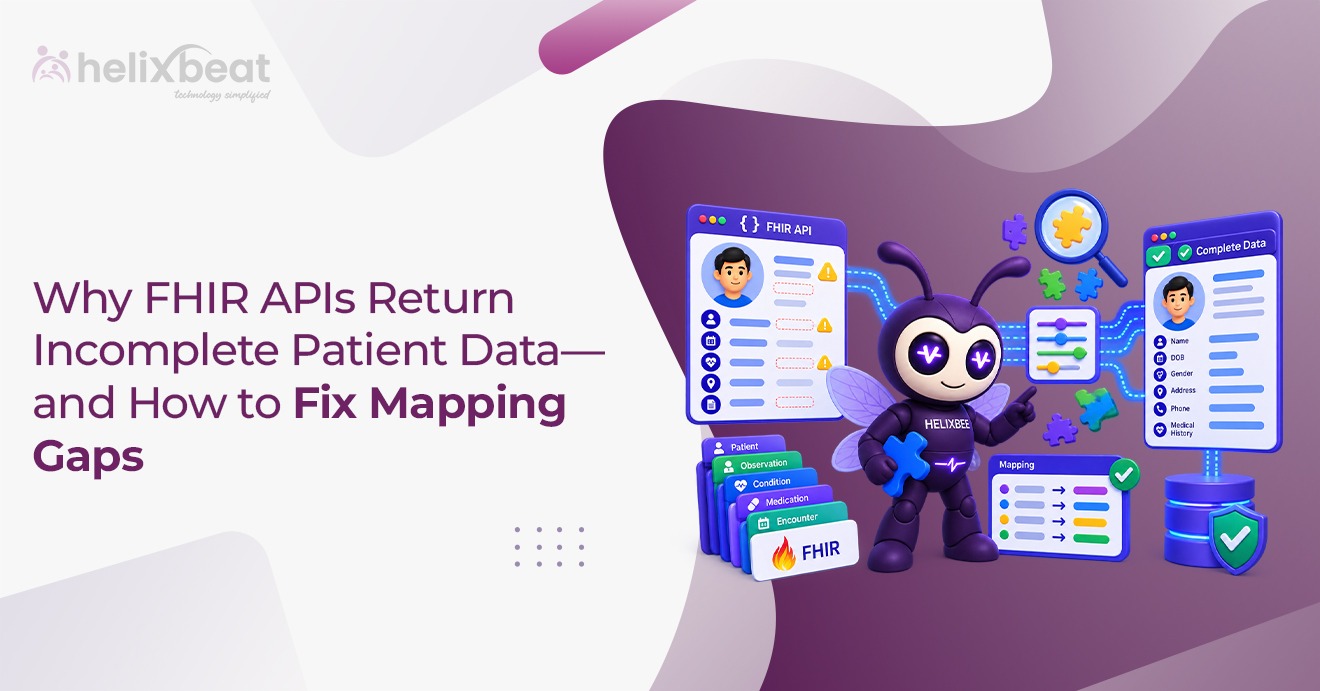
FHIR resources represent discrete data elements, like Patient, Observation, or MedicationRequest, in JSON or XML formats. Because you can search and update these resources via HTTP, you have the flexibility to manage them exactly how you need. Unlike older standards such as HL7 v2 or CDA, FHIR emphasizes modularity and developer-friendliness, attracting tech companies like Google and Apple to integrate it into their health apps.
FHIR is essentially the glue of healthcare data sharing, giving everyone a common language to use. It permits systems to query specific data without full record transfers, reducing bandwidth and enhancing security.
How EMRs, HIEs, and FHIR Collaborate for Seamless Interoperability?
The synergy among EMRs, HIEs, and FHIR drives interoperability in healthcare. EMRs generate and store the raw data, serving as the source. HIEs provide the infrastructure for routing this data across organizations. FHIR standardizes the format and methods for these exchanges, making integration straightforward.
In the U.S., the Trusted Exchange Framework and Common Agreement (TEFCA) promote this integration by establishing Qualified Health Information Networks (QHINs) that leverage FHIR.
How AERIS Bridges EMRs, HIEs, and Others with FHIR?
AERIS acts as the bridge between diverse healthcare systems, bringing together EMRs, HIEs, and other legacy systems into one cohesive platform. AERIS uses a FHIR-based API framework to exchange discrete data elements, like patient records, lab results, and medication orders, accurately and in real time. This integration eliminates data silos, enables coordinated care, and empowers healthcare professionals to make timely, informed decisions.
Why Healthcare Providers Choose AERIS?
Designed to address modern healthcare challenges, AERIS tackles data overload, system fragmentation, and workflow inefficiencies. Its flexible architecture makes it suitable for small clinics, multi-hospital networks, and everything in between.
- Seamless Integration: Connects with existing EMRs, EHRs, and legacy systems without interrupting daily operations.
- Real-Time Collaboration: Enables instant data exchange between doctors, labs, pharmacies, and insurers for faster, informed decision-making.
- Data Accuracy: Automated workflows and validation tools minimize manual errors, improving the quality of clinical insights.
- Scalability: Grows with your organization as patient volumes and data complexity increase.
- Security & Compliance: Built with HIPAA-grade encryption and audit controls to keep sensitive information protected at all times.
The AERIS Impact in Numbers
| Metric | Before AERIS | After AERIS | Outcome |
| Data Exchange Speed | Frequent delays | 50% faster exchange | Quicker care delivery |
| ROI | Slow recovery | Doubled ROI rate | Greater financial performance |
| Operational Costs | High redundancies | Reduced by 30% | Efficient resource use |
| Manual Errors | Up to 20% | Decreased by 90% | Accurate patient records |
Your Benefits, Amplified
- 50% Fewer Delays: Real-time data means critical information is always at your fingertips, turning hours into seconds.
- 100% Faster ROI: Plug-and-play integration maximizes your investment without expensive system replacements.
- 30% Cost Savings, 90% Fewer Errors: Automation eliminates waste, saving resources and ensuring accuracy.
How AERIS Works: Your 3-Step Path to Success?
- Connect Seamlessly: Integrate AERIS effortlessly into your existing systems, from legacy EHRs to modern platforms.
- Share Securely: Activate real-time data exchange with HIPAA-compliant encryption. Watch your teams and partners collaborate effortlessly.
- Optimize and Grow: Because AERIS evolves with your organization, it’s set up to help you succeed for the long haul.
Final Thoughts
Interoperability in healthcare is a necessity for delivering coordinated, timely, and high-quality patient care. By integrating EMRs, HIEs, and other systems via FHIR, healthcare organizations can break down data silos, accelerate clinical decision-making, and provide seamless care across multiple touchpoints. Platforms like AERIS demonstrate how real-time data integration and standardized exchanges transform healthcare operations, reduce errors, and enhance patient outcomes.
Experience the power of AERIS and transform the way your organization manages health information. Schedule a call with Helixbeat today!
FAQs
1. What is interoperability in healthcare?
Interoperability in healthcare is the ability of different systems and devices to exchange, interpret, and use patient data cohesively.
2. What is FHIR and why is it important?
FHIR (Fast Healthcare Interoperability Resources) is a standard that enables modular, real-time, and scalable healthcare data exchange using RESTful APIs.
3. How do EMRs, HIEs, and FHIR work together?
EMRs generate data, HIEs route it securely across organizations, and FHIR standardizes the format and methods for exchange, enabling seamless interoperability.
4. What makes AERIS suitable for healthcare providers?
AERIS integrates EMRs and HIEs using FHIR APIs to eliminate data silos, improve workflow efficiency, reduce errors, and provide real-time collaboration.
5. Can AERIS integrate with existing legacy systems?
Yes, AERIS connects with existing EHRs, EMRs, and other legacy platforms without disrupting daily operations.