

Starting a business in 2026 is exciting—but let’s be honest, it’s also overwhelming. Between building your product, hiring the right team, and keeping investors happy, one question keeps coming up for every founder:
“How much should I actually spend on marketing?”
If you’ve been Googling online marketing costs for startups, you’re not alone. Marketing is no longer optional—it’s survival. But understanding where your money goes, what’s reasonable, and how to save without killing growth is what truly matters.
In this blog, we’ll break down online marketing costs for startups in 2026, what influences them, real budget ranges, and how startups can spend smarter with the right marketing partner—like Helixbeat.
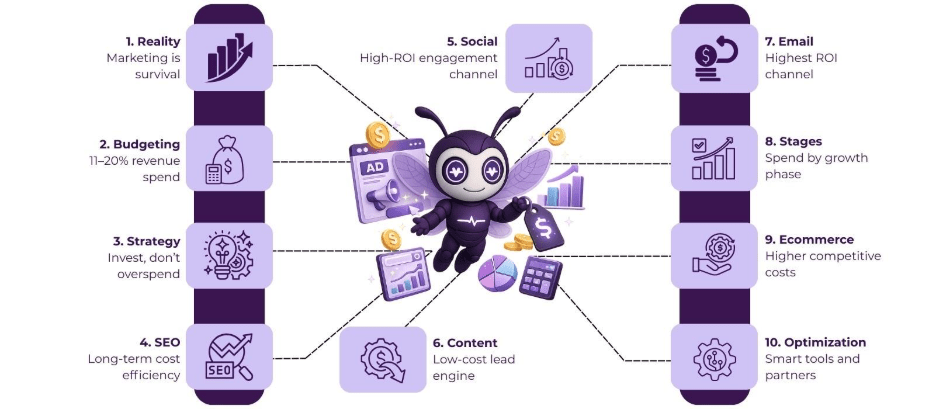
Table of Contents
The Reality of Marketing Costs for Startups in 2026
The digital marketing landscape has evolved dramatically, and so have the costs associated with it. According to recent industry data, startups typically allocate between 11-20% of their gross revenue to marketing activities. However, online marketing costs for startups can vary significantly based on industry, target audience, and growth objectives.
In 2026, digital competition is fiercer than ever. AI-driven ads, short attention spans, and crowded platforms mean that startups must spend strategically, not blindly.
The truth is, online marketing costs for startups are not just expenses anymore—they’re investments that directly impact customer acquisition, brand trust, and long-term scalability.
But the mistake many startups make?
Either overspending too early or under-investing and staying invisible.
Understanding your real marketing costs for startups helps you:
- Avoid wasting money on the wrong channels
- Plan sustainable growth
- Measure ROI instead of guessing
Breaking Down Marketing and Advertising Costs for a Startup Business
Understanding where your marketing dollars go is essential for budget planning. Here’s a detailed breakdown of typical marketing and advertising costs for a startup business:
1. Search Engine Optimization (SEO) and SEM
SEO remains one of the most cost-effective long-term strategies for startups. The typical monthly investment for SEO services ranges from $1,500 to $5,000, depending on competitiveness and scope. Studies show that SEO leads have a 14.6% close rate compared to just 1.7% for outbound leads, making it a worthwhile investment.
Search Engine Marketing (SEM) through platforms like Google Ads requires a different approach. Startups typically spend between $1,000 and $10,000 monthly on paid search campaigns. The average cost-per-click (CPC) across all industries in 2026 is approximately $2.69, though this can range from $1 to over $50 depending on your industry and keywords.
2. Social Media Marketing
Social media has become an indispensable channel for startups. The marketing budget for ecommerce startup businesses often allocates 20-30% specifically to social media efforts. Monthly costs typically include:
- Content creation and management: $1,000 – $3,000
- Paid social advertising: $1,500 – $5,000
- Community management: $500 – $2,000
- Influencer partnerships: $500 – $5,000+
According to recent research, businesses make an average of $5.78 for every dollar spent on social media marketing, demonstrating impressive ROI potential when executed correctly.
3. Content Marketing
Content marketing continues to deliver exceptional value for marketing expenses for startup budgets. The typical monthly investment includes:
- Blog content creation: $800 – $3,000
- Video production: $1,000 – $5,000
- Graphic design: $500 – $2,000
- Content distribution: $300 – $1,500
Content marketing costs 62% less than traditional marketing and generates about three times as many leads, making it an essential component of any startup advertising budget.
4. Email Marketing
Email marketing remains one of the highest-ROI channels available. For every $1 spent, email marketing generates an average return of $36. Monthly costs typically range from $300 to $2,000, including:
- Email marketing platform subscriptions: $100 – $500
- Template design and development: $200 – $1,000
- Campaign creation and management: $500 – $1,500
5. Website Development and Maintenance
Your website is your digital storefront, and maintaining it properly is crucial. Initial development costs can range from $5,000 to $50,000, while monthly maintenance typically costs $500 to $2,000. This includes hosting, security updates, content updates, and technical support.
Allocation by Growth Stage
A startup shouldn’t spend on marketing the same way an enterprise does. Your business maturity directly influences your risk tolerance, priorities, and spending efficiency. Understanding which growth stage you’re in is the first step to controlling online marketing costs for startups and avoiding unnecessary overspending on tools or channels you don’t yet need.
Marketing Spend by Business Stage
| Business Stage | % of Revenue Allocated to Marketing | Primary Focus |
| Early-Stage (Startups) | 12%–20% | Rapid customer acquisition, market validation, and testing what works |
| Scaling-Stage (SMBs) | 7%–12% | Efficiency, brand building, and strong sales–marketing alignment |
| Mature-Stage (Enterprise) | 5%–7% | Retention, automation, optimization, and global brand maintenance |
The Marketing Budget for Ecommerce Startup Businesses
Ecommerce startups face unique challenges and opportunities in digital marketing. The marketing budget for ecommerce startup ventures typically requires a larger allocation due to the competitive nature of online retail. Industry experts suggest ecommerce businesses should allocate 12-20% of their revenue to marketing activities.
Key ecommerce marketing expenses include:
- Product photography and videography: $1,000 – $5,000
- Shopping feed optimization: $500 – $2,000 monthly
- Retargeting campaigns: $1,000 – $5,000 monthly
- Marketplace advertising (Amazon, eBay, etc.): $2,000 – $10,000 monthly
Research indicates that the average customer acquisition cost (CAC) for ecommerce businesses is approximately $45, though this varies widely by industry and product type.
Smart Strategies to Reduce Online Marketing Costs for Startups
While understanding typical expenses is important, knowing how to optimize your advertising budget for startup operations is even more valuable. Here are proven strategies to maximize your marketing ROI:
1. Focus on High-ROI Channels First
Not all marketing channels are created equal. Start by identifying which channels deliver the best results for your specific business. According to HubSpot’s 2026 Marketing Report, 61% of marketers say generating traffic and leads is their top challenge. Focus your initial marketing expenses for startup activities on channels that directly address this need.
For B2B startups, LinkedIn and content marketing typically deliver the highest ROI. For B2C businesses, Instagram, TikTok, and Facebook often perform best. Testing and measuring is key to understanding what works for your unique audience.
2. Leverage Marketing Automation
Marketing automation tools can dramatically reduce labor costs while improving campaign effectiveness. While automation platforms require an initial investment (typically $300-$3,000 monthly), they can save 6+ hours per week in manual tasks and improve lead nurturing by up to 451%.
3. Build an In-House Content Team Gradually
While outsourcing can be cost-effective initially, building internal capabilities over time reduces long-term online marketing costs for startups. Start with one versatile content creator who can handle multiple formats, then expand as revenue grows.
4. Utilize Free and Low-Cost Marketing Tools
Numerous powerful marketing tools offer free tiers or low-cost options perfect for startups:
- Canva for graphic design (Free – $119.99/year)
- Buffer or Hootsuite for social media scheduling (Free – $99/month)
- Mailchimp for email marketing (Free – $299/month)
- Google Analytics for website analytics (Free)
- SEMrush or Ahrefs for SEO (Starting at $99/month)
These tools can significantly reduce your startup advertising budget requirements while maintaining professional quality.
5. Implement a Strategic Content Repurposing Plan
Create more value from every piece of content by repurposing it across multiple channels. A single blog post can become:
- Multiple social media posts
- An email newsletter
- Infographic content
- Video scripts
- Podcast episodes
This approach can reduce content creation costs by up to 60% while maintaining consistent brand presence.
How Helixbeat Helps Optimize Marketing Costs for Startups
At Helixbeat, we understand that managing online marketing costs for startups requires both strategic thinking and tactical execution. With over 19 years of experience since our establishment in 2005, we’ve helped countless startups maximize their marketing investments.
Our approach focuses on delivering measurable results while respecting startup budget constraints. We offer:
Scalable Solutions: Start with essential services and expand as your business grows. Our flexible packages accommodate average marketing cost for startup budgets while providing enterprise-level expertise.
Data-Driven Strategies: We leverage advanced analytics to ensure every dollar spent delivers measurable ROI. Our clients typically see a 35% improvement in ROI within the first six months.
Multi-Channel Expertise: From SEO and SEM to social media marketing and email campaigns, we provide integrated solutions that work together synergistically, reducing overall costs while improving results.
Transparent Reporting: We provide detailed performance reports showing exactly where your marketing and advertising costs for a startup business are going and what returns they’re generating.
Calculating Your Ideal Startup Advertising Budget
Determining the right advertising budget for startup operations requires careful consideration of multiple factors:
Stage-Based Budgeting
Pre-Launch Phase: Focus 80% of budget on website development and basic SEO. Allocate approximately $5,000-$10,000 for this phase.
Launch Phase: Increase spending to $5,000-$15,000 monthly, focusing on paid advertising, content creation, and social media to build initial traction.
Growth Phase: Scale to $10,000-$30,000 monthly as revenue increases, expanding into additional channels and optimizing successful campaigns.
Industry Benchmarks
Different industries have varying typical marketing expenses for startup budgets:
- SaaS companies: 15-25% of revenue
- Ecommerce: 12-20% of revenue
- B2B services: 10-15% of revenue
- Consumer products: 15-20% of revenue
Key Metrics to Track for Marketing Budget Optimization
Monitoring the right metrics ensures your online marketing costs for startups deliver maximum value:
- Customer Acquisition Cost (CAC): Total marketing spend divided by new customers acquired. Aim to reduce this over time through optimization.
- Customer Lifetime Value (CLV): The total revenue expected from a customer relationship. Your CLV should be at least 3x your CAC.
- Return on Ad Spend (ROAS): Revenue generated divided by advertising costs. A healthy ROAS is typically 4:1 or higher.
- Conversion Rate: Percentage of visitors who complete desired actions. Even small improvements here can dramatically impact overall costs.
- Cost Per Lead (CPL): Total marketing spend divided by leads generated. Track this by channel to identify your most efficient sources.
Common Mistakes That Inflate Online Marketing Costs for Startups
Avoid these costly errors that can unnecessarily increase your marketing costs for startups:
Spreading Budget Too Thin: Trying to be everywhere at once dilutes impact. Focus on 2-3 channels that best reach your target audience.
Neglecting Testing: Not A/B testing campaigns wastes money on suboptimal approaches. Even small improvements from testing can yield significant savings.
Ignoring Organic Growth: Over-relying on paid advertising while neglecting SEO and content marketing creates unsustainable costs. Balance paid and organic strategies.
Poor Targeting: Broad targeting wastes budget on unqualified audiences. Invest time in defining detailed buyer personas.
Lack of Tracking: Not properly tracking conversions makes it impossible to optimize spending effectively. Implement comprehensive tracking from day one.
Final Thoughts: Spend Smart, Not Scared
In 2026, online marketing costs for startups will continue to rise—but smart spending will always beat big spending.
If you understand your:
- marketing costs for startups
- average marketing cost for startup
- startup advertising budget
- marketing budget for ecommerce startup
…you’re already ahead of most founders.
The goal isn’t to spend less—it’s to spend right.
And with the right strategy and partner, marketing becomes your strongest growth engine—not your biggest expense.
FAQs
1. How is online marketing cost effective?
Online marketing is cost effective because it allows startups to control online marketing costs for startups through targeted ads, real-time tracking, and performance-based optimization.
2. How much does it cost to market a startup?
The marketing costs for startups usually range between 7% and 20% of annual revenue, depending on business stage, industry competition, and growth goals.
3. What is the average cost of online marketing?
The average marketing cost for startup online typically falls between ₹25,000 and ₹5,00,000 per month, based on channels like SEO, paid ads, and social media.
4. How much should a startup spend on advertising?
A practical startup advertising budget starts small and scales with ROI, ensuring marketing and advertising costs for a startup business remain sustainable.
5. What factors affect online marketing costs for startups?
Industry competition, chosen channels, growth stage, and targeting strategy directly impact online marketing costs for startups.