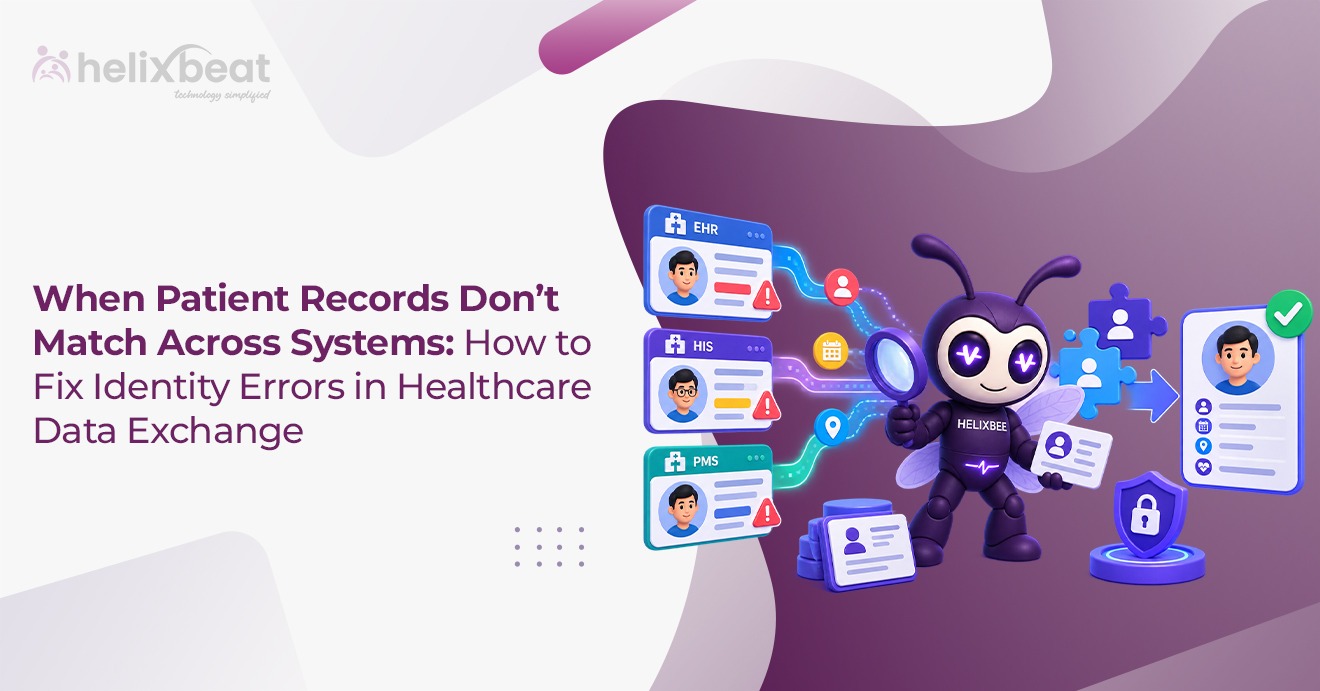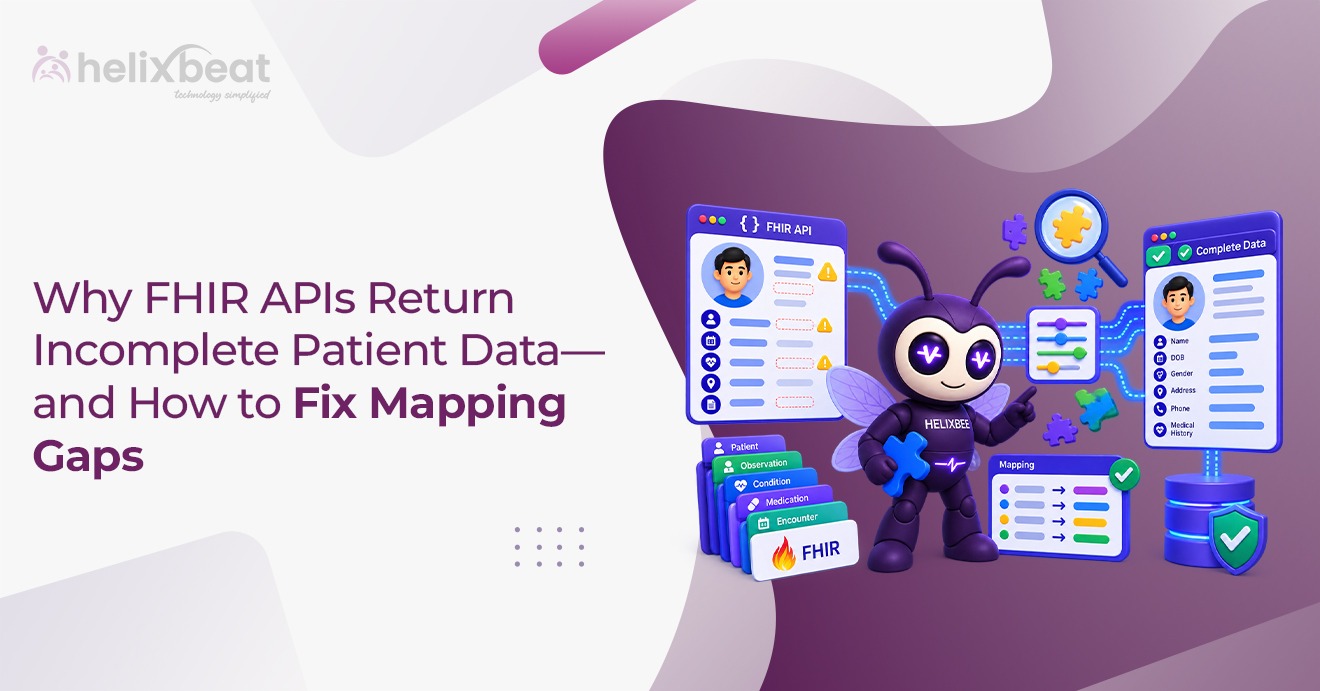


Modern healthcare depends on systems that share information seamlessly, and data exchange standards in healthcare provide the foundational rules and formats. These standards address long-standing challenges like data silos and incompatible formats. In this blog, we’ll discuss key frameworks like HL7, FHIR, and USCDI, while looking ahead to emerging trends that will shape the future of health information exchange.
Table of Contents
What Are Data Exchange Standards in Healthcare?
Data exchange standards in healthcare refer to agreed-upon protocols, formats, and vocabularies that govern how health information moves between different systems and organizations. They cover everything from clinical data like lab results and medications to administrative details such as billing and patient demographics. Without these standards, healthcare providers face errors, delays in care, and increased administrative burden.
Historically, the lack of uniformity in data handling created barriers to interoperability. Therefore, organizations like Health Level Seven International (HL7) emerged to develop global standards, while U.S.-specific initiatives from the Office of the National Coordinator for Health Information Technology (ONC) have driven national adoption. Today, these standards support real-time data sharing, patient access to records, and advanced analytics, all while maintaining security and privacy through compliance with regulations like HIPAA.
Today, over 95% of U.S. healthcare organizations use some form of HL7 standards, and initiatives like the 21st Century Cures Act mandate their use to prevent information blocking. As healthcare shifts toward value-based care and population health management, robust data exchange standards become indispensable for coordinating care across providers and empowering patients with their own health data.
The Evolution of HL7 Standards
Health Level Seven (HL7) represents one of the earliest and most influential frameworks for data exchange standards in healthcare. Founded in 1987, HL7 International develops specifications for the transfer of clinical and administrative data between software applications used by various healthcare providers. The name “Level Seven” refers to the application layer in the OSI model, focusing on high-level communication protocols.
HL7 Version 2 (v2), introduced in 1989, became the de facto standard for messaging in healthcare. It uses a pipe-delimited format to transmit data like admission/discharge/transfer (ADT) messages, lab orders, and results. By the mid-1990s, HL7 v2 achieved widespread adoption, with nearly all U.S. hospitals implementing it for internal and external data sharing. Its flexibility allowed customization, but this also led to variations that sometimes hindered true interoperability.
HL7 Version 3 (v3) arrived in the early 2000s with a more structured, model-driven approach. It emphasized reference information models (RIM) for consistent data representation across domains like patient administration and clinical documents. While v3 improved semantic accuracy, its complexity slowed adoption compared to v2.
Despite these advancements, traditional HL7 versions struggled with modern demands for real-time, web-based exchanges. This gap set the stage for newer innovations within the HL7 family, adapting to the rise of APIs and mobile health technologies.
FHIR: Revolutionizing Data Exchange in Healthcare
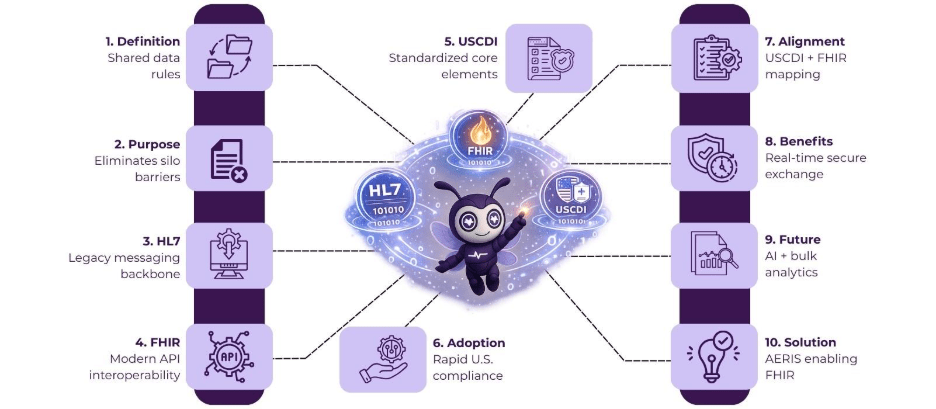
Fast Healthcare Interoperability Resources (FHIR), pronounced “fire,” marks a significant leap forward in data exchange standards in healthcare. Developed by HL7 and first released as a draft in 2011, FHIR became a full standard in 2014 with its Release 4 (R4) version gaining stability in 2019. Unlike earlier HL7 versions, FHIR leverages contemporary web technologies such as RESTful APIs, JSON, XML, and OAuth for secure, granular data access.
FHIR organizes data into modular “resources” – discrete units like Patient, Observation, or Medication – that can be queried, created, updated, or deleted independently. This modularity supports use cases from simple patient lookups to complex analytics. For example, a mobile app can pick out just the allergy info without having to download a massive file. This makes the whole process much faster and easier.
A 2025 survey indicated that 84% of U.S. healthcare organizations use FHIR APIs, up from 24% in 2021. Globally, countries like the UK, Australia, and Canada incorporate FHIR into national health strategies. Overall, FHIR makes interoperability more accessible and scalable.
USCDI: Standardizing Core Health Data Elements
The United States Core Data for Interoperability (USCDI) serves as a foundational set of data classes and elements that health IT systems must support for nationwide exchange. Managed by the ONC, USCDI replaced the Common Clinical Data Set (CCDS) in 2020 as part of the Cures Act to expand the scope of shareable data.
USCDI organizes information into classes like Allergies and Intolerances, Clinical Notes, Immunizations, and Medications, each containing specific elements. The standard evolves regularly through a transparent process that invites public and stakeholder input on new data elements and classes; Version 6 of USCDI was published in July 2025 with enhancements to expand interoperability.
USCDI works in tandem with transport standards like FHIR, specifying “what” data to exchange while FHIR handles “how.” Under the ONC Certification Program, health IT developers must support the required USCDI version as defined by current regulations — for example, USCDI v3 is the mandated baseline standard for certified products beginning in 2026. This standardization reduces variability, supports social determinants of health (SDoH) data, and facilitates research. Future versions will likely incorporate more elements for behavioral health and public health reporting.
Comparing HL7, FHIR, and USCDI
When evaluating data exchange standards in healthcare, HL7, FHIR, and USCDI each play distinct yet complementary roles. HL7 provides the broad framework, with v2 and v3 focusing on messaging and modeling for traditional exchanges. FHIR, as an HL7 product, modernizes this with API-driven, resource-based approaches suited for real-time applications.
USCDI, meanwhile, defines the content – the specific data elements required for interoperability – without prescribing the transport method. It aligns closely with FHIR through the US Core IG, which maps USCDI elements to FHIR profiles.
Future Trends in Data Exchange Standards in Healthcare
Looking ahead, healthcare data exchange standards are expected to evolve alongside growing adoption of artificial intelligence (AI), cloud-native architectures, and API-driven interoperability. FHIR will continue to expand beyond data access toward more advanced integration patterns that support analytics, automation, and clinical workflows.
FHIR Bulk Data Access is likely to see broader use for population health management, value-based care analytics, and research, as it supports large-scale data exports in standardized formats. At the same time, controlled FHIR write capabilities may gain traction in specific use cases, enabling structured updates between trusted systems under defined governance and security frameworks.
USCDI is expected to expand further, particularly in areas like social determinants of health (SDoH), behavioral health, and health equity. Future versions may increasingly reflect data elements that support advanced analytics and AI-driven use cases, although the scope and timeline of such additions will depend on regulatory priorities and stakeholder consensus.
Globally, interoperability efforts show signs of convergence around FHIR-based models. National initiatives, including country-specific core data sets influenced by USCDI concepts, suggest a gradual move toward alignment rather than full standardization. This approach allows regional healthcare systems to maintain regulatory flexibility while adopting shared technical foundations.
AI-enabled clinical decision support is also expected to mature through standards such as CDS Hooks and Clinical Quality Language (CQL), which provide structured, computable interfaces for integrating decision logic into clinical workflows. These standards may increasingly serve as bridges between clinical data and AI-driven insights.
Emerging technologies like blockchain continue to be explored for use cases like data provenance and auditability, although adoption remains experimental and dependent on scalability and governance models. Together, these developments point toward a more connected healthcare ecosystem where data flows support coordinated, patient-centered, and proactive care.
How AERIS Transforms Healthcare Information Exchange with FHIR?
AERIS by Helixbeat is a FHIR-based platform built to simplify secure, real-time healthcare data exchange. Designed for providers, hospitals, clinics, and partners such as pharmacies and insurers, AERIS helps organizations break down data silos, streamline workflows, and support better patient care.
With a scalable and integration-ready architecture, AERIS reduces data delays, improves operational efficiency, and accelerates return on investment, without disrupting existing systems.
Backed by over 20 years of healthcare IT expertise and trusted by 1,000+ customers, AERIS delivers measurable outcomes, including faster diagnoses, lower operational costs, and improved clinical accuracy.
Experience the power of AERIS and transform the way your organization manages health information. Schedule a call with Helixbeat today!
FAQs
1. Why are data exchange standards important in healthcare?
These standards reduce data silos, improve interoperability, lower administrative burden, and support timely access to patient information across organizations.
2. How is FHIR different from traditional HL7 standards?
FHIR uses modern web technologies like REST APIs, JSON, and OAuth, making data exchange faster, more flexible, and better suited for mobile apps and real-time use cases.
3. What future trends are shaping healthcare data exchange standards?
Key trends include expanded use of FHIR Bulk Data for analytics, growth in AI-driven decision support, broader inclusion of SDoH data, and global alignment around FHIR-based models.
4. How does AERIS support healthcare interoperability?
AERIS is a FHIR-based platform that helps healthcare organizations exchange data in real time, reduce operational delays, and improve collaboration across providers and partners.