

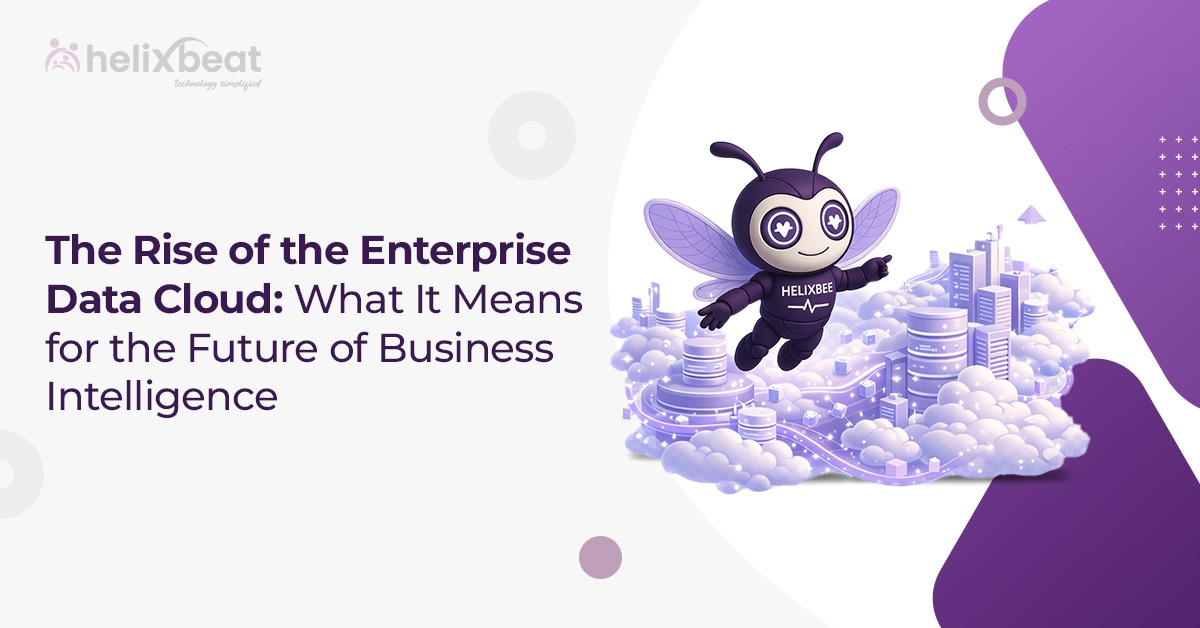
Indian businesses are generating massive volumes of data; however, turning that data into meaningful insights remains a challenge. The enterprise data cloud is emerging as a critical foundation for modern business intelligence, enabling organizations to centralize data, improve visibility, and scale analytics efficiently.
With expert support from Helixbeat, Indian enterprises can move beyond fragmented systems and adopt a truly data-driven operating model. From faster reporting to predictive insights, the enterprise data cloud is reshaping how decisions are made across industries. As competition intensifies, organizations that modernize their data infrastructure today will lead the future of business intelligence in India.
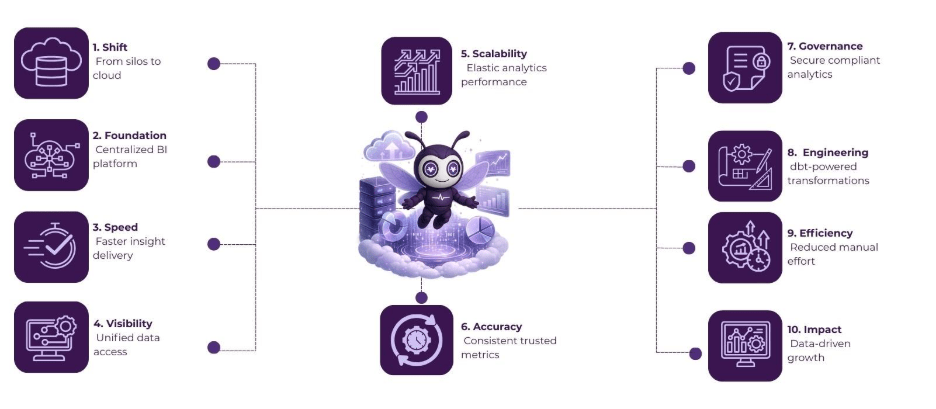
Table of Contents
Indian Enterprises Are Moving Away from Fragmented Data Systems – Here’s Why
Many Indian organizations still rely on multiple, disconnected systems, which slows decision-making and reduces confidence in insights. The shift toward a unified enterprise data cloud is helping businesses overcome these challenges.
Fragmented Systems Create Operational Bottlenecks
Data scattered across ERP platforms, CRMs, legacy databases, and cloud apps leads to inconsistent reports and delayed insights. Centralizing data in an enterprise data cloud reduces reliance on manual reconciliation.
Faster, Consistent Access to Business Intelligence
Research shows enterprises using centralized data platforms gain 30–40% faster access to BI compared to siloed systems. Unified data enables leadership teams to make timely, confident decisions.
Supporting Multi-Location Operations
For Indian enterprises expanding across cities or business units, centralized access reduces dependency on IT teams, allowing faster insights and smoother operational workflows.
How the Enterprise Data Cloud Is Redefining Business Intelligence in India
The enterprise data cloud transforms traditional BI from historical reporting to real-time, analytics-driven decision-making. Indian organizations now rely on centralized data to make faster, smarter decisions.
Faster Data Processing for Real-Time Insights
With centralized data in an enterprise data cloud, analytics teams can process large volumes of data quickly, enabling near real-time dashboards for operational and strategic decisions.
Improved Forecasting and Trend Analysis
Clean, unified datasets allow Indian businesses to predict trends and plan resources effectively, enhancing both short-term decisions and long-term strategy.
Reduced Manual Data Preparation
Centralized pipelines cut manual preparation by up to 50%, freeing teams to focus on actionable insights. Integrating tools like dbt cloud enterprise ensures reliable data transformations and improved BI accuracy.
Cost, Scalability, and Control—The Top Concerns for Indian Decision-Makers
Indian CXOs evaluating cloud platforms often prioritize predictable costs, scalability, and governance. The enterprise data cloud addresses all three by combining flexible pricing, elastic resources, and built-in controls.
Flexible Infrastructure Investment
Legacy systems require high upfront costs, whereas the enterprise data cloud offers usage-based scaling, helping Indian enterprises optimize CAPEX.
Elastic Analytics Performance
Unlike fixed-capacity systems, cloud platforms scale compute and storage as needed, ensuring fast query performance for growing datasets.
Centralized Governance for Compliance
Automated policies in an enterprise data cloud simplify auditing and data access control, reducing operational risk and ensuring compliance.
| Business Requirement | Legacy Systems | Enterprise Data Cloud |
| Infrastructure investment | High upfront cost | Usage-based scaling |
| Analytics performance | Fixed capacity | Elastic compute |
| Data governance | Manual processes | Centralized policies |
| BI readiness | Delayed reporting | Near real-time insights |
When considering dbt cloud enterprise pricing, many Indian enterprises find that reduced operational overhead and faster BI adoption deliver higher long-term value than traditional systems.
Data Governance and Compliance Matter More Than Ever in India
Indian enterprises face increasing regulatory requirements and internal audit expectations. Proper governance ensures that data-driven decisions are accurate, accountable, and auditable.
Role-Based Access Across Teams
The enterprise data cloud enables granular access control, allowing teams to view only relevant datasets while maintaining data security.
End-to-End Data Lineage
Track the flow of data from source to dashboard, ensuring transparency and trust in BI reports for leadership teams.
Auditable Transformation Workflows
Centralized, managed workflows—supported by tools like dbt cloud enterprise—make it easy to review, validate, and audit transformations, reducing reporting discrepancies by up to 25%.
How Helixbeat Helps Indian Enterprises Build BI-Ready Data Clouds
Building a business intelligence-ready data cloud requires strategy, expertise, and governance. Helixbeat helps Indian enterprises adopt scalable enterprise data cloud solutions that focus on delivering actionable insights.
Designing Cloud Data Architectures Aligned with BI Goals
Helixbeat designs cloud data platforms that integrate with business intelligence and analytics objectives, ensuring data is structured, accessible, and ready for analysis.
Integrating Analytics Engineering Tools
Platforms like dbt cloud enterprise are implemented to standardize data transformations and maintain consistent metrics, allowing teams to quickly build and deploy BI-ready models.
Implementing Governance Frameworks Without Slowing Insights
Helixbeat establishes role-based access, monitoring, and policies within the enterprise data cloud, balancing security and compliance while keeping insights flowing efficiently.
This approach enables Indian businesses to transition from raw data accumulation to insight-driven decision-making, improving operational efficiency, data accuracy, and competitive advantage.
Why Analytics Teams Choose dbt Cloud Enterprise Within Data Clouds
Analytics engineering is at the heart of modern BI. Indian data teams increasingly prefer dbt cloud enterprise within enterprise data cloud environments to accelerate reporting and improve reliability.
Version-Controlled Data Transformations
Data transformations in dbt cloud enterprise are version-controlled, ensuring consistent metrics and reducing errors across dashboards.
Faster Deployment of BI-Ready Models
Analytics teams can quickly iterate models and deliver BI-ready data to stakeholders, enhancing decision-making speed across departments.
Consistent Metrics Across Departments
Centralized data models and automated pipelines ensure uniformity in reporting, building trust in data-driven insights.
Enterprises adopting analytics engineering practices with dbt cloud enterprise report up to 40% higher trust in BI outputs, making decisions more accurate and actionable.
Measuring ROI and Business Impact of Enterprise Data Clouds
Investing in an enterprise data cloud is a strategic move that delivers measurable business benefits. Indian organizations, especially in BFSI, manufacturing, and SaaS, can quantify the impact of these platforms on efficiency and growth.
Faster Decision-Making
Centralized, real-time dashboards enable 25–35% faster decisions, allowing leadership to respond to market trends with confidence.
Reduced Operational Overhead
By reducing manual data prep and reconciliation, organizations can lower operational costs by up to 30%, freeing teams to focus on strategy.
Improved Analytics Adoption
Teams using dbt cloud enterprise and governed enterprise data cloud workflows see 15–20% higher adoption of analytics tools, ensuring decisions are data-driven across the business.
Revenue Growth and Strategic Impact
Faster insights and accurate forecasting allow companies to react quickly to demand, supporting revenue growth and stronger competitive positioning.
Even when considering dbt cloud enterprise pricing, the benefits of faster adoption, consistent metrics, and operational efficiency outweigh costs, making ROI tangible through both savings and smarter decisions.
Wrapping up
The rise of the enterprise data cloud is transforming business intelligence for Indian enterprises. With scalable architecture, governed analytics, and expert implementation by Helixbeat, organizations can convert data into reliable insights that drive faster decisions, stronger compliance, and sustainable growth.
Start your BI-ready data cloud journey with Helixbeat today!
FAQs
1. What is an enterprise data cloud?
An enterprise data cloud is a centralized cloud platform that stores, processes, and prepares organizational data for analytics and business intelligence.
2. How does an enterprise data cloud improve business intelligence?
It enables faster access to trusted data, supports real-time analytics, and delivers consistent insights across departments.
3. Is an enterprise data cloud suitable for Indian mid-sized companies?
Yes. Scalable pricing and modular architectures allow mid-sized Indian businesses to adopt enterprise data cloud solutions gradually.
4. How does dbt cloud enterprise support BI initiatives?
It transforms raw data into analytics-ready models, improving data consistency, and BI accuracy.
5. What influences dbt cloud enterprise pricing?
Pricing depends on user count, governance requirements, data volume, and analytics usage.
6. How does Helixbeat support enterprise data cloud adoption?
Helixbeat designs, implements, and optimizes data cloud platforms focused on delivering actionable business intelligence.
7. Is cloud-based business intelligence secure for Indian enterprises?
Modern enterprise data cloud platforms use encryption, access controls, and compliance frameworks that meet enterprise-grade security standards.