

Can healthcare organizations truly measure the financial and operational impact of interoperability? With increasing data fragmentation and rising operational costs, healthcare providers are under pressure to modernize their systems. This is where the concept of FHIR server ROI becomes critical. Understanding the real ROI of FHIR implementation helps healthcare leaders justify investments while aligning technology with patient care goals.
Table of Contents
What Is a FHIR Server and Why It Matters for ROI
Before diving into FHIR server ROI, it is important to understand what a FHIR server does.
A FHIR server acts as a centralized platform that enables healthcare systems to exchange structured data using standardized APIs. Unlike legacy HL7 systems, FHIR is built for modern, web-based environments, making integration faster and more flexible.
Key capabilities that impact ROI:
- Real-time data exchange across systems
- Standardized APIs reducing integration complexity
- Scalable architecture for future growth
- Support for mobile and cloud-based healthcare apps
These capabilities directly influence ROI by reducing development time, minimizing errors, and improving system usability.
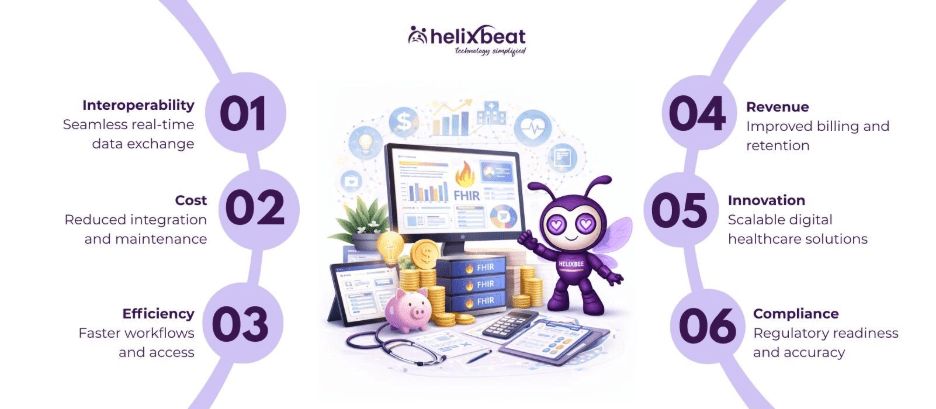
Breaking Down the Components of FHIR Server ROI
Measuring FHIR server ROI requires evaluating both tangible and intangible benefits.
1. Cost Savings
- Reduced interface development costs
- Lower maintenance expenses compared to legacy systems
- Decreased reliance on manual data entry
2. Operational Efficiency
- Faster data retrieval for clinicians
- Automated workflows across departments
- Reduced duplication of records
3. Revenue Enhancement
- Improved billing accuracy
- Faster claims processing
- Better patient retention due to improved experience
4. Strategic Value
- Readiness for regulatory compliance
- Scalability for future digital initiatives
- Competitive advantage in value-based care models
Each of these components contributes to a measurable and sustainable FHIR server ROI.
Reducing Integration Costs with FHIR
Traditional healthcare integrations are expensive and time-consuming. Custom interfaces often require months of development and ongoing maintenance.
With FHIR:
- APIs standardize communication between systems
- Developers spend less time building custom connectors
- Integration cycles are significantly shorter
Organizations report reduced integration costs by up to 30-50% when shifting to FHIR-based architectures. This reduction directly improves FHIR server ROI by lowering initial and ongoing investment.
Improving Clinical Efficiency and Productivity
One of the most impactful aspects of FHIR server ROI is its effect on clinical workflows.
How FHIR improves productivity:
- Instant access to patient records across systems
- Reduced time spent searching for data
- Better coordination between departments
For example, when lab results, imaging data, and patient history are accessible in one place, clinicians can make faster decisions. This leads to:
- Shorter patient wait times
- Increased number of patients handled per day
- Reduced clinician burnout
Improved productivity translates into both financial and operational ROI.
Enhancing Patient Experience and Its Financial Impact
Patient experience plays a big role in healthcare revenue.
FHIR-enabled systems allow:
- Patient portals with real-time updates
- Easy appointment scheduling
- Access to medical records via mobile apps
When patients can easily interact with healthcare providers, satisfaction improves. This leads to:
- Higher patient retention rates
- Increased referrals
- Better reputation in competitive markets
All these factors contribute positively to FHIR server ROI, even though they may not always appear as direct financial metrics.
Supporting Value-Based Care Models
Healthcare is shifting from fee-for-service to value-based care, where outcomes matter more than volume.
FHIR servers support this transition by:
- Enabling data sharing across care teams
- Providing real-time insights into patient outcomes
- Facilitating population health management
Impact on ROI:
- Reduced readmission rates
- Improved care quality metrics
- Better reimbursement rates
Organizations adopting value-based care models often see long-term gains, making FHIR server ROI a strategic investment rather than just a technical upgrade.
Accelerating Innovation and Digital Transformation
Innovation is a major driver of FHIR server ROI.
FHIR allows healthcare organizations to:
- Quickly develop and deploy new applications
- Integrate third-party health apps
- Support telemedicine and remote monitoring solutions
Instead of building systems from scratch, developers can use FHIR APIs to create scalable solutions.
Resulting benefits:
- Faster time-to-market for digital products
- Lower development costs
- Increased ability to adapt to market changes
This agility contributes significantly to long-term ROI.
Strengthening Data Accuracy and Reducing Errors
Data errors in healthcare can lead to financial losses and compromised patient care.
FHIR improves data accuracy by:
- Standardizing data formats
- Reducing manual data entry
- Synchronizing data across systems
ROI impact:
- Fewer billing errors
- Reduced claim rejections
- Lower risk of compliance penalties
Accurate data not only saves costs but also builds trust among patients and stakeholders.
Compliance and Regulatory Advantages
Healthcare organizations must comply with strict regulations related to data sharing and interoperability.
FHIR aligns with global interoperability standards and is increasingly mandated by healthcare authorities.
Benefits for ROI:
- Reduced risk of penalties
- Faster compliance with evolving regulations
- Simplified reporting processes
Compliance-related savings contribute indirectly but significantly to ROI.
Scalability and Future-Proofing Investments
Technology investments must support long-term growth.
FHIR servers are designed to scale with organizational needs:
- Easy integration with new systems
- Support for growing patient data volumes
- Compatibility with emerging technologies like AI
This scalability reduces the need for frequent system overhauls and improves FHIR server ROI over time.
How to Measure FHIR Server ROI Effectively?
To fully understand FHIR server ROI, organizations must track key performance indicators (KPIs).
Important metrics:
- Integration cost reduction
- Time saved in clinical workflows
- Reduction in claim denials
- Patient satisfaction scores
- Revenue growth from improved services
Best practices:
- Establish baseline metrics before implementation
- Monitor performance regularly
- Align ROI goals with organizational objectives
A structured measurement approach provides clear visibility into ROI outcomes.
Best Practices to Maximize FHIR Server ROI
1. Start with a Clear Strategy
Define goals such as improving interoperability, reducing costs, or enhancing patient experience.
2. Prioritize High-Impact Use Cases
Focus on areas where FHIR can deliver immediate value, such as patient data exchange or billing systems.
3. Invest in Skilled Resources
Having experienced developers or collaborating with a service provider like Helixbeat improves implementation efficiency.
4. Leverage Cloud-Based FHIR Solutions
Cloud platforms reduce infrastructure costs and improve scalability.
5. Continuously Optimize Systems
Regular updates and monitoring help maintain performance and maximize ROI.
Unlock Seamless Healthcare Interoperability with FUSION
Built by Helixbeat, FHIR server FUSION leverages RESTful APIs for seamless connectivity with legacy systems, modern EHRs, and emerging tools like wearable devices and telehealth platforms. This isn’t just compliance, it’s acceleration.
Organizations using FUSION report up to 70% faster data sharing, slashing referral delays by 60% and reducing redundant tests by 25%. That’s not hype; it’s a measurable impact, with providers saving $1,000 – $2,000 per patient annually through streamlined claims and operations.
Certified Excellence
FUSION is officially certified by the Drummond Group for FHIR-based interoperability, validating its conformance with healthcare data exchange standards HL7, FHIR, and SMART on FHIR. This certification demonstrates that FUSION meets industry-recognized benchmarks for secure, standardized data exchange.
Final Thoughts
FHIR server ROI reflects the overall transformation of healthcare delivery. From improving interoperability and clinical efficiency to supporting value-based care and innovation, FHIR servers provide measurable and lasting benefits.
FUSION, an enterprise-grade FHIR server, is designed to simplify interoperability, reduce IT costs, and accelerate application deployment. Connect your EHRs, labs, and billing systems effortlessly, and access real-time patient data securely. Get Started with FUSION!
FAQs
1. How can organizations maximize FHIR server ROI?
Organizations can maximize FHIR server ROI by focusing on high-impact use cases, adopting cloud-based solutions like FUSION, and continuously optimizing systems.
2. How long does it take to see FHIR server ROI?
Most organizations begin to see FHIR server ROI within 6 to 18 months, depending on implementation scale and use cases.
3. What are the key factors influencing FHIR server ROI?
Key factors include integration cost reduction, workflow efficiency, improved billing accuracy, patient experience, and scalability.
4. Does FHIR server ROI impact patient experience?
Yes, FHIR server ROI improves patient experience by enabling real-time data access, better communication, and user-friendly digital health applications.