



Launching a startup in 2026 is interesting, but it’s also riskier than ever. Many founders struggle to bring their ideas to life quickly, wasting precious time and money on products that may never find a market.
The biggest challenge? Building an MVP that actually validates your idea without draining your resources.
The solution is simple: partnering with the right mvp development company. Experts can turn your concept into a functional MVP fast, helping you test your idea, gather real user feedback, and attract investors, all while keeping costs and timelines under control. Choosing the right partner is no longer optional; it’s the smartest move for any startup ready to grow.
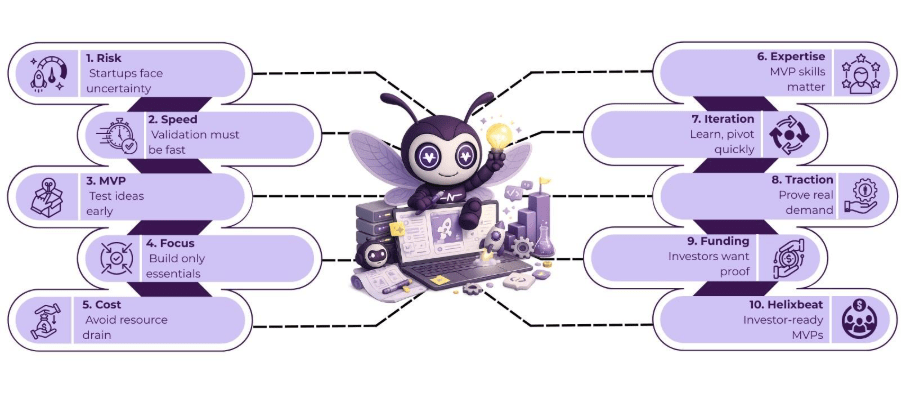
Table of Contents
What Problem Are Startups Really Facing in 2026?
Startups in 2026 face more pressure than ever to validate ideas quickly. Investors expect traction within months, not years, and the cost of hiring full-time developers or building an in-house team is often too high. Many founders struggle to balance product development with market research, leading to wasted time, overspending, and delayed launches.
Another challenge is technical execution. Without an experienced team, startups risk creating MVPs that are slow, buggy, or fail to meet user expectations. This can damage credibility, reduce chances of funding, and make it harder to pivot based on real feedback. Partnering with a top mvp development company helps overcome these hurdles by delivering a market-ready MVP faster and smarter.
What Is an MVP and Why It Is Important for Startups?
What Is an MVP?
A Minimum Viable Product (MVP) is the simplest version of your idea that actually works for real users. Think of it as a “test drive” of your product – you build just enough to see if people care, without sinking months of time or thousands of dollars into features nobody will use.
Why an MVP Is Important for Startups:
- Test your idea in the real world: Instead of guessing, you see how users actually interact with your product.
- Avoid wasting money on unnecessary features: Focus only on what truly matters to your first users.
- Learn fast and pivot smartly: Early feedback highlights what works—and what doesn’t—before scaling.
- Show traction to investors: A working MVP demonstrates that your idea can survive outside your notebook.
- Build confidence for the team: Seeing something tangible in users’ hands motivates the whole startup to push forward.
Building an MVP the right way sets the foundation for growth, funding, and long-term success – making the choice of the right MVP development company a critical decision.
Why Building an In-House MVP Doesn’t Fit for Startups
For startups in 2026, trying to build an MVP entirely in-house often leads to delays, wasted resources, and missed opportunities – which is why partnering with a top mvp development company can make all the difference.
- High costs without guaranteed results: Nearly 42% of startups fail because there’s no real market need, yet many founders still pour money into building an MVP internally without validating anything first, a costly gamble with limited insights.
- Slower time-to-market: Startups need to move fast. Estimates show MVP-first strategies can cut time-to-market by up to 35–45%, but in-house builds often drag on without MVP expertise, costing you the chance to learn early and iterate.
- Limited MVP-specific experience: Building an MVP isn’t just about coding; it’s about knowing what to build first, why it matters to users, and how to validate assumptions. Most in-house teams lack this focus, leading to features that don’t solve core problems.
- Distraction from core business goals: When founders and small teams get pulled into technical execution, it steals focus from strategic activities like customer discovery, market research, and growth planning, areas that actually determine long-term success.
Trying to manage an in-house MVP can slow your startup’s growth, which is why working with a mvp software development agency make sures faster validation, smarter builds, and a stronger chance of early success.
How the Right MVP Development Company Help Startups to Validate Faster in 2026
For startups racing against time and tight budgets, partnering with the right MVP development company can be the difference between guessing and knowing what works.
1. Structured MVP Planning to Save Time and Money
Many startups waste months building features users don’t need. A skilled mvp development company begins with discovery workshops to define what truly matters.
By prioritizing essential features and validating assumptions early, they help you focus on solutions that solve real user problems, saving both time and money while avoiding costly mistakes.
2. Rapid Prototyping and Iterative Feedback
Speed is everything in 2026. Instead of waiting for a full product launch, the right MVP partner builds rapid prototypes to test ideas with real users.
For SaaS startups, a saas mvp development company can create subscription-ready MVPs that showcase core functionality while collecting actionable feedback, allowing you to pivot or improve your product quickly based on real data.
3. Investor-Ready MVPs That Boost Funding Chances
Investors want proof, not promises. Experienced MVP development companies deliver functional, user-tested products that demonstrate traction and market potential. A well-built MVP helps founders confidently pitch to investors, showing not just an idea, but a product that can scale.
By working with the right team, startups increase their chances of funding while keeping development efficient and strategic.
Choosing the right mvp development company from the start ensures faster validation, smarter iterations, and a clear path from idea to a fundable product, giving your startup a head start in 2026.
How an MVP Development Company Improves Startups Funding Chance?
Securing funding is one of the biggest hurdles for startups in 2026. A well-built MVP can turn an idea into proof, showing investors that your concept is viable and your team can execute. Here’s how the right mvp development company makes that possible:
- Shows real user traction: Investors care about numbers, not ideas. An MVP built by experts demonstrates that people are actually using your product and solving a real problem.
- Validates market demand quickly: Experienced MVP teams prioritize the features that matter most, giving investors confidence that your startup addresses a genuine need in the market.
- Delivers a polished, scalable product: A professional MVP isn’t just functional; it’s clean, stable, and designed for growth. This shows investors you’re serious about building a long-term business.
- Reduces risk perception: Founders who launch without testing often struggle to convince investors. An MVP created by a top mvp development company reduces perceived risk by providing tangible evidence of potential success.
- Supports compelling pitches: With an MVP ready for demos, founders can present a working product instead of just slides, making investor conversations concrete, engaging, and convincing.
Working with the right mvp development company not only accelerates validation but also transforms your startup into a credible, fundable business – increasing your chances of securing investment in 2026.
Why Most Startups Choose Helixbeat for MVP Development
Most startups choose Helixbeat because we don’t just build code – we turn founder ideas into validated MVPs quickly. By focusing on real user needs, rapid prototyping, and iterative feedback, we help startups launch products that attract early adopters and investor interest.
What sets Helixbeat apart is our full-spectrum approach: strategic product thinking, scalable engineering, and design expertise. We don’t just build MVPs, we build investor-ready products that give startups a head start in growth and funding.
Your MVP is just one call away – let’s build it together. Book a free call now.
FAQ
1. What exactly does an MVP development company do for startups?
An MVP development company helps startups turn ideas into a functional, market-ready product quickly. They manage planning, prototyping, and testing, ensuring founders validate their concept without wasting time or money.
2. How long does it usually take to build an MVP?
The timeline varies by complexity, but most MVPs take 6–12 weeks. Partnering with a top MVP development company accelerates the process by using proven frameworks, rapid iteration, and experience from multiple startup launches.
3. Can SaaS startups benefit from hiring an MVP development company?
Yes. A SaaS MVP development company can build subscription-ready products with essential backend systems, scalable architecture, and user-focused design, helping SaaS founders test the market and pivot quickly.
4. Is it better to hire an in-house team or work with an MVP software development agency?
Working with an MVP software development agency is often faster and more cost-effective. Experienced agencies have refined processes and tools to validate ideas quickly, while in-house teams can struggle with trial-and-error delays.
5. How does a functional MVP influence investor interest?
Investors want proof, not promises. A working MVP from experienced MVP software development companies demonstrates market demand, reduces perceived risk, and increases your startup’s chances of securing funding.