

At its simplest, a cloud based visitor management system is software that digitizes and automates how organizations register, track, and manage visitors — all through the cloud.
Instead of storing visitor logs in a physical book or on a single computer at reception, everything is securely stored online. That means authorized teams can access data anytime, from anywhere.
A cloud based visitor management system is designed to:
- Digitally register visitors
- Verify identities
- Notify hosts instantly
- Track who is on-site in real time
- Maintain audit-ready logs
- Support compliance requirements
Unlike traditional software, a cloud based visitor management system stores data in secure cloud servers rather than local hardware. This eliminates the need for complex installations at every office location.
And that’s where it becomes especially powerful for multi-site organizations.
Table of Contents
Why Multi-Site Organizations in the U.S. Need a Smarter Approach
If you manage multiple offices — whether across different states or nationwide — visitor management becomes complicated quickly.
Think about it:
- Different security teams
- Separate reception processes
- Inconsistent compliance documentation
- No centralized visibility
- Manual reporting
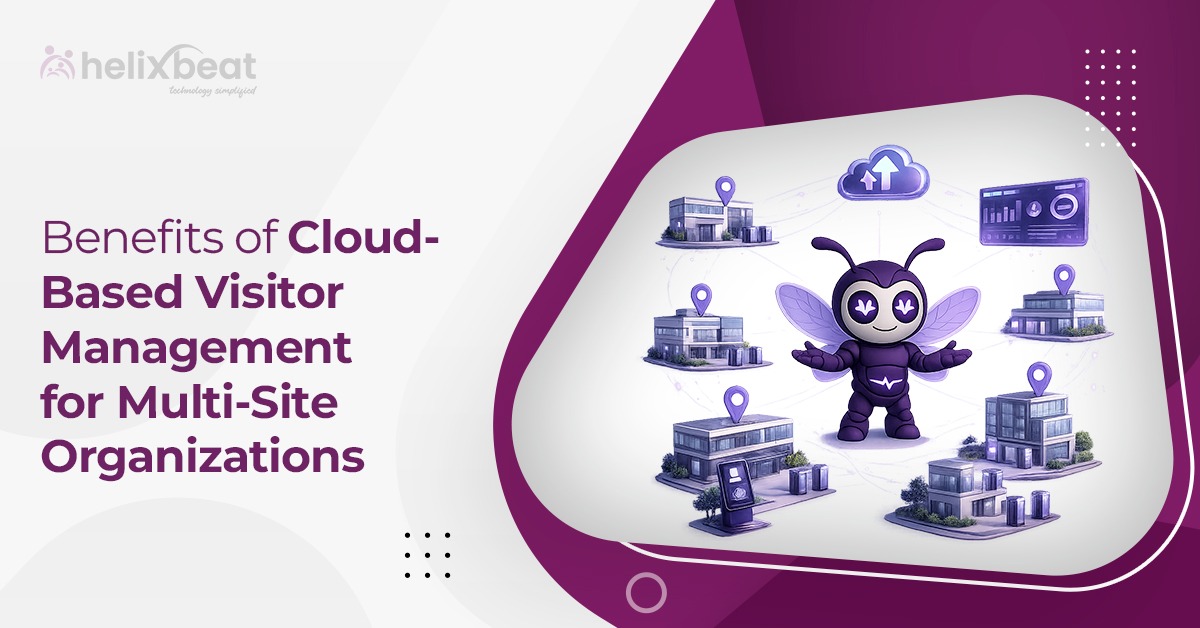
For multi-site organizations, a cloud based visitor management system creates one unified, standardized process across all locations.
Whether you have 3 offices or 300, every site follows the same check-in protocol. Every visitor record is stored centrally. Every security team has visibility.
And in the U.S., where workplace security and data privacy regulations are increasingly strict, that consistency matters.
1. Stronger Security Across All Locations
Security is the top concern for U.S. enterprises. According to the FBI, physical security incidents in commercial properties have increased over the past decade. At the same time, corporate espionage and unauthorized access risks remain high.
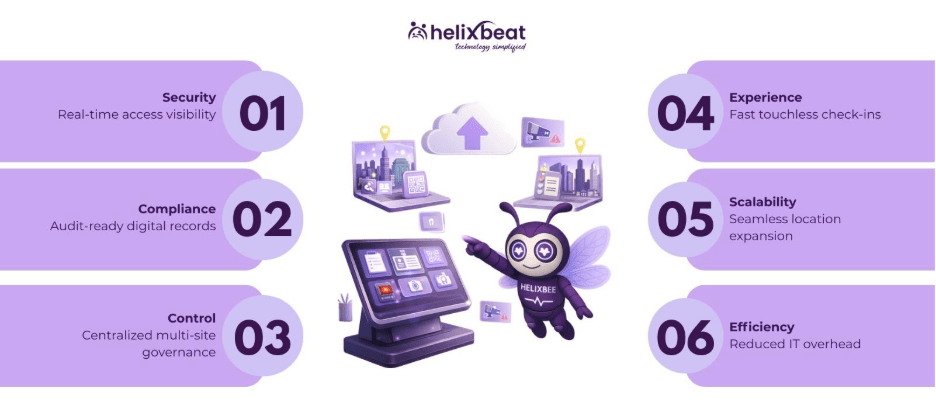
With a cloud based visitor management system, security teams can:
- Verify government-issued IDs
- Capture visitor photos
- Screen against watchlists
- Track real-time entry and exit
- Instantly revoke access
Because all data is centralized, corporate security leaders can see who is inside any facility at any moment.
This level of visibility is nearly impossible with manual logs or disconnected systems.
2. Easier Compliance With U.S. Regulations
Regulatory compliance isn’t optional in the United States. Organizations must comply with:
- HIPAA (Healthcare)
- CCPA (California privacy law)
- SOC 2 (Data security standards)
- OSHA (Workplace safety regulations)
A cloud based visitor management system helps organizations meet compliance requirements by:
- Maintaining secure digital logs
- Automating data retention policies
- Creating audit-ready reports
- Ensuring data encryption
In industries like healthcare, manufacturing, finance, and government contracting, these features are not just convenient — they’re essential.
3. Centralized Control for Multi-Site Operations
Managing visitor processes separately at each location leads to inconsistencies.
Because a cloud based visitor management system operates in real time across all sites, headquarters can:
- Set standardized policies
- Monitor visitor trends across locations
- Manage permissions centrally
- Update workflows instantly
For example, if a company updates its NDA requirements, it can deploy the change across every location immediately — no manual retraining required.
This kind of centralized control saves time and reduces risk.
4. Faster Check-Ins and Better Visitor Experience
First impressions matter.
According to a PwC study, 73% of consumers say experience is a key factor in choosing a company. That experience begins the moment someone walks through your door.
From the visitor perspective, a cloud based visitor management system feels modern and efficient:
- Pre-registration links
- QR code check-in
- Touchless entry
- Automatic badge printing
- Instant host alerts
No paperwork. No waiting. No confusion.
For organizations competing for talent, clients, or partnerships, that professional first impression makes a difference.
5. Real-Time Emergency Management
Emergencies happen — fires, severe weather, security threats.
In those situations, knowing exactly who is inside the building is critical.
A cloud based visitor management system provides real-time occupancy lists, allowing safety teams to:
- Account for all visitors instantly
- Run evacuation reports
- Share live data with emergency responders
Manual logbooks simply cannot deliver that level of reliability.
6. Scalability for Growing Enterprises
Expansion is a sign of success — but it also creates operational complexity.
As organizations expand, a cloud based visitor management system scales effortlessly. Adding a new location doesn’t require installing heavy infrastructure or building new systems from scratch.
Instead, new offices can be onboarded quickly using the same centralized platform.
This is particularly valuable for:
- Franchise models
- Healthcare networks
- Enterprise corporations
- Co-working providers
- Educational institutions
The system grows as your organization grows.
7. Reduced IT Burden
For CIOs and IT leaders, infrastructure complexity is a constant challenge.
A cloud based visitor management system reduces the need for:
- On-site servers
- Manual software updates
- Maintenance at each location
- Hardware-heavy installations
Because updates are handled centrally in the cloud, IT teams can focus on strategic initiatives instead of managing reception software.
8. Data-Driven Insights Across Locations
Data is power.
Data collected by a cloud based visitor management system provides valuable insights such as:
- Peak visitor hours
- High-traffic locations
- Frequent vendors
- Contractor trends
- Visitor volume patterns
Multi-site organizations can use this data to:
- Optimize staffing
- Improve security coverage
- Adjust reception workflows
- Plan facility usage
Instead of guessing, leadership teams can make informed decisions.
9. Cost Efficiency Over Time
While some organizations hesitate at initial investment, the long-term savings are significant.
Over time, a cloud based visitor management system lowers costs by:
- Eliminating paper logs
- Reducing administrative workload
- Minimizing security risks
- Preventing compliance penalties
- Cutting IT infrastructure expenses
For large enterprises with multiple sites, these savings compound quickly.
Real-World Example
Imagine a U.S.-based healthcare network with 25 clinics across different states.
Previously, each clinic used manual sign-in sheets. Compliance audits were stressful. Visitor logs were inconsistent. Security teams had no centralized visibility.
By implementing a cloud based visitor management system, the company:
- Standardized visitor check-ins across all clinics
- Centralized reporting for HIPAA compliance
- Reduced check-in time by over 60%
- Improved audit preparation speed
- Gained real-time visibility across all locations
The result? Improved security, smoother operations, and stronger regulatory confidence.
Why VISTA Is Built for Multi-Site Organizations
Solutions like VISTA by Helixbeat are designed specifically with enterprise and multi-location needs in mind.
VISTA by Helixbeat is a cloud based visitor management system built to unify visitor operations across distributed offices, healthcare facilities, corporate campuses, and enterprise environments.
It supports:
- Pre-registration workflows
- Contactless QR check-in
- Real-time host notifications
- Centralized dashboards
- Role-based access control
- Compliance-ready reporting
- Multi-location visibility
For U.S. enterprises looking to modernize security while maintaining operational flexibility, solutions like this provide both control and scalability.
The Competitive Advantage of Going Cloud
Today’s workplaces are hybrid, fast-moving, and security-conscious.
Organizations are managing:
- Remote employees
- Rotational office attendance
- Vendor access
- Third-party contractors
- Compliance audits
A cloud based visitor management system brings all these moving parts together into one intelligent platform.
Instead of reacting to problems, organizations can proactively manage security, compliance, and experience.
Final Thoughts
The way organizations welcome visitors says a lot about how they operate.
In a country where security risks, compliance regulations, and operational complexity continue to grow, manual processes are no longer enough.
In short, a cloud based visitor management system is no longer a luxury — it’s a necessity for multi-site organizations in the United States.
It delivers:
- Stronger security
- Centralized control
- Better compliance
- Faster visitor experiences
- Real-time visibility
- Scalable growth
- Reduced IT burden
- Data-driven decision-making
For enterprises managing multiple locations, the question is no longer if they should modernize visitor management.
The real question is: how soon can they make the switch?
FAQs
1. What is a cloud based visitor management system?
A cloud based visitor management system is software that digitizes visitor check-ins, stores data securely online, and provides real-time visibility across locations.
2. Why is it important for multi-site organizations?
It centralizes visitor data, standardizes security policies, and gives headquarters full visibility across all office locations.
3. Is a cloud based visitor management system secure?
Yes. Most platforms use encryption, access controls, and secure cloud hosting to protect sensitive visitor information.
4. How does it help with compliance in the US?
It maintains digital logs, automates data retention, and generates audit-ready reports for regulations like HIPAA and CCPA.
5. Can it scale as a company grows?
Absolutely. A cloud based visitor management system easily adds new locations without heavy infrastructure or complex installations.