

Large hospitals operate in one of the most complex digital environments in modern healthcare. Thousands of clinicians, administrators, and support staff interact with electronic health records daily. These systems manage patient demographics, clinical notes, lab results, imaging, billing data, medication orders, and more.
When properly optimized, electronic health records improve care coordination, patient safety, compliance, and operational efficiency. When poorly configured, they contribute to clinician burnout, workflow friction, and delayed care delivery.
In this comprehensive guide, we explore practical, evidence-based EHR optimization strategies tailored specifically for large hospitals.
Table of Contents
What Is EHR Optimization?
EHR optimization refers to the continuous improvement of electronic health records systems to enhance usability, clinical outcomes, data accuracy, and operational performance.
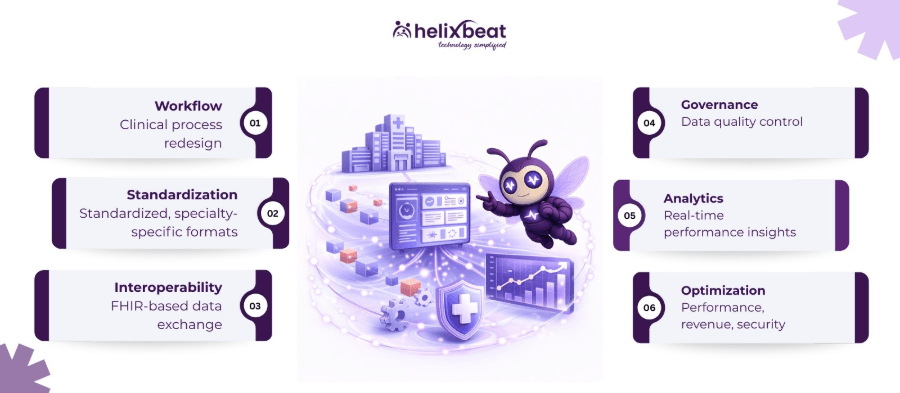
In large hospitals, optimization goes beyond initial implementation. It includes:
- Workflow redesign
- Data standardization
- Interoperability upgrades
- Performance tuning
- User training
- Governance improvements
- Analytics integration
Optimization is not a one-time event. It is an ongoing process driven by evolving regulations, clinical needs, and technological advancements.
Why EHR Optimization Matters for Large Hospitals?
Large hospitals differ from small practices in several ways:
- Multiple specialties and subspecialties
- Complex inpatient and outpatient workflows
- High patient volumes
- Multiple facilities or campuses
- Large interdisciplinary teams
- Regulatory scrutiny
Because of this complexity, electronic health records must function reliably at scale.
Research published in journals such as the Journal of the American Medical Informatics Association (JAMIA) shows that poor EHR usability contributes to clinician burnout. The American Medical Association (AMA) has also highlighted documentation burden as a major concern among physicians.
Optimization directly affects:
- Clinical efficiency
- Patient safety
- Revenue cycle performance
- Compliance with CMS and regulatory programs
- Staff satisfaction
Core EHR Optimization Strategies for Large Hospitals
1. Conduct a Comprehensive Workflow Assessment
Before making technical changes, hospitals must understand how clinicians actually use electronic health records.
Steps to Take:
- Shadow physicians, nurses, and support staff
- Map real-world workflows
- Identify duplicate documentation points
- Track time spent per task
- Analyze bottlenecks in order entry and discharge processes
Many large hospitals discover that inefficient workflows result from legacy configurations that were never revisited after go-live.
2. Standardize Clinical Documentation Templates
In large hospitals, documentation inconsistency can create confusion and reporting challenges.
Optimization Actions:
- Create specialty-specific templates
- Remove outdated fields
- Align templates with evidence-based guidelines
- Reduce unnecessary required fields
- Avoid overuse of copy-paste functionality
Template standardization improves:
- Data integrity
- Coding accuracy
- Quality reporting
- Clinical decision support performance
Structured data entry also enhances analytics and interoperability.
3. Optimize Clinical Decision Support (CDS)
Clinical Decision Support systems embedded in electronic health records can improve patient safety when properly configured.
However, excessive alerts lead to alert fatigue.
Best Practices:
- Review alert override rates
- Remove low-value alerts
- Align CDS rules with current guidelines
- Customize by specialty
- Monitor performance metrics
High-performing hospitals regularly evaluate their CDS logic to balance safety with usability.
4. Strengthen Interoperability Capabilities
Large hospitals exchange data with:
- Primary care providers
- Specialty clinics
- Laboratories
- Imaging centers
- Pharmacies
- Health Information Exchanges (HIEs)
Federal regulations such as the 21st Century Cures Act promote interoperability and prohibit information blocking.
Optimization Focus Areas:
- FHIR-based APIs
- HL7 interface upgrades
- Direct messaging configuration
- Real-time data exchange
- Participation in regional HIEs
Improved interoperability enhances care continuity and reduces duplicate testing.
5. Improve Data Governance and Standardization
Data quality directly affects analytics, reporting, and compliance.
Establish a Data Governance Framework:
- Define data ownership
- Standardize coding systems (ICD-10, CPT, SNOMED CT, LOINC)
- Create validation protocols
- Conduct routine data audits
- Implement master patient index (MPI) controls
Inconsistent data entry leads to inaccurate reporting and reimbursement challenges.
Large hospitals benefit from multidisciplinary governance committees that oversee electronic health records policies.
6. Enhance System Performance and Infrastructure
Performance issues can severely disrupt hospital operations.
Technical Optimization Measures:
- Upgrade server infrastructure
- Migrate to cloud-based hosting (where appropriate)
- Monitor system latency
- Conduct database optimization
- Implement disaster recovery testing
Downtime procedures should be tested regularly to minimize risk during outages.
7. Leverage Advanced Analytics and Reporting
Electronic health records contain valuable clinical and operational data.
Optimization Strategy:
- Build real-time dashboards
- Track key performance indicators (KPIs)
- Monitor readmission rates
- Analyze length of stay
- Review medication error trends
Advanced analytics supports:
- Value-based care models
- Population health management
- Quality reporting
- Risk stratification
Hospitals participating in accountable care organizations (ACOs) particularly benefit from robust reporting capabilities.
8. Improve Revenue Cycle Integration
Electronic health records directly impact billing and reimbursement.
Areas to Optimize:
- Charge capture workflows
- Coding accuracy
- Documentation completeness
- Prior authorization processes
- Denial management tracking
Revenue integrity teams should collaborate closely with clinical informatics departments.
9. Strengthen Cybersecurity and Access Controls
Large hospitals are frequent targets of ransomware attacks.
Healthcare consistently ranks among the most targeted sectors for cyber incidents.
Critical Measures:
- Multi-factor authentication (MFA)
- Role-based access controls
- Routine vulnerability testing
- Staff phishing training
- Data encryption at rest and in transit
Regular audits of user access rights prevent inappropriate data exposure.
10. Install a FHIR Server as a Strategic Optimization Layer
For large hospitals, implementing a FHIR server like FUSION allows structured data to be accessed through standardized APIs. As a result, hospitals can:
- Deploy SMART on FHIR applications
- Integrate specialty-specific clinical tools
- Connect population health platforms
- Enable innovation without core EHR disruption
This modular approach reduces vendor lock-in and accelerates digital transformation initiatives.
Optimized electronic health records with FHIR capabilities improve:
- Risk stratification
- Quality measure reporting
- Chronic disease tracking
- Value-based care performance analysis
FHIR-based data extraction simplifies data aggregation across departments and facilities. For large hospitals navigating value-based care, digital transformation, and regulatory compliance, FHIR server optimization is no longer optional. It is a foundational component of a modern, high-performing EHR ecosystem.
Unlock Seamless Healthcare Interoperability with FUSION
Built by Helixbeat, FHIR server FUSION leverages RESTful APIs for plug-and-play integration, enabling seamless connectivity with legacy systems, modern EHRs, and emerging tools like wearable devices and telehealth platforms. This isn’t just compliance, it’s acceleration.
FUSION goes deeper by embedding critical medical coding systems like SNOMED CT, LOINC, and ICD-10 directly into its architecture. This built-in intelligence maintains data consistency and accuracy, transforming raw information into actionable insights ready for clinical decisions, regulatory reporting, and advanced analytics. No more wrestling with mismatched formats or manual mappings: FUSION handles the heavy lifting!
Organizations using FUSION report up to 70% faster data sharing, slashing referral delays by 60% and reducing redundant tests by 25%. That’s not hype; it’s a measurable impact, with providers saving $1,000–$2,000 per patient annually through streamlined claims and operations.
How FUSION Ignites Data-Driven Innovation?
The true magic of healthcare FHIR lies in its potential to fuel innovation, and FUSION amplifies this like no other. As a reliable engine for standardized data flows, it powers downstream applications that were once out of reach.
Take chronic disease management, for example. By integrating real-time data from wearables and EHRs, FUSION enables continuous monitoring and proactive interventions, potentially cutting hospital readmissions and optimizing therapies. Or, imagine a telehealth consultation that’s instantly better because the doctor has the patient’s full history right there. FUSION makes that happen, giving virtual care a huge boost in quality and making patients much happier.
Certified Excellence
FUSION is officially certified by the Drummond Group for FHIR-based interoperability, validating its conformance with healthcare data exchange standards HL7, FHIR, and SMART on FHIR. This certification demonstrates that FUSION meets industry-recognized benchmarks for secure, standardized data exchange — giving you the confidence to integrate seamlessly across systems.
What This Means for You
In a complex healthcare ecosystem, FUSION simplifies connectivity and safeguards data integrity. With enterprise-grade uptime (99.99%) and secure authentication powered by OAuth2 and encrypted endpoints, it supports trusted, real-time collaboration between hospitals, labs, and payers.
Whether you’re mapping USCDI elements for regulatory reporting or automating data flows for public-health initiatives, FUSION keeps you compliant with current interoperability frameworks and ready for future mandates.
Final Thoughts
For large hospitals, electronic health records are far more than digital filing systems. They sit at the center of clinical workflows, revenue operations, compliance reporting, cybersecurity strategy, interoperability initiatives, and patient engagement efforts. When optimization is approached methodically, electronic health records evolve into powerful drivers of operational excellence and high-quality care.
If your hospital is looking to modernize workflows, improve interoperability, strengthen analytics, and unlock the full potential of electronic health records, FUSION can help. Our experts work with large healthcare systems to streamline EHR performance, integrate FHIR capabilities, enhance data governance, and support scalable digital growth.
Connect with Helixbeat today to transform your electronic health records into a high-performance clinical engine.
FAQs
1. What does EHR optimization mean for large hospitals?
EHR optimization refers to the ongoing improvement of electronic health records to enhance usability, clinical workflows, data quality, interoperability, and operational efficiency within complex hospital environments.
2. Why is electronic health records optimization important in large hospital systems?
Large hospitals manage high patient volumes and multiple specialties. Optimization improves clinician productivity, patient safety, compliance performance, and revenue cycle accuracy.
3. How does workflow analysis improve electronic health records performance?
Workflow analysis identifies bottlenecks, duplicate documentation, and inefficient processes. Adjusting EHR configurations to match real-world workflows reduces time spent on administrative tasks.
4. What role does a FHIR server play in EHR optimization?
A FHIR server enables standardized, real-time data exchange between electronic health records and external systems. It supports interoperability, patient access, and integration with third-party applications.
5. How can hospitals reduce documentation burden within electronic health records?
Hospitals can deploy smart templates, voice recognition tools, ambient documentation solutions, and streamlined clinical decision support to reduce excessive manual entry.