

Managing time and attendance across multiple locations is one of the fastest ways payroll errors, compliance risks, and workforce frustration begin to surface. In fact, nearly 75% of US companies experience payroll issues due to timekeeping errors, and this risk increases significantly when workforce data is scattered across branches, cities, or states.
As operations scale, disconnected systems make it harder to maintain accuracy, consistency, and trust. That’s exactly where employee timekeeping software becomes critical—not only for tracking hours, but for creating clear visibility without slipping into micromanagement. Instead of chasing timesheets or reconciling mismatched data, businesses gain a single, reliable view of their workforce.
Modern platforms like Synergy HRMS make this balance achievable. They help US businesses centralize workforce data while still giving local managers the flexibility to run day-to-day operations their way. This blog explains how organizations can achieve that balance—maintaining control, meeting compliance requirements, and building employee trust without slowing teams down.
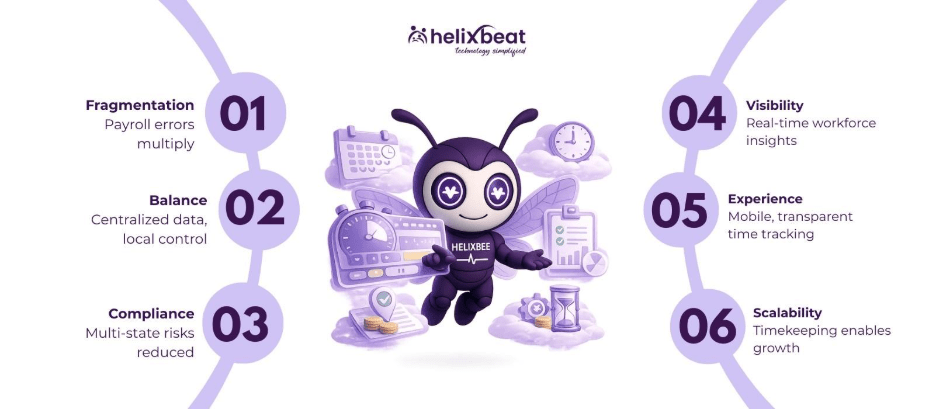
Table of Contents
When Every Location Tracks Time Differently, Payroll Errors Become Inevitable
When time tracking lacks consistency, payroll accuracy doesn’t stand a chance. The more locations involved, the faster small gaps turn into costly mistakes.
Why fragmented timekeeping breaks payroll accuracy at scale
In multi-location organizations, inconsistency is the real enemy. While one branch relies on spreadsheets, another uses biometric devices, and a third tracks hours manually. As a result, payroll teams are left reconciling mismatched formats, incomplete punches, and inconsistent overtime rules every pay cycle.
Data shows that 1 in every 5 payrolls contains errors, and fixing those mistakes can cost businesses up to $291 per employee each year. For companies operating across cities or states, those costs don’t just add up—they multiply quickly.
Without centralized employee timekeeping software in place:
- Overtime calculations vary based on manager interpretation
- Missed punches remain unnoticed until payroll week
- Payroll processing cycles grow longer month after month
The hidden cost of “fixing it later”
Most organizations underestimate the real impact of payroll errors. While financial losses are obvious, long-term damage runs deeper. Repeated inaccuracies erode employee trust, increase HR support tickets, and raise compliance exposure. In fact, employees who are paid incorrectly are twice as likely to disengage. At scale, centralization is no longer a nice-to-have—it becomes a form of damage control.
Centralized Time Data Sounds Great—Until Local Managers Feel Stripped of Control
Centralization often promises efficiency, yet resistance builds when managers feel their authority slipping away. That tension is where many systems fail.
Why centralized systems often fail at the ground level
Many US organizations hesitate to centralize time tracking because of a valid concern: will local managers lose flexibility? In industries like retail, healthcare, logistics, and field services, each location operates under unique staffing and scheduling realities.
However, traditional systems tend to centralize data and control. They often:
- Force rigid schedules across all locations
- Remove manager-level approvals
- Create delays when correcting attendance issues
Because of this, adoption suffers. Centralization without local authority quickly becomes another top-down tool that managers and employees resist.
What modern employee timekeeping software gets right
Today’s platforms take a different approach. Modern employee timekeeping software centralizes visibility, not decision-making. While leadership gains real-time oversight, local managers still approve time, resolve exceptions, and manage schedules. This balance allows organizations to standardize data without disrupting how teams operate on the ground.
Multi-State Labor Laws Make Timekeeping a Compliance Minefield
As businesses expand across states, compliance complexity increases just as fast. Without accurate time data, risk becomes unavoidable.
Why US labor compliance is harder for multi-location businesses
Operating across multiple states means navigating a patchwork of labor regulations, including:
- Different overtime thresholds
- State-specific meal and rest break laws
- Local predictive scheduling requirements
In a single year, over $274 million in back wages was collected due to wage and hour violations. Many of these penalties stem from inaccurate or inconsistent time tracking. Unfortunately, manual processes and disconnected tools simply can’t adapt quickly enough when regulations change.
How centralized systems reduce compliance exposure
With centralized employee timekeeping software, compliance becomes proactive instead of reactive. Overtime rules apply automatically based on location, break compliance is enforced digitally, and detailed audit trails are created without manual effort. This not only reduces risk but also strengthens defensibility during audits.
Real-Time Visibility Across Locations Changes How Leaders Make Decisions
When workforce data arrives too late, decisions are already compromised. Visibility in real time changes how leaders respond—and plan.
Why delayed data leads to reactive workforce management
When time data stays locked within individual locations, leadership decisions remain retrospective. Staffing shortages, overtime spikes, and absenteeism trends are often discovered weeks later, after costs have already been incurred, and productivity has taken a hit.
Organizations using real-time workforce analytics are 56% more likely to improve productivity outcomes, simply because they can act before problems escalate.
What centralized dashboards unlock
Centralized employee timekeeping software gives leaders a real-time view of workforce performance across locations. This includes:
- Live labor cost tracking by location
- Overtime trend comparisons across regions
- Early indicators of burnout or understaffing
With this level of insight, workforce management shifts from reactive firefighting to predictive planning.
Employees Expect Mobile, Transparent Time Tracking—Not Just HR
Today’s employees expect time tracking to be fast, transparent, and mobile—just like the apps they use in daily life. Without it, frustration grows quickly.
Why employee experience now drives timekeeping adoption
US employees increasingly want self-service tools for managing work-related tasks, from clocking hours to tracking leave. Outdated time clocks and paper logs create friction:
- Missed punches go unreported
- Leave balances feel unclear
- Employees distrust payroll outcomes
The impact of app-based employee timekeeping software
Mobile-enabled employee timekeeping software allows employees to:
- Clock in from approved locations
- View hours worked in real time
- Request corrections instantly
This transparency reduces disputes, increases accountability, and builds trust across all locations.
How Synergy HRMS Centralizes Timekeeping Without Micromanaging Locations
Centralization doesn’t have to mean micromanagement. The right system balances oversight with flexibility, keeping operations smooth at every location.
Synergy HRMS as more than employee timekeeping software
Synergy HRMS is a full HRMS solution with advanced employee timekeeping software built in—not a standalone tool. It is designed for organizations managing distributed, multi-location workforces.
What sets Synergy apart is how it balances structure and autonomy:
- Centralized data for leadership
- Location-level controls for managers
- Self-service access for employees
Key Synergy HRMS capabilities for multi-location businesses
| Challenge | How Synergy HRMS Solves It |
| Disconnected time data | Centralized dashboards across all US locations |
| Loss of local control | Role-based approvals by branch or region |
| Compliance complexity | Automated rule enforcement by state |
| Payroll delays | Clean, payroll-ready time data |
| Employee disputes | Transparent, app-based time visibility |
Synergy HRMS is also mobile-enabled, making it ideal for deskless, frontline, and field-based teams.
Centralized Timekeeping Becomes a Growth Enabler, Not Just an HR Tool
When standardized early, timekeeping stops being a headache and becomes a strategic advantage for growing organizations.
Why scalable businesses fix timekeeping early
High-growth US companies standardize time tracking before payroll chaos arises. Automated employee timekeeping software helps them reduce operational costs and streamline HR processes, with data showing 18% lower HR costs over three years.
From operational efficiency to strategic advantage
When timekeeping is centralized and trusted:
- Payroll becomes predictable
- Compliance risk shrinks
- Managers focus on people, not corrections
At this stage, employee timekeeping software evolves from an administrative necessity to a tool that drives business growth.
Wrapping Up
For multi-location US businesses, centralized timekeeping is about clarity, not control. The right employee timekeeping software, like Synergy HRMS, delivers real-time visibility, local autonomy, and compliance confidence. When time data flows seamlessly, everything else moves faster and more accurately.
Your workforce deserves clarity—upgrade to Synergy HRMS today!
FAQs
1. Can centralized timekeeping handle union and non-union locations together?
Yes. Advanced platforms apply different labor rules by location or employee group while maintaining one unified data structure.
2. What happens if a location loses internet connectivity?
Mobile-enabled systems store punches offline and sync automatically once connectivity is restored, preventing data loss.
3. How does centralized timekeeping reduce payroll processing time?
Payroll-ready data eliminates manual reconciliation, cutting processing cycles by up to 30–40%, according to payroll benchmarking studies.
4. How does timekeeping software support rapid business expansion?
New locations can be added with predefined rules, approval flows, and compliance settings—without rebuilding processes from scratch.
5. Can timekeeping data be used beyond payroll?
Yes. Organizations use it for workforce forecasting, overtime control, productivity analysis, and compliance reporting.