

With health going digital, FHIR has emerged as the gold standard for moving data from one place to another. Developed by Health Level Seven International (HL7), Fast Healthcare Interoperability Resources (FHIR) facilitates seamless communication between disparate systems. Beyond just handling health records, FHIR in healthcare acts as a bridge for everything from lab systems to wearable medical devices. This expansion addresses critical needs in modern healthcare, like real-time data sharing and improved patient outcomes.
According to HL7 and ONC-aligned industry data, a large majority of U.S. hospitals now support FHIR-based APIs within their EHR systems, but the real innovation lies in how FHIR is being applied beyond traditional clinical records. Therefore, we’ll explore how FHIR bridges the gap between different tech, like heart monitors and lab software, to help everything run smoothly.
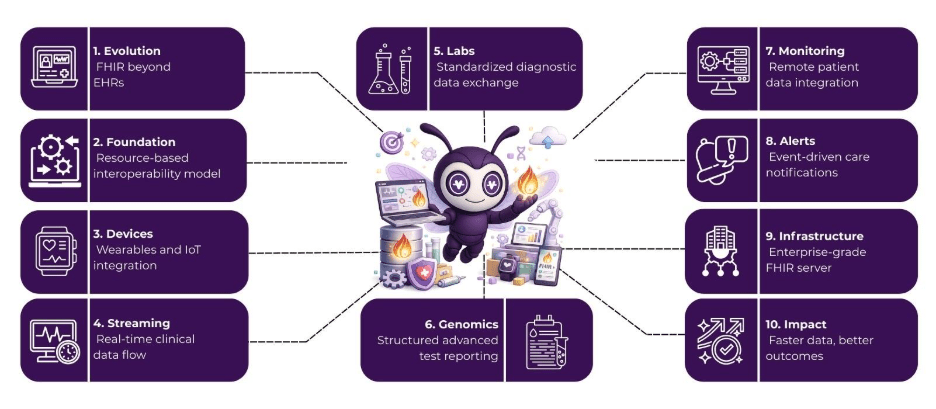
Table of Contents
Understanding the Foundations of FHIR in Healthcare
FHIR in healthcare builds on a resource-oriented architecture. Each resource represents a specific data element, like a patient’s demographics or a diagnostic test result. These resources can be queried, created, updated, or deleted via standard HTTP methods, similar to how web services operate. This approach contrasts with rigid, message-based standards of the past.
For example, by using the Observation resource to log blood pressure or glucose, you can share critical health data with a whole range of platforms outside the EHR. FHIR relies on this foundation to stop data from getting trapped in separate silos. The U.S. Core FHIR profiles, mandated by the Office of the National Coordinator for Health Information Technology (ONC), set baselines for interoperability in the United States.
FHIR in Healthcare Device Integration: Connecting Wearables and IoT
One of the most transformative applications of FHIR in healthcare involves medical devices. From wearable fitness trackers to implanted pacemakers, devices generate vast amounts of data. FHIR uses the Device resource to describe the equipment, DeviceMetric to track how it’s performing, and Observation to tie it all to the patient’s actual results.
Consider smartwatches like the Apple Watch. These devices continuously capture heart rate, activity, sleep, and ECG data. With FHIR APIs, this patient-generated information can flow directly into healthcare systems. For example, users can share their stats with providers via Apple’s HealthKit, thanks to its built-in support for FHIR export. As a result, clinicians can view Apple Watch data inside EHRs or through connected applications, supporting remote monitoring of chronic conditions and earlier clinical interventions.
Within hospitals, FHIR in healthcare also supports IoT device integration. Ventilators, infusion pumps, and bedside monitors share data via FHIR gateways, with IHE FHIR profiles providing standardized device communication. This shift toward FHIR-enabled device connectivity transforms isolated equipment into part of a unified clinical ecosystem.
Moreover, FHIR supports real-time streaming. Using WebSockets or subscriptions, devices can push updates instantly. This capability proves critical in intensive care units, where delays in data can impact decisions. Standards like IEEE 11073, when mapped to FHIR, bridge legacy devices to modern networks.
Integrating Labs with FHIR in Healthcare: Streamlining Diagnostic Data
Laboratory information systems (LIS) manage a wide range of test results, from common blood work to specialized genomic assays. FHIR in healthcare provides standardized resources such as DiagnosticReport and Observation that represent lab results and associated data in structured form, making it possible to share results, interpretations, and specimen information across systems in a consistent way.
Traditional lab integrations relied on HL7 v2 messages, which often required custom mappings. FHIR replaces the custom mappings of HL7 v2 with a RESTful API to request and retrieve specific resources (e.g., using GET operations for Observation or DiagnosticReport) through standardized REST endpoints.
API platforms that support FHIR profiles — such as third-party diagnostic networks that exchange orders and results with major labs — illustrate how modern interoperability frameworks can integrate laboratory data into broader clinical workflows.
There are also dedicated implementation guides, including the HL7 FHIR Genomics Reporting Implementation Guide, which define conventions for reporting genomic test results in structured FHIR formats.
By providing uniform data models and API mechanisms, FHIR enables more flexible querying of lab results, improved electronic exchange with EHRs and downstream systems, and the potential for faster availability of diagnostic information in clinical decision-making processes.
FHIR in Healthcare Remote Monitoring: Supporting Telehealth and RPM
Remote Patient Monitoring (RPM) systems collect health data from patients outside traditional clinical environments using connected devices. FHIR resources like Observation capture readings from home-based devices, while CarePlan, Goal, and ServiceRequest can represent monitoring protocols, clinical objectives, and follow-up actions. This structured approach enables RPM data to be integrated into electronic health records and care management platforms in a consistent, interoperable format.
Major digital health and medical technology companies, including Philips and Medtronic, support interoperability standards such as HL7 and FHIR across their connected care and digital health platforms.
FHIR also supports real-time event notifications through subscription mechanisms. Instead of constantly checking for updates, FHIR pings connected systems in real-time whenever new data or specific triggers occur. This capability enables proactive care models, such as alerting care teams when a patient’s blood glucose, oxygen saturation, or blood pressure readings indicate potential deterioration.
In mental and behavioral health, FHIR-enabled applications can exchange structured data such as mood assessments, questionnaires, wearable-derived activity metrics, and therapy notes, supporting more integrated digital care experiences across platforms.
In the United States, the Centers for Medicare & Medicaid Services (CMS) provides reimbursement pathways for RPM services and promotes the use of standardized APIs for data sharing. While FHIR is not mandated for RPM reimbursement, it is widely adopted as a practical standard for meeting interoperability requirements.
Powering Interoperability at Scale with FUSION
As healthcare organizations move beyond basic EHR integrations into device connectivity, laboratory interoperability, and remote monitoring, the underlying FHIR infrastructure becomes just as important as the standard itself. Therefore, a robust FHIR server is required to store, validate, secure, and exchange large volumes of clinical and device-generated data in real time.
FUSION is an enterprise-grade FHIR server designed to support these advanced interoperability use cases. It provides a centralized platform for managing FHIR resources across multiple domains, including devices, diagnostics, and remote patient monitoring systems.
FUSION supports core FHIR capabilities like:
- Storage and retrieval of high-volume Observation, Device, DiagnosticReport, CarePlan, Patient resources, and more
- RESTful APIs aligned with HL7 FHIR specifications
- Subscription-based event notifications for near real-time updates
- Validation against FHIR profiles and implementation guides
- Secure authentication and authorization mechanisms
FUSION goes deeper by embedding critical medical coding systems like SNOMED CT, LOINC, and ICD-10 directly into its architecture. This built-in intelligence maintains data consistency and accuracy, transforming raw information into actionable insights ready for clinical decisions, regulatory reporting, and advanced analytics. No more wrestling with mismatched formats or manual mappings: FUSION handles the heavy lifting!
Organizations using FUSION report up to 70% faster data sharing, slashing referral delays by 60% and reducing redundant tests by 25%. That’s not hype; it’s a measurable impact, with providers saving $1,000–$2,000 per patient annually through streamlined claims and operations.
If you’re looking to operationalize FHIR for device integration, lab connectivity, and remote monitoring, FUSION is built for modern interoperability requirements.
Certified Excellence
FUSION is officially certified by the Drummond Group for FHIR-based interoperability, validating its conformance with healthcare data exchange standards HL7, FHIR, and SMART on FHIR. This certification demonstrates that FUSION meets industry-recognized benchmarks for secure, standardized data exchange — giving you the confidence to integrate seamlessly across systems.
What This Means for You
In a complex healthcare ecosystem, FUSION simplifies connectivity and safeguards data integrity. With enterprise-grade uptime (99.99%) and secure authentication powered by OAuth2 and encrypted endpoints, it supports trusted, real-time collaboration between hospitals, labs, and payers.
Whether you’re mapping USCDI elements for regulatory reporting or automating data flows for public-health initiatives, FUSION keeps you compliant with current interoperability frameworks and ready for future mandates.
Final Thoughts
As FHIR in healthcare expands beyond EHR-to-EHR exchange into devices, laboratories, and remote monitoring ecosystems, healthcare organizations need infrastructure that can reliably support these complex, high-volume interoperability demands. FUSION provides a purpose-built FHIR server foundation for managing, validating, and exchanging clinical and device data across diverse systems using HL7 FHIR standards.
Discover how FUSION can power your interoperability strategy and accelerate your FHIR initiatives. Contact us today to learn more.
FAQs
1. What is FHIR in healthcare?
FHIR (Fast Healthcare Interoperability Resources) is a standard developed by HL7 for exchanging healthcare data using modern, web-based APIs and structured data resources.
2. How does FHIR support device integration?
FHIR represents device data using resources such as Device, DeviceMetric, and Observation, allowing wearable and bedside device readings to be shared with clinical systems.
3. Can FHIR be used for laboratory data exchange?
Yes. FHIR resources like DiagnosticReport and Observation allow lab results, interpretations, and specimen details to be exchanged in a standardized format.
4. How does FHIR enable remote patient monitoring?
FHIR captures home device readings as Observation resources and uses CarePlan and Goal to represent monitoring protocols and care objectives.
5. What are FHIR subscriptions?
Subscriptions allow systems to receive notifications when data changes, supporting near real-time alerts and event-driven workflows.