

Healthcare organizations face growing pressure to manage costs while providing high-quality patient care. One of the major challenges in modern healthcare IT is integrating multiple systems, including electronic health records (EHRs), laboratory information systems, imaging software, and billing platforms. However, traditional integration approaches often require custom interfaces, expensive middleware, and continuous maintenance.
Currently, FHIR enables secure, efficient, and standardized data exchange across healthcare systems. By implementing FHIR server integration, healthcare organizations can streamline interoperability, reduce IT development and maintenance expenses, and improve access to patient data in real time. In this blog, we explore how FHIR servers lower healthcare IT integration costs, supported by real-world examples.
Table of Contents
What Is FHIR Server Integration?
FHIR server integration refers to connecting healthcare IT systems using FHIR standards. Unlike traditional HL7 V2 or CDA-based integrations, FHIR uses modern web technologies like RESTful APIs, JSON, and XML. This approach simplifies data sharing between applications and reduces the complexity of building custom interfaces.
Key Components of FHIR Servers:
- Resources: The building blocks of FHIR, representing healthcare data elements like patients, medications, and appointments.
- RESTful APIs: Allow CRUD (Create, Read, Update, Delete) operations on FHIR resources using standard HTTP protocols.
- Terminology Services: Support standard coding systems like SNOMED CT, LOINC, and ICD-10 to maintain consistent clinical data.
- Security Protocols: OAuth2 and SMART on FHIR provide controlled access to sensitive health information.
Advantages Over Traditional Integration Methods:
| Traditional Integration | FHIR Server Integration | Cost Impact |
| Custom interfaces for each system | Standardized APIs | Lower development cost |
| Complex middleware management | Lightweight web services | Reduced maintenance cost |
| Limited interoperability | Cross-platform compatibility | Fewer integration failures |
| Slow updates and upgrades | Modular resources | Quicker deployment |
How FHIR Servers Reduce Development Costs?
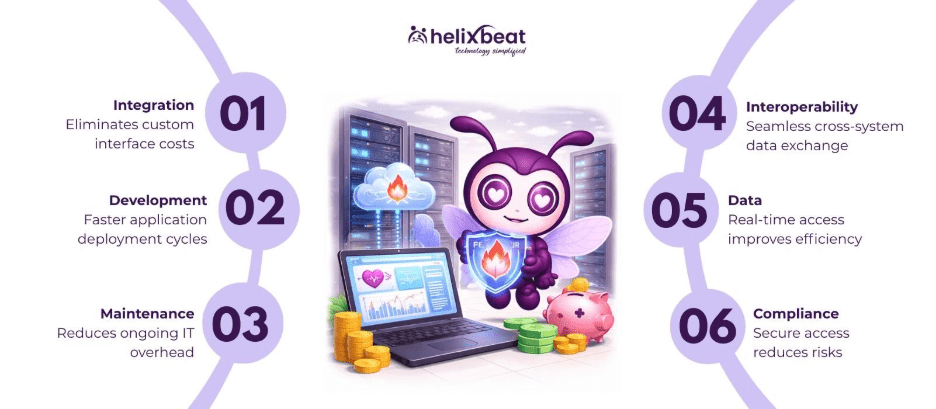
Developing interfaces between healthcare systems traditionally involves custom coding, extensive testing, and ongoing support. By adopting a FHIR server, organizations replace these resource-heavy, one-off interfaces with a standardized framework.
Reduced Need for Custom Interfaces
FHIR server integration leverages standard APIs that allow systems to communicate without creating unique, point-to-point connections for each application. As a result, hospitals can connect EHRs, laboratory systems, and patient portals using the same FHIR interface. This dramatically reduces development time and associated labor costs.
Accelerated Application Development
FHIR resources and APIs are well-documented and widely supported. As a result, applications such as patient engagement tools, telemedicine platforms, and reporting dashboards can be deployed faster.
Lower Maintenance and Operational Costs
Streamlined Upgrades
With FHIR server integration, updates to one system rarely require reworking interfaces for every connected application. Standardized APIs mean that upgrades can be applied modularly without affecting the entire network.
Reduced Error Handling Costs
Traditional interfaces often lead to mismatched data formats, errors in patient records, and manual reconciliation. However, standardizing data via FHIR reduces administrative overhead and mitigates the risk of compliance-related fines by eliminating common structural errors.
Enhancing Interoperability Across Systems
Cross-Vendor Compatibility
FHIR server integration allows EHRs, laboratory systems, imaging software, and billing applications from different vendors to exchange data seamlessly. As a result, hospitals can avoid the costs of replacing legacy systems while still achieving high interoperability.
Real-Time Data Exchange
Real-time access to patient data enhances clinical decision-making, reduces duplicate tests, and optimizes resource allocation. For example, emergency departments can immediately access laboratory results or imaging reports without waiting for manual transfers, saving both time and operational costs.
Cost Benefits in Data Storage and Management
Efficient Data Models
FHIR resources are modular and standardized, which reduces data redundancy. Instead of storing multiple incompatible formats, healthcare organizations can maintain a single source of truth and lower storage costs.
Cloud-Based FHIR Servers
Many healthcare organizations deploy FHIR servers in the cloud. Cloud storage reduces capital expenditure on physical servers, provides automatic scaling, and eliminates the need for in-house data center management.
Supporting Compliance and Security
Simplified Audit Trails
FHIR APIs record access logs for every data transaction. This capability reduces manual auditing labor and supports regulatory reporting.
Role-Based Access Control
By integrating FHIR servers, healthcare IT teams can define user roles and permissions more efficiently. As a result, sensitive data is only accessible to authorized personnel, which reduces risks and potential legal costs associated with data breaches.
Real-World Examples of Cost Savings
Hospital System EHR Integration
A multi-hospital network implemented FHIR APIs to integrate three different EHR platforms. They reported:
- 40% reduction in custom interface development costs
- 30% decrease in IT maintenance expenses
- Faster deployment of new clinical applications
Laboratory Data Management
A regional laboratory network adopted a FHIR server to connect multiple hospitals and clinics. Results included:
- 50% reduction in duplicate lab tests
- Faster delivery of results to clinicians
- Reduced labor hours spent reconciling data errors
| Savings Area | Before FHIR | After FHIR | Cost Reduction |
| Interface Development | $500,000 | $300,000 | 40% |
| Maintenance | $200,000 | $140,000 | 30% |
| Duplicate Tests | $100,000 | $50,000 | 50% |
Measuring ROI of FHIR Server Integration
Healthcare organizations can quantify the return on investment (ROI) from FHIR adoption by tracking key metrics:
- Reduction in interface development hours
- Decrease in IT maintenance costs
- Reduced duplicate testing and administrative errors
- Faster application deployment and patient data access
Studies show that hospitals adopting FHIR standards can reduce IT integration costs by 30-50%, depending on the size of the organization and complexity of systems.
Best Practices for Cost-Effective FHIR Server Integration
- Prioritize high-impact systems first – Start integration with systems that exchange the most data, such as EHRs and labs.
- Adopt cloud-based FHIR servers – Reduce capital expenditure and scale on demand.
- Use standard FHIR resources – Minimize custom extensions to reduce maintenance costs.
- Train staff effectively – Proper training accelerates adoption and reduces errors.
- Leverage vendor-supported APIs – Vendors often provide prebuilt FHIR endpoints for quicker integration.
Unlock Seamless Healthcare Interoperability with FUSION
Built by Helixbeat, FHIR server FUSION leverages RESTful APIs for seamless connectivity with legacy systems, modern EHRs, and emerging tools like wearable devices and telehealth platforms. This isn’t just compliance, it’s acceleration.
Organizations using FUSION report up to 70% faster data sharing, slashing referral delays by 60% and reducing redundant tests by 25%. That’s not hype; it’s a measurable impact, with providers saving $1,000 – $2,000 per patient annually through streamlined claims and operations.
Certified Excellence
FUSION is officially certified by the Drummond Group for FHIR-based interoperability, validating its conformance with healthcare data exchange standards HL7, FHIR, and SMART on FHIR. This certification demonstrates that FUSION meets industry-recognized benchmarks for secure, standardized data exchange.
Final Thoughts
FHIR server integration is revolutionizing healthcare IT by providing a standardized, scalable, and cost-effective approach to system interoperability. By reducing development, maintenance, and operational costs, FHIR servers allow healthcare organizations to focus resources on improving patient care.
FUSION, an enterprise-grade FHIR server, is designed to simplify interoperability, reduce IT costs, and accelerate application deployment. Connect your EHRs, labs, and billing systems effortlessly, and access real-time patient data securely. Get Started with FUSION!
FAQs
1: What is FHIR server integration?
FHIR server integration connects healthcare IT systems using standardized FHIR APIs and resources, enabling seamless data exchange between EHRs, labs, imaging systems, and patient portals.
2: How does FHIR reduce healthcare IT costs?
FHIR reduces costs by standardizing APIs, lowering the need for custom interfaces, minimizing maintenance, reducing errors, and optimizing data storage.
3: Can FHIR servers work with legacy EHR systems?
Yes. Middleware or data mapping tools can bridge older systems with modern FHIR servers, allowing integration without replacing legacy infrastructure.
4: What types of healthcare data can FHIR servers handle?
FHIR servers manage patient records, medications, lab results, imaging data, appointments, billing information, and more using standardized resources.