

Digital transformation in healthcare is accelerating rapidly, driven by the need for interoperability, better patient outcomes, and streamlined clinical workflows. At the heart of this shift lies a powerful enabler: APIs. A well-defined healthcare API strategy allows healthcare organizations to connect systems, share data securely, and innovate faster.
One of the most widely adopted standards supporting this transformation is FHIR. In this blog, we’ll explore how to build a robust healthcare API strategy using HL7 FHIR, step by step.
Table of Contents
What Is a Healthcare API Strategy?
A healthcare API strategy is a structured approach to designing, implementing, and managing APIs that enable seamless data exchange across healthcare systems. It defines how applications communicate, how data is accessed, and how security and compliance are maintained.
Instead of fragmented integrations, APIs create a standardized layer that connects:
- Electronic health records (EHRs)
- Laboratory systems
- Patient-facing applications
- Billing and administrative platforms
A strong healthcare API strategy allows organizations to scale integrations, reduce complexity, and support innovation across the care continuum.
Key Benefits of a Healthcare API Strategy Using FHIR
A well-executed healthcare API strategy offers several advantages:
Improved Interoperability
FHIR enables real-time data exchange between systems, which eliminates silos and improves care coordination.
Faster Innovation
Developers can build applications quickly using standardized APIs and accelerate digital health innovation.
Better Patient Engagement
By using APIs, patients can pull their health records straight into mobile apps, which naturally builds trust and keeps them involved.
Regulatory Alignment
FHIR meets most global data standards, making it much easier for organizations to stay compliant.
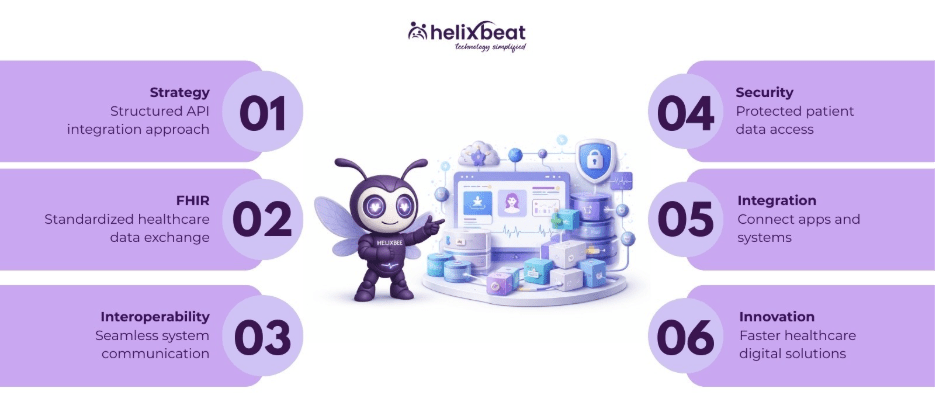
Core Components of a Healthcare API Strategy
Before implementing FHIR, it’s important to define the foundational elements of your healthcare API strategy.
1. API Governance Framework
Define policies for:
- API design standards
- Versioning
- Documentation
- Lifecycle management
A governance framework maintains consistency across all APIs.
2. Security and Compliance
Healthcare data is highly sensitive. Therefore, your strategy should include:
- OAuth 2.0 for authorization
- OpenID Connect for authentication
- Data encryption (in transit and at rest)
- Audit logging
3. Data Standardization
Align your data models with FHIR resources to enable interoperability.
4. Developer Experience
Provide clear documentation, sandbox environments, and SDKs to make API adoption easier.
Step-by-Step Guide to Building a Healthcare API Strategy Using HL7 FHIR
Step 1: Define Your Objectives
Start by identifying what you want to achieve with your healthcare API strategy.
Common goals include:
- Connecting disparate systems
- Enabling patient data access
- Supporting third-party app integration
- Improving clinical workflows
Clear objectives guide your API design and implementation.
Step 2: Assess Your Current Infrastructure
Evaluate your existing systems:
- Are your EHRs FHIR-compatible?
- Do you use legacy standards like HL7 v2 or CDA?
- What integration challenges exist?
This assessment helps identify gaps and opportunities.
Step 3: Adopt FHIR as Your Data Standard
Transitioning to HL7 FHIR involves:
- Mapping existing data to FHIR resources
- Defining profiles for specific use cases
- Using FHIR terminology standards like SNOMED CT and LOINC
This step forms the backbone of your healthcare API strategy.
Step 4: Design RESTful APIs
FHIR APIs follow REST principles:
- GET for retrieving data
- POST for creating resources
- PUT/PATCH for updates
- DELETE for removal
Design APIs around FHIR resources such as:
- Patient
- Observation
- Encounter
- MedicationRequest
Focus on simplicity and consistency.
Step 5: Build an API Layer with AERIS
With AERIS, you can create an API gateway or middleware layer that:
- Translates legacy data into FHIR format
- Manages API traffic
- Handles authentication and authorization
This layer acts as a bridge between old systems and modern applications.
Step 6: Implement Security Protocols
Security is a critical component of any healthcare API strategy.
Key measures include:
- OAuth 2.0 for secure access
- Role-based access control (RBAC)
- Token-based authentication
- Data masking for sensitive fields
These controls protect patient data and maintain compliance.
Step 7: Develop and Test APIs
Build APIs iteratively and test them thoroughly:
- Unit testing for individual endpoints
- Integration testing across systems
- Performance testing under load
Use FHIR test servers and validation tools to verify compliance.
Step 8: Create Developer-Friendly Documentation
Comprehensive documentation improves adoption:
- API endpoints and parameters
- Example requests and responses
- Error handling guidelines
Interactive documentation tools can enhance usability.
Step 9: Enable Third-Party Integrations
A successful healthcare API strategy supports external developers.
Provide:
- Developer portals
- Sandbox environments
- API keys and access controls
This encourages innovation and expands your ecosystem.
Step 10: Monitor and Optimize
Track API performance and usage:
- Response times
- Error rates
- API traffic patterns
Use analytics to identify improvements and optimize performance.
How AERIS Revolutionizes Interoperability with FHIR APIs?
Imagine a world where your healthcare organization thrives with seamless, secure, and real-time data exchange. That’s the power of AERIS by Helixbeat, a game-changing platform designed to transform how you connect, collaborate, and care. Built for healthcare providers, clinics, hospitals, and cross-industry partners like pharmacies and insurers, AERIS harnesses FHIR APIs to break down data silos, streamline operations, and put patient care first.
Ready to cut delays by 50%, double your ROI, and empower your team with instant access to critical data? Let’s dive into why AERIS is the solution you’ve been waiting for.
Why AERIS is Your Key to Healthcare Innovation?
At Helixbeat, we know your challenges: fragmented systems, delayed data, and rising costs. AERIS is here to change that, offering a personalized, scalable, and secure platform that fits your unique needs. Whether you’re a small clinic or a sprawling hospital network, AERIS delivers measurable results that elevate patient outcomes and boost your bottom line.
- 20+ Years of Expertise: Our team brings decades of healthcare IT experience to ensure AERIS works for you.
- 50+ IT Professionals: A dedicated crew powers AERIS, delivering unmatched support and innovation.
- 1,000+ Customers: Join a thriving community of healthcare leaders already transforming with AERIS.
- 10,000+ Projects Completed: Proven success across countless integrations and workflows.
- 95% Returning Customers: Our clients trust AERIS to deliver, time and time again.
Providers adopting AERIS report faster diagnoses, lower costs, and improved outcomes, positioning it as the go-to tool for future-proof HIE.
Your Benefits, Amplified
- 50% Fewer Delays: Real-time data means critical information is always at your fingertips, turning hours into seconds.
- 100% Faster ROI: Plug-and-play integration maximizes your investment without expensive system replacements.
- 30% Cost Savings, 90% Fewer Errors: Automation eliminates waste, saving resources and ensuring accuracy.
Final Thoughts
Building a strong healthcare API strategy using HL7 FHIR is a decisive step toward achieving true interoperability in modern healthcare. By aligning your APIs with FHIR, focusing on governance, prioritizing security, and enabling seamless integrations, healthcare providers can move beyond disconnected systems and create a unified digital ecosystem.
If you’re ready to modernize your healthcare infrastructure and unlock the full potential of FHIR-based APIs, AERIS is your next step. Contact us to accelerate interoperability!
FAQs
1. What is a healthcare API strategy?
A healthcare API strategy is a framework for designing and managing APIs that enable secure and efficient data exchange across healthcare systems.
2. Why is HL7 FHIR important?
HL7 FHIR provides a standardized way to exchange healthcare data using modern web technologies, improving interoperability.
3. How does FHIR differ from older standards?
FHIR uses RESTful APIs and modern data formats like JSON, making it more flexible and developer-friendly than older standards like HL7 v2.
4. What are FHIR resources?
FHIR resources are modular data components such as Patient, Observation, and Medication used to structure healthcare data.
5. Is FHIR secure?
FHIR supports industry-standard security protocols like OAuth 2.0 and OpenID Connect to protect sensitive data.