

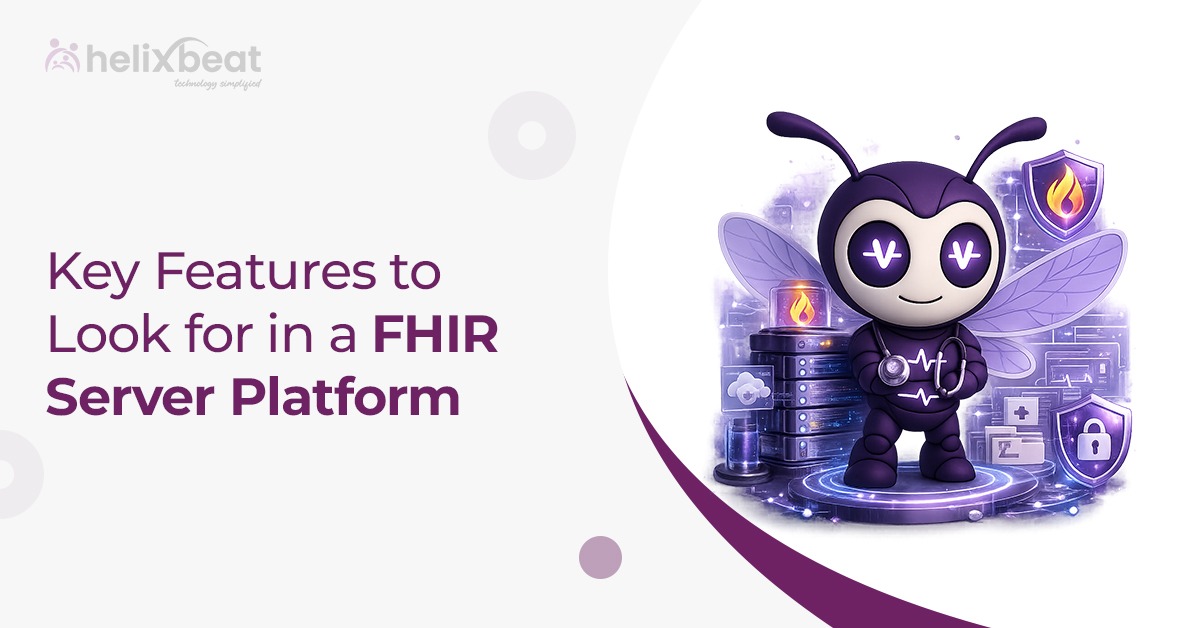
Today, healthcare systems across the globe are moving toward interoperable, data-driven ecosystems. At the heart of it all is the FHIR server, which serves as the foundation for moving data securely and instantly. As organizations adopt modern healthcare IT infrastructures, choosing the right platform becomes key as it directly impacts scalability, compliance, and patient outcomes.
Therefore, in this guide, we explore the key features to look for in a FHIR server platform.
Table of Contents
What Is a FHIR Server Platform?
A FHIR server platform is a software system designed to store, manage, and exchange healthcare data using the Fast Healthcare Interoperability Resources (FHIR) standard. It provides APIs and tools that allow healthcare applications to communicate seamlessly, regardless of their underlying technologies.
FHIR servers support standardized data formats like JSON and XML and enable interoperability between systems like electronic health records (EHRs), mobile health apps, and clinical decision support tools.
Why Choosing the Right FHIR Server Platform Matters?
Selecting the right FHIR server platform goes beyond technical compatibility. It impacts:
- Data accessibility across systems
- Compliance with global healthcare regulations
- Scalability for future growth
- Security and privacy of sensitive patient data
- Speed of innovation and deployment
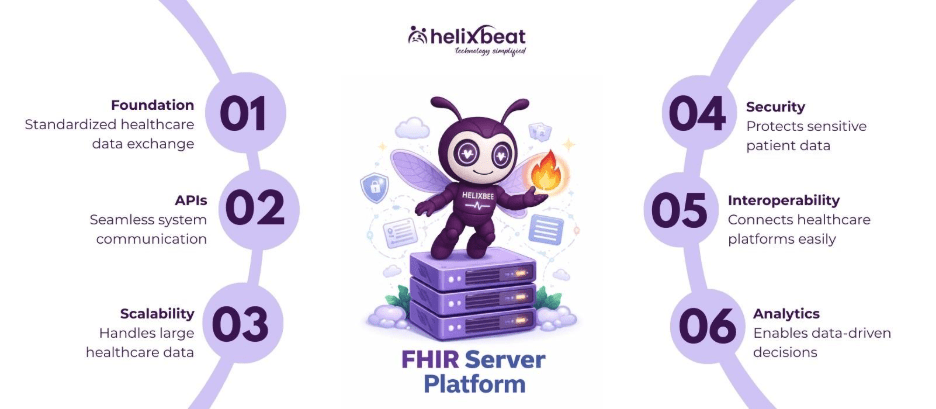
Key Features to Look for in a FHIR Server Platform
1. Full Compliance with FHIR Standards
The most fundamental requirement of any FHIR server platform is strict adherence to FHIR specifications.
Look for:
- Support for multiple FHIR versions (DSTU2, STU3, R4, R5)
- Compatibility with core FHIR resources (Patient, Observation, Encounter, etc.)
- Validation against FHIR profiles and implementation guides
A standards-compliant platform enables seamless interoperability across systems and reduces integration complexity.
2. Robust API Capabilities
By using APIs, FHIR platforms facilitate a smooth flow of information across the entire healthcare network.
Essential API features include:
- RESTful API architecture
- CRUD operations (Create, Read, Update, Delete)
- Advanced search capabilities
- Batch and transaction support
- Subscription-based notifications
A well-designed API layer allows developers to build scalable applications quickly and efficiently.
3. Scalability and Performance
Healthcare data volumes are growing exponentially. Therefore, a modern FHIR server platform must handle:
- High transaction loads
- Large datasets
- Real-time data processing
Key considerations:
- Horizontal and vertical scaling capabilities
- Load balancing support
- Low latency response times
Cloud-native platforms often provide better scalability compared to on-premise solutions.
4. Security and Data Privacy
Healthcare data is highly sensitive, making security a top priority for any FHIR server platform.
Critical security features must include:
- OAuth 2.0 and OpenID Connect authentication
- Role-based access control (RBAC)
- Data encryption (at rest and in transit)
- Audit logging and monitoring
- Compliance with regulations like HIPAA
A secure platform protects patient information while maintaining regulatory compliance.
5. Interoperability and Integration Support
The primary goal of a FHIR server platform is interoperability. It should easily integrate with:
- Electronic Health Record (EHR) systems
- Laboratory systems
- Imaging platforms
- Third-party healthcare applications
Look for:
- Support for HL7 v2 and CDA alongside FHIR
- Integration with legacy systems
- Middleware compatibility
Strong interoperability capabilities help create a unified healthcare ecosystem.
6. Data Storage and Management Flexibility
Different healthcare organizations have unique data storage requirements. Therefore, a flexible FHIR server platform should support:
- Structured and unstructured data
- Multiple database options (SQL, NoSQL)
- Versioning and history tracking
- Data normalization and indexing
Efficient data management enhances performance and simplifies analytics.
7. Advanced Search and Query Functionality
A powerful search mechanism is important for extracting meaningful insights from healthcare data.
Key features must include:
- Parameter-based search
- Full-text search
- Filtering and sorting
- Pagination support
- Support for chained and reverse-chained queries
These capabilities allow clinicians and developers to retrieve relevant data quickly.
8. Support for SMART on FHIR
SMART on FHIR is a widely adopted framework for building interoperable healthcare applications.
A modern FHIR server platform should support:
- SMART authorization workflows
- Third-party app integration
- Secure data sharing across applications
This feature enables innovation by allowing developers to build plug-and-play healthcare apps.
9. Real-Time Data Exchange
Timely access to patient data directly impacts clinical outcomes.
Therefore, look for platforms offering:
- Event-driven architecture
- Webhooks and subscriptions
- Real-time updates and notifications
Real-time capabilities improve care coordination and decision-making.
10. Terminology Services Integration
Healthcare data relies heavily on standardized terminologies.
An advanced FHIR server platform should integrate with:
- SNOMED CT
- LOINC
- ICD-10
Features to look for:
- Code validation
- Value set expansion
- Terminology mapping
This helps maintain data consistency and improves clinical accuracy.
11. Data Analytics and Reporting
Data has become the backbone of how healthcare organizations make their most important calls.
Hence, a strong FHIR server platform should support:
- Built-in analytics tools
- Data export capabilities
- Integration with BI tools
- Population health insights
Analytics capabilities help organizations derive value from their data.
12. Customization and Extensibility
Every healthcare organization has unique workflows.
Therefore, a FHIR server platform should allow:
- Custom resource creation
- Extension support
- Configurable workflows
- Plugin architecture
Customization enables organizations to adapt the platform to their specific needs.
13. Monitoring and Logging Capabilities
Operational visibility is key to maintaining system performance.
Look for:
- Real-time monitoring dashboards
- Error tracking
- Usage analytics
- Audit logs
These features help identify issues and optimize system performance.
14. Support for Bulk Data Operations
Bulk data handling is non-negotiable for population health management.
That’s why a modern FHIR server platform should support:
- Bulk data export (Flat FHIR)
- Data import capabilities
- Integration with data lakes
This feature is particularly useful for research and analytics.
Unlock Seamless Healthcare Interoperability with FUSION
Built by Helixbeat, FHIR server FUSION leverages RESTful APIs for seamless connectivity with legacy systems, modern EHRs, and emerging tools like wearable devices and telehealth platforms. This isn’t just compliance, it’s acceleration.
Organizations using FUSION report up to 70% faster data sharing, slashing referral delays by 60% and reducing redundant tests by 25%. That’s not hype; it’s a measurable impact, with providers saving $1,000 – $2,000 per patient annually through streamlined claims and operations.
Certified Excellence
FUSION is officially certified by the Drummond Group for FHIR-based interoperability, validating its conformance with healthcare data exchange standards HL7, FHIR, and SMART on FHIR. This certification demonstrates that FUSION meets industry-recognized benchmarks for secure, standardized data exchange.
Final Thoughts
Choosing the right FHIR server platform plays a defining role in how effectively healthcare organizations exchange data, scale operations, and deliver patient-centric care. From interoperability and security to scalability and analytics, every feature contributes to building a future-ready digital health ecosystem.
Ready to modernize your healthcare infrastructure with a FHIR server? Connect with our experts today to explore how you can implement FUSION tailored to your organization.
FAQs
1. What is a FHIR server platform?
A FHIR server platform is a system that stores, manages, and exchanges healthcare data using the FHIR standard, enabling interoperability between different healthcare applications and systems.
2. Why is a FHIR server platform important in healthcare?
A FHIR server platform allows seamless data sharing across systems, improving care coordination, reducing duplication, and supporting better clinical decision-making.
3. What features should I prioritize in a FHIR server platform?
Key features include FHIR compliance, robust APIs, scalability, security, interoperability, real-time data exchange, and support for standards like SMART on FHIR.
4. Is a cloud-based FHIR server platform better than on-premise?
Cloud-based platforms offer better scalability, flexibility, and lower infrastructure costs, while on-premise solutions provide more control over data and security.
5. How does a FHIR server platform support interoperability?
It uses standardized APIs and data formats to allow different healthcare systems, such as EHRs and mobile apps, to communicate and exchange data efficiently.