

In the U.S. healthcare system, payments are no longer just transactions—they are part of a complex ecosystem involving patients, providers, insurers, and regulatory bodies. As financial workflows grow more intricate, healthcare organizations are increasingly relying on advanced healthcare payment platforms to manage everything from billing to claims and collections.
But not all platforms are built for the realities of healthcare.
One of the most critical decisions providers face today is choosing between open and closed healthcare payment platforms. This choice directly impacts operational efficiency, patient satisfaction, and long-term financial performance.
More importantly, it determines whether your organization is prepared for the future—or stuck managing outdated systems.
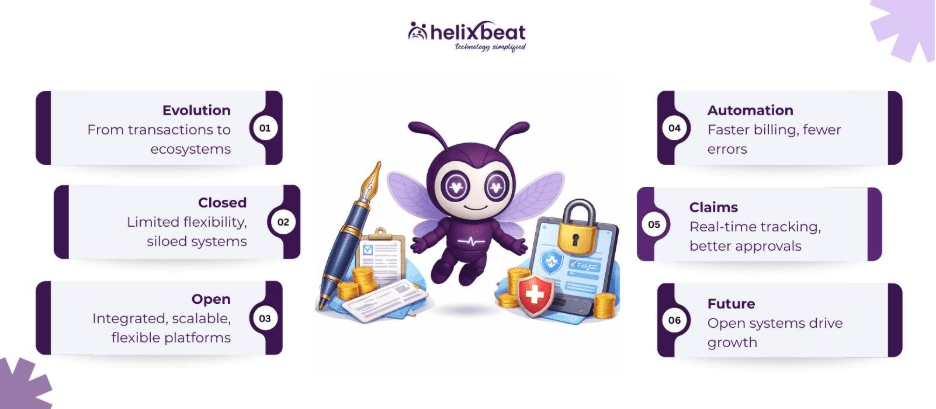
Table of Contents
The Evolution of Healthcare Payment Platforms
Traditional payment systems were never designed for healthcare. They lacked the ability to handle insurance workflows, compliance requirements, and multi-party transactions.
Modern healthcare payment platforms have evolved to address these challenges by offering:
- Integrated billing and payment systems
- Insurance claim handling
- Real-time payment tracking
- Compliance with HIPAA and PCI-DSS
- Patient-centric payment experiences
However, the architecture behind these platforms—open vs. closed—defines how effectively they perform.
What Are Closed Healthcare Payment Platforms?
Closed healthcare payment platforms are built as all-in-one systems with limited external connectivity.
They typically offer:
- Built-in billing modules
- Basic payment processing
- Fixed workflows
At first glance, they appear convenient—especially for smaller practices. Everything is contained within a single system, requiring minimal setup.
But this simplicity comes with trade-offs.
Closed systems often struggle to support:
- Advanced healthcare claim payment platforms integration
- Real-time data sharing
- Custom workflows
- Scalable operations
As a result, they can create bottlenecks in revenue cycles and limit growth.
What Are Open Healthcare Payment Platforms?
Open healthcare payment platforms are designed for interoperability and flexibility.
They allow healthcare organizations to:
- Integrate with EHRs, insurance systems, and analytics tools
- Customize workflows
- Automate complex financial processes
- Scale across multiple locations
This is where platforms like Paynova stand apart.
Instead of functioning as a simple payment processor, Paynova operates as a connected financial ecosystem, enabling seamless interaction between patients, providers, and payers.
The Real Difference: Transaction Tool vs. Financial Ecosystem
The biggest distinction between open and closed healthcare payment platforms is this:
- Closed systems process payments
- Open systems manage the entire financial journey
A modern healthcare payment automation platform doesn’t just collect money—it:
- Automates billing workflows
- Reduces claim errors
- Speeds up reimbursements
- Improves financial visibility
This shift from transactional tools to intelligent ecosystems is reshaping healthcare finance.
Integration: The Backbone of Efficiency
In the U.S., healthcare systems rely on multiple technologies—EHRs, insurance clearinghouses, patient portals, and analytics tools.
Closed healthcare payment platforms often operate in isolation, leading to:
- Data silos
- Manual data entry
- Increased errors
Open platforms eliminate these issues through seamless integration.
With a solution like Paynova, providers can connect:
- Clinical systems
- Billing systems
- Insurance networks
This ensures that data flows in real time—reducing administrative overhead and improving accuracy.
Automation: The Core of Modern Healthcare Finance
Manual processes are one of the biggest challenges in healthcare billing.
A robust healthcare payment automation platform transforms operations by:
- Automating claim submissions
- Validating billing codes
- Detecting errors before submission
- Managing payment reconciliation
Closed systems offer limited automation, often restricted to basic workflows.
In contrast, advanced healthcare payment platforms like Paynova leverage automation to:
- Minimize claim denials
- Accelerate payment cycles
- Reduce operational costs
Automation is no longer optional—it’s essential for survival in a competitive healthcare landscape.
Claims Management: Where Platforms Truly Differ
Claims processing is the financial backbone of healthcare.
Efficient healthcare claim payment platforms ensure:
- Faster reimbursements
- Reduced denials
- Accurate billing
Closed platforms often lack deep integration with payer systems, leading to:
- Delayed claims
- Higher rejection rates
- Limited visibility
Open platforms, especially those built for healthcare like Paynova, provide:
- Real-time claim tracking
- Automated validation
- Seamless payer integration
This significantly improves revenue cycle performance.
Patient Experience: A Competitive Advantage
Today’s patients expect the same convenience in healthcare payments as they do in retail.
They want:
- Transparent billing
- Flexible payment options
- Digital-first experiences
Open healthcare payment platforms support:
- Online and mobile payments
- Payment plans and recurring billing
- Real-time billing updates
Closed systems often fail to deliver these experiences, leading to:
- Delayed payments
- Patient dissatisfaction
A modern healthcare payment automation platform enhances patient trust while improving collections.
Compliance and Security in the U.S. Healthcare System
Compliance is non-negotiable.
Healthcare organizations must adhere to:
- HIPAA
- PCI-DSS
- Data protection regulations
Both open and closed healthcare payment platforms can meet compliance standards—but open platforms offer:
- Advanced monitoring
- Real-time alerts
- Automated compliance checks
Solutions like Paynova are built with compliance at their core, ensuring secure and reliable transactions across all touchpoints.
Scalability: Preparing for Growth
Healthcare organizations are expanding—through mergers, telehealth, and multi-location operations.
Closed healthcare payment platforms often struggle to scale due to:
- Rigid infrastructure
- Limited integration capabilities
Open platforms provide:
- Flexible architecture
- Support for high transaction volumes
- Easy expansion across locations
For organizations using advanced healthcare claim payment platforms, scalability is essential to handle increasing complexity.
Cost Considerations: Short-Term vs. Long-Term Value
Closed platforms may appear cost-effective initially due to:
- Lower setup costs
- Simpler implementation
However, hidden costs often emerge:
- Manual processing
- Inefficiencies
- System limitations
Open healthcare payment platforms require a higher upfront investment but deliver:
- Better ROI
- Reduced administrative costs
- Improved cash flow
A well-designed healthcare payment automation platform ultimately pays for itself through efficiency gains.
Why the Industry Is Moving Toward Open Platforms
The shift toward open healthcare payment platforms is driven by:
- Demand for interoperability
- Rise of value-based care
- Need for real-time financial insights
- Growing patient expectations
Healthcare organizations can no longer afford disconnected systems.
They need platforms that unify:
- Payments
- Claims
- Billing
- Analytics
This is exactly where solutions like Paynova are redefining the market.
Final Thoughts
The debate between open and closed healthcare payment platforms is ultimately about control, efficiency, and future readiness.
Closed platforms may work for small, simple setups—but they limit growth.
Open platforms empower healthcare organizations to:
- Streamline operations
- Improve patient experience
- Optimize revenue cycles
In a system as complex as U.S. healthcare, the ability to integrate, automate, and scale is no longer optional.
It’s essential.
For providers looking to stay competitive, adopting an open, intelligent healthcare payment automation platform—supported by advanced healthcare claim payment platforms—is the clear path forward.
FAQs
1. What are healthcare payment platforms?
Healthcare payment platforms are systems that manage billing, payments, and claims processing within healthcare organizations while ensuring compliance and efficiency.
2. What is the main difference between open and closed platforms?
Open healthcare payment platforms allow integration and customization, while closed platforms are limited to built-in features with minimal flexibility.
3. Why are healthcare claim payment platforms important?
They streamline insurance claims processing, reduce denials, and accelerate reimbursements—improving overall revenue cycle performance.
4. What does a healthcare payment automation platform do?
It automates billing, claims, and payment workflows, reducing manual errors and improving efficiency.
5. Is Paynova an open or closed platform?
Paynova is designed as an open, healthcare-first platform that integrates payments, claims, and billing into a unified ecosystem.