

Healthcare payments are no longer just about sending bills and waiting for checks.
According to industry reports, nearly 30–40% of patient payments are delayed due to billing confusion, lack of payment flexibility, or poor digital experiences. At the same time, patient financial responsibility in the U.S. has risen sharply with high-deductible health plans—making patient collections one of the biggest revenue challenges for providers today.
That’s where analytics comes in.
A modern patient pay portal isn’t just a payment tool—it’s a powerful data engine. When used correctly, it tells you why patients pay, when they pay, and what stops them from completing payments.
In this blog, we’ll break down 7 critical analytics metrics every healthcare provider should track—and how PayNova helps you turn insights into faster, more predictable collections.
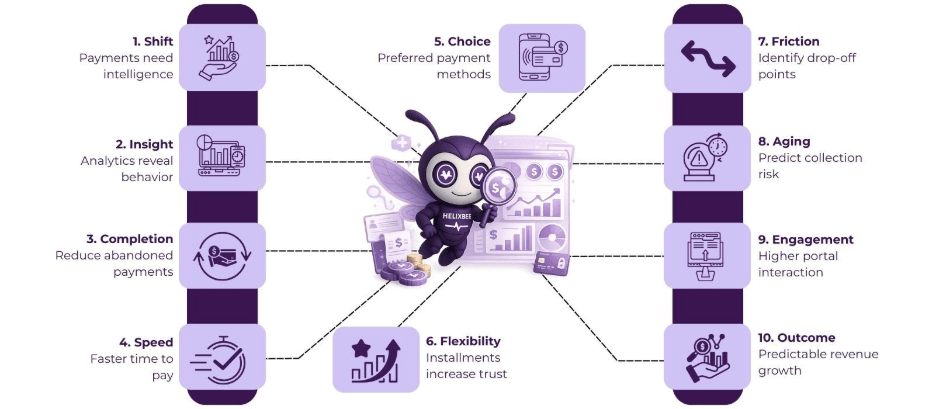
Table of Contents
Why Patient Pay Portal Analytics Matter More Than Ever
Healthcare providers are facing a new reality:
- Patients behave like consumers
- Transparency impacts payment behavior
- Digital convenience drives faster collections
Yet many organizations still treat payments as a backend function.
A data-driven patient pay portal allows providers to move from reactive billing to proactive revenue management—predicting payment outcomes instead of chasing balances.
Let’s explore the metrics that make that possible.
1. Payment Completion Rate
What it measures:
The percentage of initiated payments that are successfully completed.
This is one of the clearest indicators of how effective your patient pay portal truly is.
A low completion rate often signals:
- Confusing interfaces
- Too many payment steps
- Limited payment options
How PayNova helps:
PayNova simplifies the payment journey with intuitive design, fewer clicks, and multiple payment methods—significantly improving completion rates and reducing abandoned payments.
2. Average Time to Pay
What it measures:
How long it takes for patients to complete payment after receiving a bill.
In today’s healthcare environment, speed equals stability. The longer balances sit unpaid, the harder they are to collect.
A well-optimized patient pay portal shortens this window by enabling:
- Immediate online payments
- Mobile-friendly access
- Automated reminders
PayNova advantage:
With real-time notifications and frictionless checkout, PayNova consistently reduces time-to-pay—improving cash flow without increasing staff workload.
3. Payment Method Distribution
What it measures:
Which payment methods patients prefer—credit cards, ACH, digital wallets, or payment plans.
This metric tells you whether your patient pay portal aligns with patient expectations or creates unnecessary friction.
Why it matters:
If patients don’t see their preferred payment option, they delay—or abandon—payment altogether.
PayNova advantage:
PayNova supports cards, ACH, digital wallets, and recurring plans, ensuring your portal adapts to patient behavior—not the other way around.
4. Installment Plan Adoption Rate
What it measures:
The percentage of patients choosing payment plans over one-time payments.
With rising out-of-pocket costs, flexibility is no longer optional. A modern patient pay portal must support installment payments seamlessly.
What high adoption indicates:
- Patient trust
- Transparent billing
- Financial accessibility
PayNova advantage:
PayNova automates installment plans and recurring billing—reducing defaults while giving patients control over their finances.
5. Drop-Off Points in the Payment Journey
What it measures:
Where patients abandon the payment process.
This is one of the most powerful yet underutilized insights from a patient pay portal.
Drop-offs commonly occur due to:
- Login friction
- Unexpected balances
- Poor mobile experience
PayNova advantage:
PayNova provides journey-level analytics, helping providers pinpoint friction points and optimize the payment flow for maximum conversions.
6. Outstanding Balance Aging
What it measures:
How long patient balances remain unpaid, segmented by time intervals (0–30, 31–60, 61–90 days).
A data-driven patient pay portal doesn’t just show balances—it predicts risk.
Why it matters:
The longer a balance ages, the lower the likelihood of collection.
PayNova advantage:
PayNova enables automated reminders, smart follow-ups, and escalation workflows based on balance aging—reducing bad debt without aggressive collections.
7. Portal Engagement Rate
What it measures:
How often patients log in, view bills, and interact with payment options.
A highly engaged patient pay portal directly correlates with higher payment success.
Low engagement often points to:
- Poor UX
- Lack of transparency
- Missing communication
PayNova advantage:
PayNova’s clean interface, itemized billing, and self-service features increase engagement—turning billing into a positive patient experience.
Turning Metrics Into Action with PayNova
Analytics only matter if they lead to action.
PayNova doesn’t just show data—it transforms insights into outcomes by:
- Automating follow-ups based on behavior
- Personalizing payment experiences
- Predicting collection risks
- Integrating seamlessly with EHR and billing systems
With PayNova, your patient pay portal becomes a strategic revenue tool—not just a payment page.
Why PayNova Stands Out in Healthcare Payments
Generic payment gateways weren’t built for healthcare complexity.
PayNova is.
It’s designed to handle:
- Insurance + patient payments
- HIPAA & PCI-DSS compliance
- Split billing and partial payments
- Telehealth and remote care
All while delivering the analytics healthcare leaders need to make smarter financial decisions.
The Future of Patient Collections Is Predictive
Healthcare payments are no longer about chasing money—they’re about understanding behavior.
A modern patient pay portal powered by analytics allows providers to:
- Predict payment outcomes
- Reduce administrative burden
- Improve patient trust
- Stabilize revenue
PayNova brings all of this together in one secure, intelligent platform.
Final Thoughts
Patient collections don’t fail because patients don’t want to pay.
They fail because systems aren’t built around how patients actually behave.
By tracking the right metrics—and acting on them—healthcare providers can transform collections from a pain point into a competitive advantage.
With PayNova, your patient pay portal doesn’t just collect payments—it predicts success.
FAQ
1. What is required to start implementing a patient pay portal?
Implementing a patient pay portal requires system integration, payment setup, compliance configuration, and basic staff training.
2. Can we implement a patient pay portal without changing our billing process?
Yes. A patient pay portal integrates with existing billing workflows without disrupting current operations.
3. How does implementing a patient pay portal help patients pay faster?
A patient pay portal offers easy access, multiple payment options, and clear bills, encouraging faster payments.
4. Is implementing a patient pay portal secure and compliant?
Yes. A patient pay portal is built to meet HIPAA and PCI-DSS compliance requirements.
5. How soon can we see results after implementing a patient pay portal?
Most providers see improved collections within the first few billing cycles after implementing a patient pay portal.