

Healthcare payments are no longer just about collecting money—they’re about protecting trust.
In 2026, a patient payment portal is expected to do far more than process transactions. It must protect sensitive health data, secure financial information, meet evolving regulations, and still deliver a smooth, frustration-free patient experience. With cyber threats growing smarter and healthcare data remaining one of the most valuable targets, security is no longer optional—it’s foundational.
Patients today expect Amazon-level convenience and bank-grade security. Healthcare providers, meanwhile, face rising compliance pressure, sophisticated fraud attempts, and increasing digital payment volumes from in-person care, telehealth, and remote services.
So the big question is:
Is your patient payment portal ready for 2026?
Let’s break down the five must-have security features every modern patient payment portal needs in 2026—and how solutions like PayNova are setting the benchmark for secure, future-ready healthcare payments.
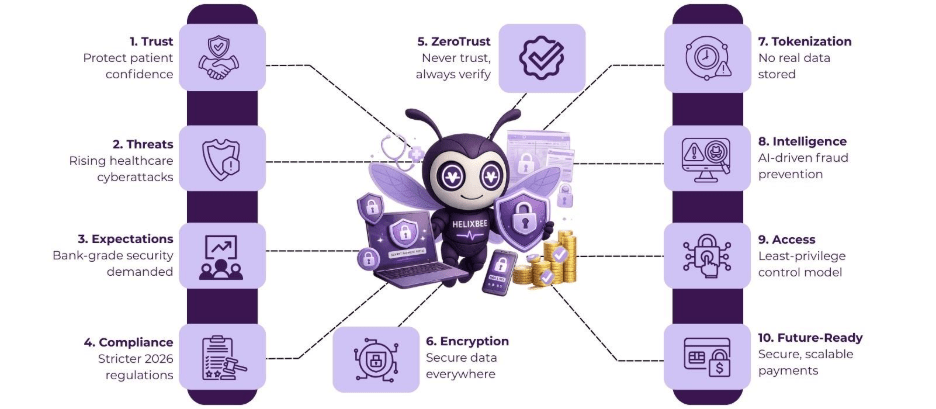
Table of Contents
Why Security Features Are Crucial for a Patient Payment Portal in 2026
By 2026, a patient payment portal is no longer just a convenience tool—it is a critical security layer within the healthcare ecosystem. With healthcare data breaches reaching record highs and cybercriminals increasingly targeting patient-facing systems, robust security has become a non-negotiable requirement.
Modern patient payment portals handle highly sensitive information, including payment data, personal identifiers, and protected health information (PHI). This makes them prime targets for identity theft, payment fraud, and ransomware attacks. Without advanced security measures such as Zero Trust access, encryption, and real-time threat detection, even a single vulnerability can expose thousands—or millions—of patient records.
Regulatory expectations in 2026 are also more stringent. Healthcare organizations are expected to demonstrate proactive security practices, not just basic HIPAA compliance. At the same time, patients are more aware of data privacy risks and are less likely to engage with portals they don’t trust.
Strong security features protect not only patient data but also provider revenue, reputation, and long-term digital adoption. In 2026, security is the foundation of a reliable, scalable, and trusted patient payment portal.
1. Zero Trust Network Access (ZTNA) & Adaptive Authentication
The days of “trust once, access everything” are over.
Traditional perimeter-based security models—like VPNs—assume that users inside the network are safe. In 2026, that assumption is dangerously outdated. Modern patient payment portals must adopt Zero Trust Network Access (ZTNA).
What Zero Trust Means for a Patient Payment Portal
Zero Trust operates on one core principle:
Never trust. Always verify.
Every login attempt—whether from a patient, billing staff, or administrator—is treated as a potential threat.
Key Components You Must Have
Multi-Factor Authentication (MFA)
MFA is no longer optional. A secure patient payment portal must require at least two forms of verification, such as:
- Password + OTP
- Biometric + device confirmation
Behavioral Monitoring & Conditional Access
The portal should analyze:
- Device health
- Location
- Login time
- User behavior patterns
Context-Aware Login
If a patient logs in from a new city at 3 AM using an unfamiliar device, the system should immediately trigger additional verification.
How PayNova Helps:
PayNova’s patient payment portal uses adaptive authentication with Zero Trust principles, ensuring every access request is validated in real time—without compromising user experience.
2. End-to-End Encryption (E2EE) & Tokenization
In 2026, encrypting data “sometimes” is not enough. Data must be protected everywhere, always.
A secure patient payment portal must safeguard data:
- At rest
- In transit
- During processing
End-to-End Encryption (E2EE)
Data at Rest:
AES-256 encryption ensures stored data remains unreadable, even if systems are compromised.
Data in Transit:
TLS 1.3 encryption protects information as it moves between:
- Patient devices
- Payment gateways
- Healthcare systems
This ensures intercepted data is completely useless to attackers.
Tokenization: The Real Game-Changer
Instead of storing actual card or bank details, tokenization replaces sensitive data with meaningless tokens.
Even if attackers breach the portal:
- No real financial data is exposed
- Tokens cannot be reverse-engineered
How PayNova Helps:
PayNova’s patient payment portal combines E2EE with advanced tokenization, dramatically reducing breach impact and compliance risk for healthcare providers.
3. AI-Powered Fraud Detection & Real-Time Monitoring
Cyberattacks don’t wait for quarterly audits—and neither should your security.
By 2026, static security rules and manual reviews are simply too slow. A modern patient payment portal must actively defend itself using AI-driven intelligence.
AI-Driven Threat Detection
AI algorithms continuously scan for anomalies such as:
- Unusual payment amounts
- Rapid spikes in failed login attempts
- Multiple payments from suspicious locations
- Abnormal access to billing data
The moment suspicious activity appears, alerts are triggered instantly.
Continuous 24/7 Monitoring
Healthcare systems operate around the clock—and so do attackers.
A secure patient payment portal must offer:
- Real-time threat detection
- Automated responses to high-risk events
- Immediate escalation before damage occurs
How PayNova Helps:
PayNova uses AI-powered fraud detection and continuous monitoring to stop threats before they turn into breaches—protecting both revenue and reputation.
4. Strict Role-Based Access Control (RBAC) & Least Privilege
Not everyone needs access to everything—and that’s a good thing.
In 2026, Role-Based Access Control (RBAC) is essential for minimizing internal risk. Many healthcare breaches happen not due to hackers, but because of excessive internal access.
Principle of Least Privilege
Users should only access the data absolutely necessary for their role.
Examples:
- Billing staff can view payment data—but not clinical notes
- Front-desk staff can collect co-pays—but not modify insurance records
- Admins can configure systems—but with logged, audited actions
Granular Permissions
A robust patient payment portal must support:
- Fine-grained role definitions
- Department-based access
- Temporary permissions for contractors
Automated Session Timeouts
If a user walks away from a logged-in system, the portal should automatically log them out after inactivity—preventing unauthorized access.
How PayNova Helps:
PayNova enforces strict RBAC with automated session timeouts, reducing insider risk while maintaining operational efficiency.
5. HIPAA & PCI-DSS Compliance with Regular Penetration Testing
Compliance is no longer just a checkbox—it’s a continuous commitment.
In 2026, regulators expect healthcare organizations to prove security readiness, not just claim it.
HIPAA Compliance
A patient payment portal must ensure:
- Confidentiality of PHI
- Secure access controls
- Audit trails for all financial interactions
PCI-DSS Level 1 Certification
For handling card payments, PCI-DSS Level 1 is the gold standard. It ensures:
- Secure payment processing
- No unsafe storage of card data
- Regular vulnerability assessments
Penetration Testing & Security Audits
Proactive testing identifies weaknesses before attackers do.
Regular:
- Penetration testing
- Vulnerability scans
- Security audits
are essential to meet evolving 2026 healthcare IT standards.
How PayNova Helps:
PayNova is built with HIPAA and PCI-DSS compliance at its core, backed by regular penetration testing and ongoing security audits—so providers stay ahead of threats and regulations.
Why PayNova Is Built for the Future of Patient Payments
In 2026, healthcare providers need more than a payment tool—they need a secure, intelligent patient payment portal that protects patients, staff, and revenue.
PayNova delivers:
- Zero Trust security architecture
- End-to-end encryption and tokenization
- AI-powered fraud detection
- Strict role-based access control
- Proven HIPAA and PCI-DSS compliance
All wrapped in a seamless, patient-friendly experience.
Final Thoughts
Security is no longer invisible infrastructure—it’s a competitive advantage.
Patients choose providers they trust. Regulators demand systems they can verify. And healthcare organizations need solutions that scale securely with digital transformation.
If your patient payment portal isn’t built with these five security features, it’s not ready for 2026.
PayNova is.
Because secure payments don’t just protect data—they protect care
FAQs
1. Why is a patient payment portal a major security target?
Because it combines financial data, PHI, and personal information in one system.
2. Is HIPAA compliance enough for patient payment portals in 2026?
No. Providers must also implement proactive security measures like monitoring and penetration testing.
3. How do security features improve patient trust?
Secure portals encourage patients to use online payments and self-service features confidently.
4. What happens if a patient payment portal is breached?
It can lead to financial loss, legal penalties, reputational damage, and patient churn.
5. Are advanced security features expensive to maintain?
They are far less costly than the financial and legal impact of a data breach.