

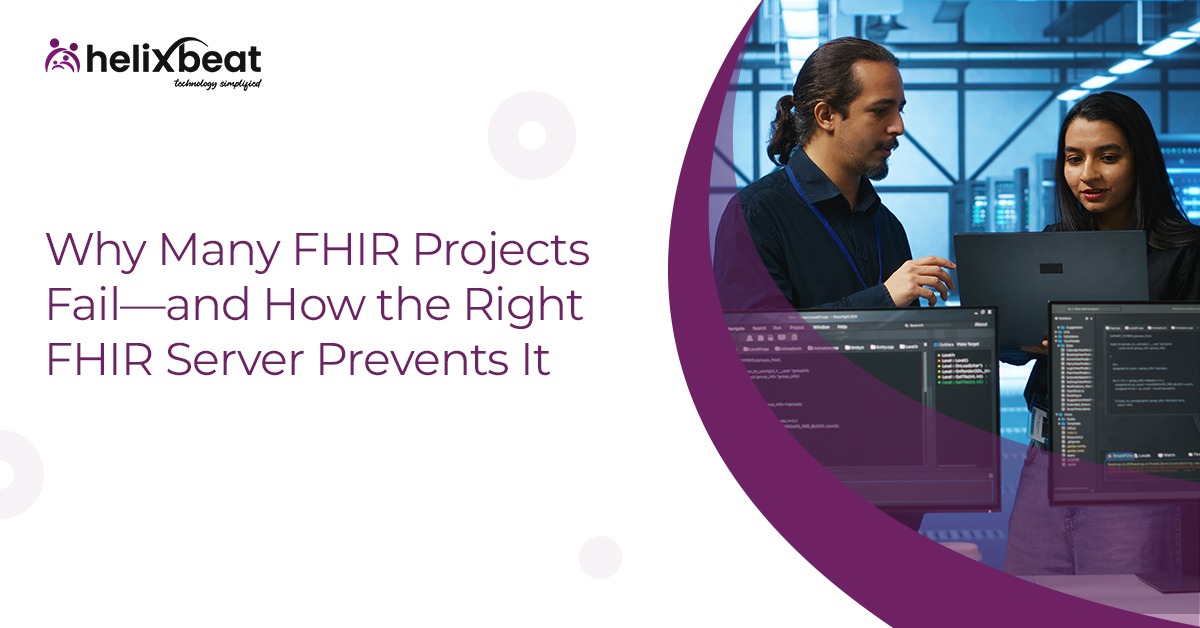
In healthcare technology, custom Electronic Health Record (EHR) systems promise tailored solutions to meet specific organizational needs. But a lot of these projects run into major roadblocks and don’t end up working as well as they should. To get past these hurdles, many are turning to FHIR because it’s effective at helping different platforms talk to each other.
In this blog, we’ll discuss the common pitfalls in custom EHR projects and demonstrate how FHIR addresses them.
Table of Contents
Common Reasons Custom EHR Projects Fail
Custom EHR and other health IT projects often struggle because of planning, technical, and organizational challenges. Across industries, about 25% of technology projects fail completely, approximately 20–25% deliver no measurable return on investment, and up to 50% require significant reworking after launch. Among EHR initiatives, estimates suggest that roughly 20% of implementations are considered outright failures, while more than 50% either fail to deliver expected value or are underutilized post‑deployment.
These outcomes highlight the complexity of digital transformation in healthcare and the importance of robust strategy, governance, and execution.
Inadequate Planning and Governance
One direct cause involves weak project governance and unclear leadership. Without defined objectives, projects drift, which results in misaligned requirements and scope creep. For example, rushing designs without thorough needs assessments leads to incompatible workflows and costly revisions.
Similarly, inadequate planning also contributes to budget underestimations and unrealistic timelines, with administrators often setting unattainable 6-12 month deadlines for implementations that demand more time.
Poor Stakeholder Engagement and User Resistance
Getting people on board is important, yet many projects exclude clinicians, nurses, and administrators from the process. This exclusion fosters resistance, as staff may view the system as burdensome rather than beneficial. Studies show that 60% of EHR failures stem from user resistance, often due to fears of added work or errors. Without effective communication and training, adoption suffers, which leads to underutilization.
Usability and Workflow Disruptions
EHR design flaws exacerbate issues, such as excessive navigation, inconsistent interfaces, and fragmented information. These elements increase cognitive load, prolong documentation times, and prompt workarounds like duplicating entries, which increases error risks. Therefore, physicians rate EHR usability low, with median scores around 45.9 out of 100, associating each point drop with a 3% rise in burnout risk.
Integration and Interoperability Challenges
Compatibility with existing systems poses another major obstacle. Many custom EHRs fail to align with legacy platforms, which creates data silos and hinders information sharing. Fragmented adoption of standards worsens this, as varying data formats across organizations complicate exchanges. Besides, high integration costs, especially in consolidated hospital environments, further strain resources.
Cost Overruns and Scalability Issues
Financial miscalculations are rampant, with projects often exceeding budgets due to added features that introduce complexity and risk. Scalability problems arise when systems cannot handle growing data volumes or evolving needs, which leads to performance issues like slowdowns or outages.
These failures not only waste resources but also impact patient care, with errors potentially contributing to harm.
How FHIR Addresses EHR Project Failures?
FHIR tackles many root causes of custom EHR failures by standardizing data exchange and reducing complexity.
Enhancing Planning and Governance
FHIR provides clear, standardized frameworks for data sharing that guide project planning from the start. By defining integration requirements around FHIR APIs, organizations can better control scope, align with industry standards, and establish governance structures early. This clarity helps reduce ambiguity and prevents integration challenges later in the project lifecycle.
Boosting Stakeholder Engagement
The modular nature of FHIR makes it easy to integrate tools like SMART on FHIR apps directly into EHRs. Therefore, by improving daily processes, FHIR helps gain clinician support and increases overall stakeholder engagement.
Improving Usability and Workflows
FHIR promotes consistent data representation, which reduces system fragmentation and makes navigation easier for users. By supporting seamless integration with clinical apps, it eliminates repetitive data entry, reduces errors, and eases documentation workloads for healthcare teams.
Managing Costs and Scalability
Built on widely adopted web technologies, FHIR reduces development and integration costs while supporting scalable, modular system architectures. This approach enables healthcare organizations to adapt to future needs without frequent system overhauls and handle growing data volumes more efficiently.
Unlock Seamless Healthcare Interoperability with FUSION
Imagine a platform that not only meets modern healthcare standards like FHIR but actually pushes your operations forward. That’s FUSION: the FHIR server designed to make interoperability effortless and impactful. Whether you’re a hospital administrator streamlining workflows or a payer optimizing reimbursements, FUSION bridges the gap.
Built on FHIR, it leverages RESTful APIs for plug-and-play integration, enabling seamless connectivity with legacy systems, modern EHRs, and emerging tools like wearable devices and telehealth platforms. This isn’t just compliance, it’s acceleration.
FUSION goes deeper by embedding critical medical coding systems like SNOMED CT, LOINC, and ICD-10 directly into its architecture. This built-in intelligence maintains data consistency and accuracy, transforming raw information into actionable insights ready for clinical decisions, regulatory reporting, and advanced analytics. No more wrestling with mismatched formats or manual mappings: FUSION handles the heavy lifting!
Organizations using FUSION report up to 70% faster data sharing, slashing referral delays by 60% and reducing redundant tests by 25%. That’s not hype; it’s a measurable impact, with providers saving $1,000–$2,000 per patient annually through streamlined claims and operations.
How FUSION Ignites Data-Driven Innovation?
The true magic of healthcare FHIR lies in its potential to fuel innovation, and FUSION amplifies this like no other. As a reliable engine for standardized data flows, it powers downstream applications that were once out of reach.
Take chronic disease management, for example. By integrating real-time data from wearables and EHRs, FUSION enables continuous monitoring and proactive interventions, potentially cutting hospital readmissions and optimizing therapies. Or, imagine a telehealth consultation that’s instantly better because the doctor has the patient’s full history right there. FUSION makes that happen, giving virtual care a huge boost in quality and making patients much happier.
Certified Excellence
FUSION is officially certified by the Drummond Group for FHIR-based interoperability, validating its conformance with healthcare data exchange standards HL7, FHIR, and SMART on FHIR. This certification demonstrates that FUSION meets industry-recognized benchmarks for secure, standardized data exchange — giving you the confidence to integrate seamlessly across systems.
What This Means for You?
In a complex healthcare ecosystem, FUSION simplifies connectivity and safeguards data integrity. With enterprise-grade uptime (99.99%) and secure authentication powered by OAuth2 and encrypted endpoints, it supports trusted, real-time collaboration between hospitals, labs, and payers.
Whether you’re mapping USCDI elements for regulatory reporting or automating data flows for public-health initiatives, FUSION keeps you compliant with current interoperability frameworks and ready for future mandates.
Final Thoughts
Custom EHR projects often fail due to poor planning, limited stakeholder involvement, usability gaps, integration challenges, and rising costs. These issues slow adoption, drain budgets, and disrupt clinical workflows. However, FHIR offers a practical way forward by standardizing data exchange, supporting modular development, and reducing long-term system complexity.
Take the next step with FUSION to modernize your EHR strategy. Schedule a Call with Helixbeat today!
FAQs
1. Why do custom EHR projects fail so often?
Custom EHR projects fail due to weak planning, unclear governance, limited clinician involvement, usability issues, and integration challenges with existing systems.
2. What role does FHIR play in preventing EHR failures?
FHIR standardizes how healthcare data is structured and exchanged, which reduces integration complexity and supports modular, scalable system design.
3. How does poor stakeholder engagement affect EHR success?
When clinicians and staff are excluded from the design process, systems often feel burdensome, which leads to resistance, underuse, and workflow disruptions.
4. Can FHIR improve EHR usability?
FHIR supports consistent data representation and app-based workflows, which reduces fragmentation and lowers documentation effort when paired with well-designed interfaces.