

Big data in cloud has become the backbone of data-driven decision-making for modern enterprises. As organizations generate terabytes of data daily, the need for scalable, efficient, and secure analytics solutions is more critical than ever. Cloud-based big data analytics provides flexibility, cost-effectiveness, and faster insights, enabling businesses to respond in real time to emerging opportunities and challenges.
Platforms like Helixbeat DaaS, with their advanced tools, are accelerating this transformation by streamlining data storage, processing, and visualization in the cloud. In this blog, we explore the types of big data analytics, the key challenges organizations face, the essential tools for success, and the ongoing shift toward cloud computing for analytics.
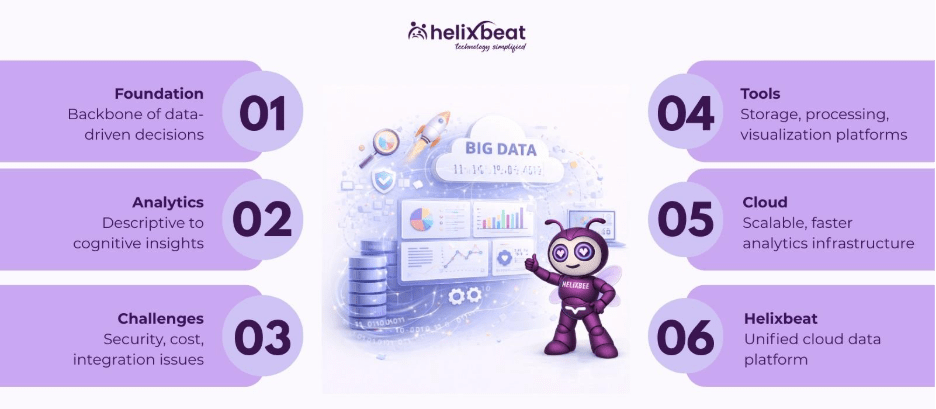
Table of Contents
Understanding the Types of Big Data Analytics: How They Drive Decisions
Before adopting cloud computing for big data analytics, it’s crucial to understand the types of analytics that organizations rely on:
| Analytics Type | Purpose | Real-World Impact |
| Descriptive Analytics | Understand historical data | Helps companies identify trends and patterns efficiently |
| Diagnostic Analytics | Explain why something happened | Reduces operational inefficiencies and errors |
| Predictive Analytics | Forecast future outcomes | Increases revenue by predicting customer behavior |
| Prescriptive Analytics | Suggest actions | Enhances decision-making and resource optimization |
| Cognitive Analytics | AI-driven insights | Powers personalized recommendations and automation |
Leveraging big data in cloud environments enhances the performance of each analytics type, providing faster results, scalable infrastructure, and seamless access to critical insights.
Explore how Helixbeat DaaS accelerates your analytics- Get in Touch with Experts
Top Challenges in Cloud-Based Big Data Analytics
Businesses often encounter hurdles when implementing cloud-based big data analytics. Key challenges include:
- Data Security & Privacy: Protecting sensitive data remains a top concern in big data and cloud computing.
- Data Integration: Merging legacy systems with cloud platforms can be complex and time-consuming.
- High Costs: Mismanaged cloud resources can quickly increase expenses.
- Skill Gap: Organizations often need specialized staff for big data analytics in cloud computing.
- Data Quality: Inconsistent or incomplete datasets affect analytics accuracy and insights.
Addressing these challenges proactively ensures successful deployment and maximizes ROI from cloud computing for big data analytics.
Essential Tools for Big Data Analytics in Cloud Computing
Selecting the right tools is crucial for unlocking the full potential of big data analytics in cloud computing.
| Tool Category | Popular Tools | Key Benefits |
| Data Storage | Amazon S3, Google Cloud Storage | Scalable, reliable storage for massive datasets |
| Data Processing | Apache Spark, Hadoop | Efficient handling of large-scale data |
| Visualization | Tableau, Power BI | Converts raw data into actionable insights |
| AI & Machine Learning | TensorFlow, Azure ML | Supports predictive and prescriptive analytics |
| Data Integration | Talend, Informatica | Simplifies combining cloud and on-premises datasets |
Helixbeat DaaS integrates seamlessly with these tools, enabling faster insights, streamlined data workflows, and smoother reporting in cloud-based big data analytics environments.
Helixbeat DaaS: Driving Smarter Analytics in the Cloud
Helixbeat DaaS transforms big data in cloud by providing a unified, end-to-end platform for data ingestion, storage, processing, and visualization. Key benefits include:
- Scalability: Automatically adjusts to handle increasing data volumes.
- Real-Time Analytics: Delivers instant insights from live datasets.
- Enhanced Security: Built-in compliance measures and data encryption protect sensitive information.
- Cost Efficiency: Reduces infrastructure overhead while optimizing performance.
Organizations leveraging cloud computing for big data analytics with Helixbeat DaaS have reported significant improvements in analytics efficiency, proving its transformative impact on modern cloud-based data strategies.
Transform your data strategy with Helixbeat DaaS today!
Benefits of Cloud Computing in Big Data Analytics
The shift to cloud computing in big data analytics offers measurable advantages for modern enterprises, enabling faster decision-making and operational efficiency:
- Flexibility: Scale resources up or down seamlessly based on demand.
- Faster Insights: Cloud-based big data analytics platforms process data more quickly than traditional on-premises systems.
- Reduced Infrastructure Costs: Pay-as-you-go models lower upfront investment and optimize expenses.
- Collaboration: Teams can access and analyze data from anywhere, supporting global and cross-functional workflows.
| Benefit | Data Impact | Example |
| Scalability | 67% of enterprises scale analytics workloads in the cloud | Retailers adjust to seasonal demand |
| Speed | Cloud analytics is 5x faster than on-premises | Real-time fraud detection in banking |
| Cost Savings | Average 30% reduction in operational costs | Small businesses optimize data storage expenses |
| Collaboration | 82% of companies enable cross-team data access | Global teams work on unified dashboards |
These benefits demonstrate why big data in cloud environments are essential for enterprises seeking growth and agility.
Future Trends: Big Data Analytics in Cloud Computing
The landscape of cloud computing for big data analytics is evolving rapidly, with emerging trends shaping the future of enterprise data strategies:
- AI-Enhanced Analytics: AI algorithms strengthen predictive and prescriptive insights for faster, smarter decision-making.
- Edge Computing Integration: Processing data closer to its source reduces latency and improves responsiveness.
- Serverless Architectures: Minimize infrastructure management overhead while scaling automatically with demand.
- Data Governance & Compliance: Strong frameworks maintain data integrity, privacy, and security across cloud environments.
- Industry-Specific Solutions: Tailored big data analytics in cloud computing for sectors like healthcare, finance, retail, and manufacturing.
By adopting these trends, organizations can remain competitive and extract maximum value from cloud-based big data analytics.
Wrapping Up
Big data in cloud, powered by platforms like Helixbeat DaaS, is transforming analytics across industries. By understanding analytics types, addressing challenges, leveraging the right tools, and embracing emerging trends, businesses can unlock faster insights, improve operational efficiency, and drive growth.
The future belongs to organizations ready to harness big data and cloud computing for intelligent, cloud computing in big data analytics solutions.
Stay ahead with Helixbeat DaaS and modern cloud analytics!
FAQs
1. What is big data in cloud?
Big data in cloud refers to storing, processing, and analyzing massive datasets using cloud computing infrastructure.
2. How does Helixbeat DaaS help with cloud analytics?
Helixbeat DaaS streamlines data workflows, provides real-time insights, and scales automatically for large datasets.
3. What are common challenges in cloud-based big data analytics?
Security, integration, cost management, data quality, and skill gaps are key challenges.
4. Which tools are best for cloud-based big data analytics?
Tools like Apache Spark, Hadoop, Tableau, Power BI, TensorFlow, and Talend are widely used.
5. Why should businesses shift big data analytics to cloud?
The cloud offers scalability, cost efficiency, collaboration, and faster processing for large datasets.
6. What are future trends in big data analytics in cloud computing?
AI-driven analytics, edge computing, serverless architectures, and industry-specific solutions are emerging trends.
7. How does cloud computing improve analytics efficiency?
Cloud infrastructure reduces processing time, provides scalable storage, and enables real-time insights.