

The kickoff went well. The vendor demo worked. Six months later, the lab feed drops results, clinicians distrust the dashboard, and the go-live date has been moved twice.
If this sounds familiar, you are not alone. When an EHR integration goes sideways, it’s rarely because of bad technology. It usually traces back to early setup decisions regarding scope, accountability, and testing. The good news is that you can completely pull a stalled project back on track.
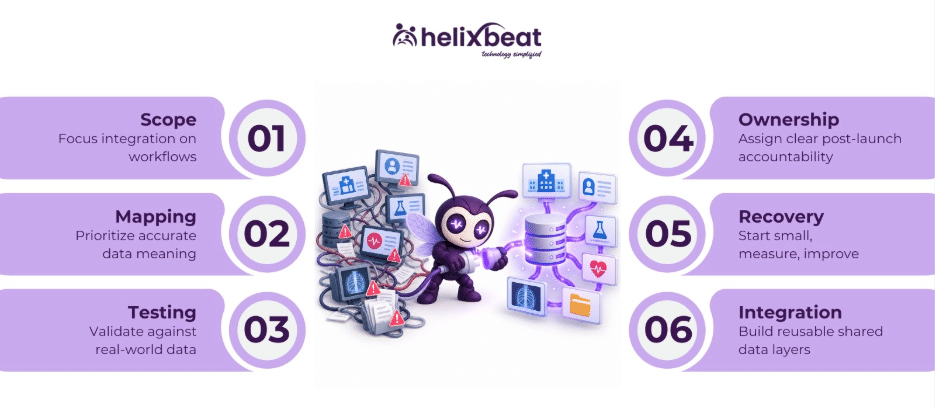
Table of Contents
Seven Places Projects Break
- The goal is “build the interface,” not “fix the workflow.”
A ticket that says “send lab results to system X” delivers a working feed. However, it does not tell you whether a care manager can act on it. That’s why EHR data integration projects scoped around connections tend to finish technically but fail operationally. Instead, scope around an outcome, like flagging pending results within an hour of discharge.
- Mapping is treated as a side task.
Connectivity is the visible part of healthcare data integration. Meaning is the hard part. Field mapping, code translation, and unit handling often take more effort than moving a message from A to B. A value that arrives in the wrong unit is worse than one that never arrives, because nobody notices. Our guide on why FHIR APIs return incomplete patient data shows how small mapping gaps create records that look complete but are not.
- Testing happens on clean data.
Sandbox data is tidy, but real electronic health records data is not. Expect free text where you planned for codes, missing fields, local abbreviations, and duplicate patients. Teams that test only on synthetic samples encounter these problems on go-live day, and that is where EHR data integration budgets get burned.
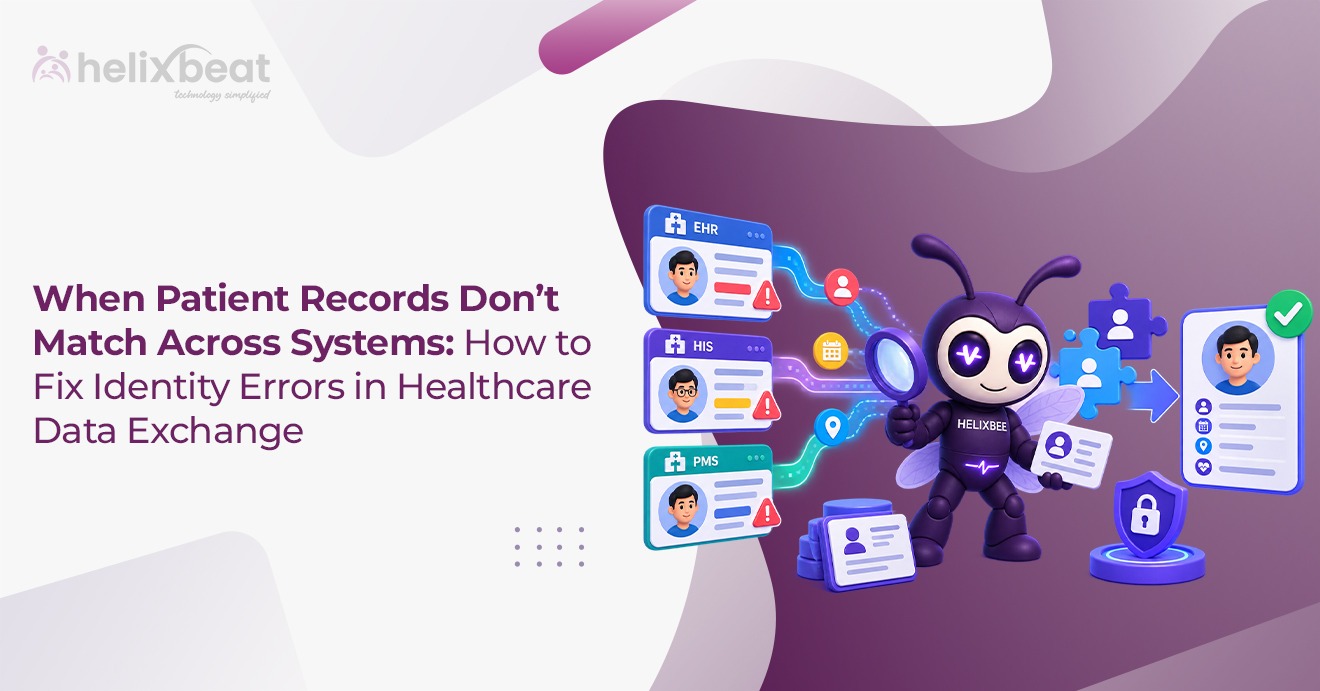
- Patient identity is postponed.
Two records for one person will pass through any interface untouched. Therefore, fix matching before you scale feeds.
- The vendor is a dependency nobody scheduled.
API credentials, sandbox access, interface build queues, and release calendars often sit with the EHR vendor. Due to this, projects lose weeks waiting on a change window that was never on the plan. That’s why electronic health record integration must also follow the vendor’s release cycle, because a new EHR version can change how a feed behaves. Put vendor dates on your integration calendar.
- Clinicians join late.
Nurses, physicians, and informatics staff know which fields matter and which alerts can be ignored. Therefore, bring them in at the mapping stage, not at user acceptance testing.
- Nobody owns it after go-live.
Interfaces are not set-and-forget. Queues back up, certificates expire, and upstream teams change a field without warning. Without an owner, a runbook, and alerts, feeds fail quietly. Sustainable EHR data integration is an operations discipline, not a one-time build.
A Recovery Plan You Can Start This Month
First, recognize the warning signs of a stalled EHR data integration project. Go-live dates have slipped twice. Nobody can state what success looks like. Clinicians still export data by hand despite the new feed. The interface team cannot say what the last EHR upgrade changed.
Recovering EHR data integration work starts with a pause, not a sprint. Then follow these steps:
- Run a two-week triage. List every interface in scope with its status, owner, and blocker. Separate technical blockers, like authentication, from decision blockers, like unsigned mappings. Decision blockers are usually the bigger problem.
- Shrink the scope. Pick one workflow with a measurable result and park the rest. A narrow win rebuilds sponsor confidence.
- Write a data contract. For each field, record source, target, format, code set, unit, and what happens when the value is missing. Have a clinical lead and an IT lead sign it.
- Test on production-like data. Use de-identified extracts or a protected non-production copy. Set acceptance criteria upfront, such as the highest tolerable rate of unmatched patients. Independent API and integration testing can catch what the build team overlooks.
- Run in shadow mode. Let the new feed run beside the old process and compare outputs before clinicians switch over.
- Hand over to operations. A finished EHR data integration build still needs monitoring for latency, errors, and queue depth. Add a named on-call owner and regression tests for every EHR upgrade.
Track three numbers throughout: unmatched-patient rate, feed latency, and hours of manual reconciliation.
Stop Rebuilding the Same Connection
If every project builds its own point-to-point links, recovery repeats with each new request. However, a shared layer changes the math. Systems connect to it once, and new consumers reuse what already exists. That turns EHR data integration into a service and makes governance simpler.
AERIS is that shared layer. It is a no-code / plug-and-play data exchange and interoperability platform that sits between systems so organizations do not have to keep wiring every new application directly to the EHR. The platform is built for real-time exchange where needed, while remaining compatible with existing batch or event-driven workflows.
Why the Stakes Are Rising?
Regulation adds pressure. Under the 21st Century Cures Act information blocking rules, in force since April 2021, providers, health IT developers, and health information networks must avoid practices likely to interfere with access, exchange, or use of electronic health information unless an exception applies. Since October 2022, that covers all electronic health information in a designated record set, not only the USCDI subset.
Although poor integration is not automatically information blocking, slow or restrictive access practices can raise questions. Therefore, ask compliance counsel where your exposure lies.
The Takeaway
Failed projects are rarely lost causes. They usually need a smaller scope, clearer ownership, and honest testing. Fix those, and electronic health record integration becomes predictable. Start with one workflow, prove it, and expand from there. That is how EHR data integration earns lasting trust.
Get in touch with us to discover how AERIS can turn fragmented data into a reliable service.
FAQs
- What is EHR data integration?
It is the work of connecting an EHR with other systems, such as labs, billing, analytics tools, health information exchanges, and apps. Teams typically use HL7 v2 messages, FHIR APIs, clinical documents, or file transfers, plus mapping and validation.
- Why do these projects fail most often?
Common causes include scoping around connections rather than workflows, underestimating mapping work, testing on clean data, delaying patient matching, and leaving no owner after go-live.
- How do I know if a struggling project is salvageable?
If a real workflow need, an executive sponsor, and at least some working feeds exist, recovery is usually realistic. A short triage of interfaces, owners, and blockers will tell you where you stand.
- How long does recovery take?
It depends on the number of interfaces, vendor responsiveness, and data quality. A two-week triage followed by a single-workflow pilot is a sensible way to get a grounded estimate.
- Will moving to FHIR fix a failing project?
Not by itself. FHIR standardizes how data is accessed, but mapping, patient identity, testing, and ownership problems remain. Many organizations run HL7 v2 and FHIR side by side.