

Health information exchange (HIE) is at a technological inflection point. Traditional methods of sharing clinical data between providers, payers, laboratories, and patients often involve bespoke interfaces, batch file transfers, and document‑based exchanges that are slow, brittle, and difficult to maintain. Over the past decade, the rise of application programming interface (API)‑driven approaches has transformed how healthcare data moves across systems, catalyzing a new era of interoperability, accessibility, and real‑time insights.
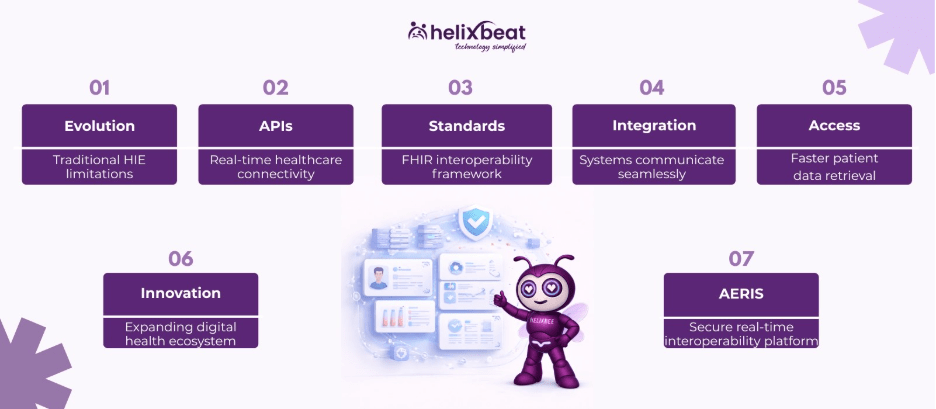
Here, we’ll explore how API‑driven HIE is reshaping data sharing, the standards and technologies involved, practical benefits for care delivery, and future trends that will influence healthcare systems worldwide.
Table of Contents
What Is API‑Driven Health Information Exchange?
APIs are software intermediaries that let systems communicate without human intervention. In healthcare, APIs serve as the digital glue that connects disparate health information technologies, enabling them to request, send, and process specific datasets on demand. When applied to health information exchange, APIs allow clinical, administrative, and patient data to be shared efficiently between electronic health record systems (EHRs), apps, registries, and analytics platforms.
In contrast with older document‑centric methods, where complete clinical summaries are exchanged, APIs use structured data formats that break information into modular elements that systems can query and interpret. This modularity is central to real‑time data exchange workflows that support coordinated care and agile digital services.
The Role of Standards in API‑Based HIE
For APIs to work across healthcare domains, shared data standards are essential. Without common specifications, APIs from one vendor would be unintelligible to systems from another, perpetuating the very fragmentation HIE seeks to resolve.
HL7 and FHIR
A major catalyst for API‑driven HIE has been Fast Healthcare Interoperability Resources (FHIR), a standard developed by HL7 International that defines data formats (“resources”) and a web‑based API for exchanging clinical and administrative data across systems. Interoperability solutions like AERIS use FHIR APIs make data exchange more flexible, fine‑grained, and suited to real‑time use cases.
Older parts of the HL7 standard family, such as HL7 v2, focused on messaging rather than APIs. While HL7 v2 remains widely used, API‑enabled FHIR is rapidly becoming the preferred mechanism for modern health information exchange.
SMART on FHIR and the App Ecosystem
On top of FHIR, specifications like SMART on FHIR allow third‑party applications to plug into EHRs and HIE platforms securely, with standardized authorization. This opens the door for mobile apps, patient portals, analytic tools, and specialty software to read and write clinical data through APIs in a controlled, interoperable way.
How API‑Driven Exchange Works in Practice?
To understand the impact of API‑driven HIE on data sharing, consider a real‑world scenario. In a traditional setup, if Hospital A wants to transfer a patient’s medical history to Hospital B, it might send a consolidated document via a secure email or file transfer protocol. The recipient then has to parse, import, and reconcile that document with its internal systems — a slow process that may involve manual work.
With API‑driven exchange, Hospital B’s systems can query Hospital A’s APIs in near real‑time to fetch only the latest clinical observations, medications, or diagnostic results. This approach reduces redundant data transfer and puts the most current information at clinicians’ fingertips.
APIs can also enable patient‑centered workflows, where patients access or share their longitudinal records via apps and portals that talk to multiple EHR systems’ APIs. These consumer‑oriented data paths support care coordination and empower patients to share health records with providers or caregivers as needed.
Standards and Ecosystem Growth
The success of API‑driven HIE is tightly linked to industry standards and evolving policy landscapes. In the United States, interoperability regulations, like the 21st Century Cures Act, mandate the implementation of standard APIs to promote access, sharing, and patient rights.
API adoption is not uniform globally, but momentum is building as regulators, vendors, and healthcare organizations recognize the value of open, standards‑based exchange.
Different FHIR implementation guides, such as those geared to payer data exchange or insurance networks, expand how APIs can be used across the healthcare ecosystem.
How AERIS Makes Interoperability Possible in 2026?
Imagine a world where your healthcare organization thrives with seamless, secure, and real-time data exchange. That’s the power of AERIS by Helixbeat, a game-changing platform designed to transform how you connect, collaborate, and care. Built for healthcare providers, clinics, hospitals, and cross-industry partners like pharmacies and insurers, AERIS harnesses FHIR APIs to break down data silos, streamline operations, and put patient care first.
Ready to cut delays by 50%, double your ROI, and empower your team with instant access to critical data? Let’s dive into why AERIS is the solution you’ve been waiting for.
Why AERIS is Your Key to Healthcare Innovation?
At Helixbeat, we know your challenges: fragmented systems, delayed data, and rising costs. AERIS is here to change that, offering a personalized, scalable, and secure platform that fits your unique needs. Whether you’re a small clinic or a sprawling hospital network, AERIS delivers measurable results that elevate patient outcomes and boost your bottom line.
- 20+ Years of Expertise: Our team brings decades of healthcare IT experience to ensure AERIS works for you.
- 50+ IT Professionals: A dedicated crew powers AERIS, delivering unmatched support and innovation.
- 1,000+ Customers: Join a thriving community of healthcare leaders already transforming with AERIS.
- 10,000+ Projects Completed: Proven success across countless integrations and workflows.
- 95% Returning Customers: Our clients trust AERIS to deliver, time and time again.
Providers adopting AERIS report faster diagnoses, lower costs, and improved outcomes, positioning it as the go-to tool for future-proof HIE.
Your Benefits, Amplified
- 50% Fewer Delays: Real-time data means critical information is always at your fingertips, turning hours into seconds.
- 100% Faster ROI: Plug-and-play integration maximizes your investment without expensive system replacements.
- 30% Cost Savings, 90% Fewer Errors: Automation eliminates waste, saving resources and ensuring accuracy.
Final Thoughts
API‑driven health information exchange is transforming the way healthcare data moves between systems, organizations, and people. By using modern standards such as FHIR and RESTful APIs, providers can access up‑to‑date information on demand, create interoperable services, and support innovative digital health applications.
AERIS is an interoperability platform designed for secure, real-time data exchange. From hospitals and clinics to insurers and pharmacies, AERIS helps healthcare stakeholders eliminate silos, accelerate data sharing, and strengthen care management outcomes. Connect with Helixbeat today to transform how your organization exchanges data and delivers coordinated care.
FAQs
1. What is API-driven health information exchange?
API-driven HIE uses software interfaces to allow systems to request and share specific healthcare data in real time, improving interoperability between providers, patients, and apps.
2. How does FHIR relate to API-driven HIE?
FHIR (Fast Healthcare Interoperability Resources) is a standard that defines data formats and APIs for exchanging clinical and administrative health information efficiently.
3. What are the main benefits of using APIs in HIE?
APIs enable real-time access to patient data, improve interoperability, support patient engagement, allow modular system design, and foster innovative digital health applications.
4. Are there security risks with API-driven HIE?
Yes, APIs create access points to sensitive data. Strong authentication, authorization, and encryption practices are required to protect patient information and comply with regulations like HIPAA.