

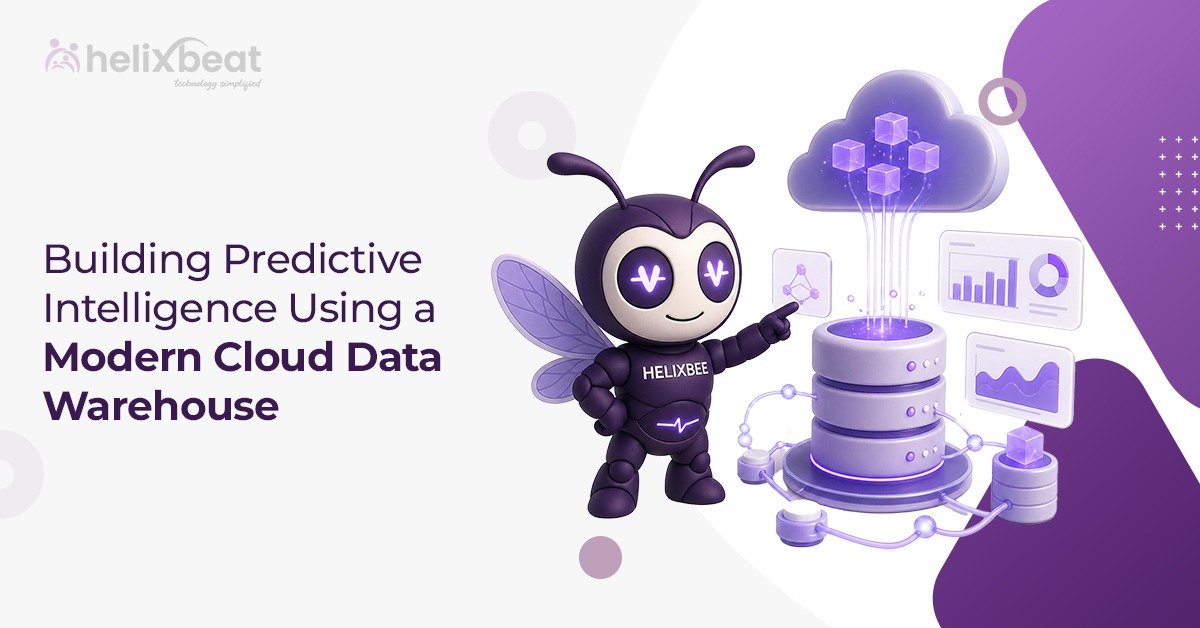
What if your data could move beyond reporting the past and actually help predict what comes next?
A modern cloud data warehouse makes this possible when integrated with advanced AI and analytics capabilities. With Helixbeat DWaaS, organizations can unlock predictive intelligence without the burden of managing complex infrastructure or legacy systems.
A cloud-based data warehouse is no longer just a storage layer—it has evolved into an intelligent system that processes data continuously, learns from patterns, and generates real-time forecasts.
As enterprises increasingly adopt data-driven strategies, predictive intelligence becomes a critical capability for improving agility, reducing risks, and identifying business opportunities faster than ever before.
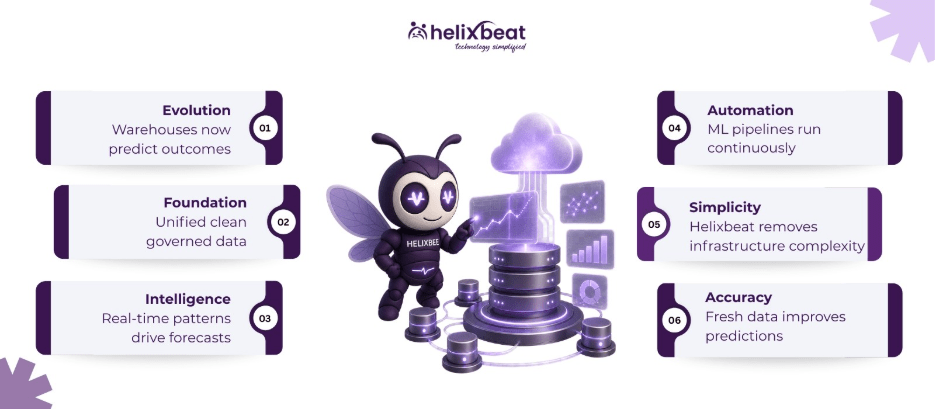
Table of Contents
How does a modern cloud data warehouse enable predictive intelligence?
A modern cloud data warehouse is designed to unify enterprise data, scale instantly, and process analytics efficiently across large environments. It serves as the backbone for transforming raw data into predictive insights that support strategic business decisions.
Predictive intelligence works by analyzing both historical datasets and real-time data patterns to identify trends, risks, and future outcomes with higher accuracy.
Key capabilities that enable prediction
A cloud based data warehouse supports:
- Centralized data integration from multiple sources
- High-speed processing for large-scale datasets
- Built-in support for AI and machine learning tools
- Real-time analytics pipelines
These capabilities allow businesses to forecast customer behavior, demand fluctuations, and operational risks effectively.
Why it matters for businesses
Without a unified data system, predictions often become fragmented, inconsistent, and unreliable. A cloud-native approach ensures accuracy, consistency, and seamless synchronization across all data layers.
Predictive intelligence becomes truly actionable when data is clean, connected, and continuously updated in real time within a structured environment.
What data foundation is required for predictive analytics in cloud based data warehouses?
Predictive analytics depends heavily on the quality, structure, and governance of data stored in a cloud based data warehouse.
Without a strong foundation, even advanced AI models fail to generate accurate predictions or meaningful insights.
Core data requirements
To build reliable predictive intelligence, organizations need:
- Clean and structured datasets
- Historical and real-time data integration
- Strong metadata management
- Defined data governance frameworks
A cloud data warehouse solutions ecosystem ensures all these elements operate together seamlessly for scalable analytics.
Importance of unified data architecture
A fragmented system leads to inconsistent forecasting and reduced accuracy. A unified architecture improves reliability, reduces latency, and enhances model performance.
Organizations using cloud based data warehouse services can continuously refine data pipelines for stronger predictive outcomes.
Common challenges include:
- Data silos across departments
- Poor data quality
- Lack of real-time ingestion
Addressing these challenges is critical before implementing predictive analytics systems.
How do cloud data warehouse solutions support real-time machine learning pipelines?
Modern businesses require predictions in real time rather than delayed reporting. This is where cloud data warehouse solutions become essential.
A modern cloud data warehouse integrates directly with machine learning pipelines to enable continuous intelligence generation.
How real-time ML works
Real-time machine learning pipelines follow a continuous loop:
- Data ingestion from multiple sources
- Processing and transformation within the warehouse
- Model training and inference execution
- Delivery of insights and predictions
This loop runs continuously within a cloud-based data warehouse environment, ensuring constant intelligence flow.
Advantages of real-time pipelines
- Faster decision-making
- Immediate anomaly detection
- Dynamic pricing and forecasting
- Improved customer personalization
These capabilities allow enterprises to act instantly on insights and improve business responsiveness.
Role of automation
Automation reduces manual dependency in model updates and ensures predictions remain accurate as data evolves. It enhances scalability, improves consistency, and supports continuous optimization across enterprise analytics systems.
How does Helixbeat DWaaS simplify predictive intelligence deployment?
Deploying predictive intelligence systems can be complex but Helixbeat DWaaS simplifies the entire process by removing infrastructure barriers and providing a ready-to-use analytics environment.
It enables organizations to focus on insights and outcomes instead of managing backend complexity.
What Helixbeat DWaaS offers
Helixbeat delivers a fully managed modern cloud data warehouse platform designed for enterprise-scale predictive intelligence.
Key capabilities include:
- Built-in scalability for large datasets
- Integrated analytics and AI support
- Secure and compliant data handling
- Seamless data orchestration across systems
With Helixbeat DWaaS, businesses can shift from infrastructure management to value-driven decision-making.
Why managed DWaaS matters
Traditional data environments require:
- Heavy infrastructure setup costs
- Dedicated engineering teams
- Continuous maintenance and upgrades
In contrast, DWaaS eliminates these operational barriers by offering a fully managed ecosystem.
Business impact
Organizations using cloud based data warehouse services like Helixbeat experience:
- Faster deployment of predictive models
- Reduced operational overhead
- Improved return on data investments
This makes predictive intelligence more accessible even for mid-sized and scaling enterprises.
What best practices improve predictive accuracy in cloud based data warehouse services?
To maximize predictive accuracy, organizations must optimize how they use cloud based data warehouse services, even when working with advanced AI systems.
Proper design, governance, and continuous improvement remain essential for reliable outcomes.
Data optimization practices
- Regular data cleaning and validation
- Removal of duplicate and inconsistent records
- Structuring datasets for ML readiness
Model improvement strategies
- Continuous model retraining with fresh data
- Feature engineering using real-time inputs
- Monitoring and correcting model drift
A modern cloud data warehouse ensures these processes operate efficiently at scale.
Security and governance
- Role-based access control
- Encryption of data at rest and in transit
- Compliance with industry regulations
Strong governance ensures trust, reliability, and accuracy in predictive outputs.
Wrapping Up
A modern cloud data warehouse form the backbone of predictive intelligence in today’s data-driven enterprises. With platforms like Helixbeat DWaaS, organizations can unlock real-time forecasting, scalable analytics, and faster decision-making.
Key takeaways
- Predictive intelligence depends on unified, high-quality data
- Real-time pipelines improve business responsiveness
- Managed services reduce complexity and increase scalability
FAQs
1. How does a modern cloud data warehouse support predictive modeling with machine learning?
A modern cloud data warehouse integrates directly with ML tools to process historical and real-time data, enabling models to train continuously and generate accurate predictions without manual data movement.
2. What kind of data is needed for predictive intelligence in a cloud based data warehouse?
A cloud based data warehouse requires structured, historical, and real-time streaming data such as customer behavior logs, transaction records, operational metrics, and IoT inputs for reliable predictive outcomes.
3. How fast can predictive insights be generated using cloud data warehouse solutions?
With advanced cloud data warehouse solutions, predictive insights can be generated in near real time depending on data volume, pipeline design, and model complexity—often within seconds to minutes.
4. What industries benefit most from cloud based data warehouse services for predictive analytics?
Industries like retail, healthcare, finance, logistics, and SaaS benefit the most as cloud based data warehouse services help forecast demand, detect fraud, optimize supply chains, and improve customer personalization.