

Healthcare interoperability has evolved rapidly over the last decade. At the center of this transformation lies FHIR (Fast Healthcare Interoperability Resources).
One of the most critical aspects of implementing FHIR is FHIR resource mapping. Whether you’re integrating legacy Electronic Health Record (EHR) systems or building new healthcare applications, mapping data correctly between systems and FHIR resources is necessary for accuracy, consistency, and usability.
In this guide, we break down FHIR resource mapping in a practical, developer-friendly way.
Table of Contents
What is FHIR Resource Mapping?
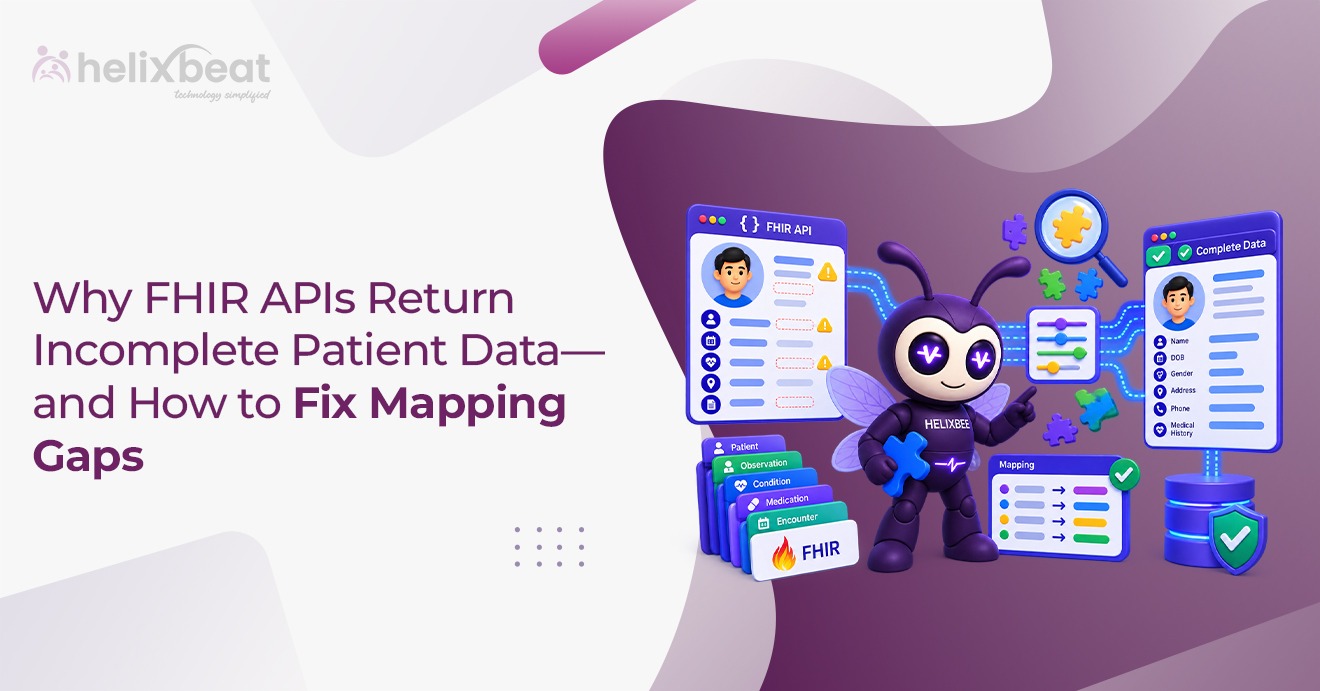
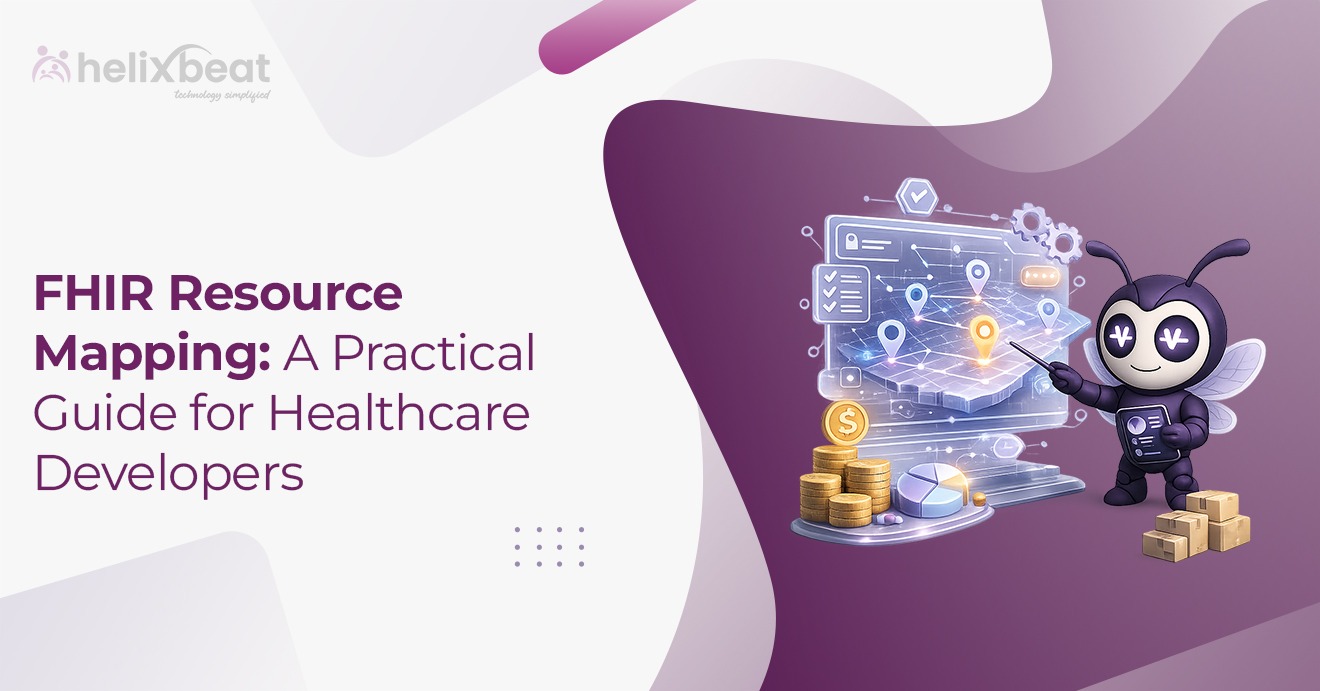
FHIR resource mapping is the process of transforming data from one format or system into FHIR-compliant resources.
This typically involves:
- Extracting data from a source system (e.g., legacy EHR, database, CSV)
- Transforming the data into the correct structure
- Mapping fields to corresponding FHIR resource elements
- Validating the output against FHIR standards
Example–
A legacy system might store patient data like this:
- patient_name → “John Doe”
- dob → “1985-06-15”
- gender_code → “M”
This would map to a FHIR Patient resource:
{
“resourceType”: “Patient”,
“name”: [
{
“text”: “John Doe”
}
],
“birthDate”: “1985-06-15”,
“gender”: “male”
}
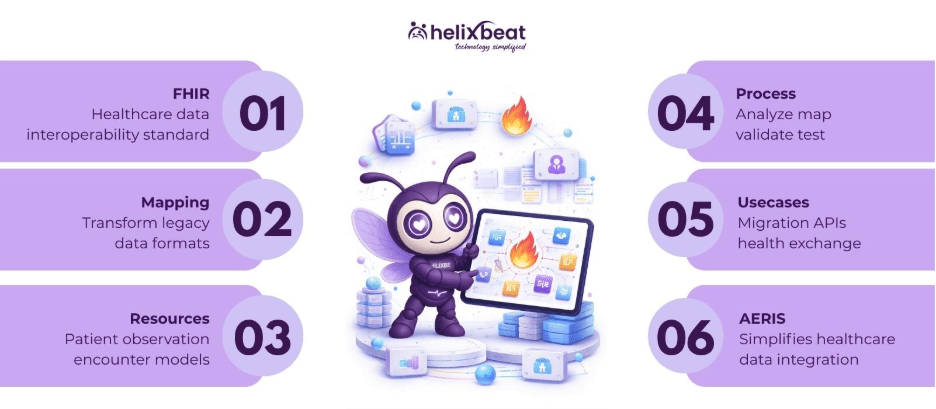
Why FHIR Resource Mapping Matters?
FHIR resource mapping is a foundational step in interoperability. Without accurate mapping:
- Data can become inconsistent or misinterpreted
- Clinical decisions may be affected
- Integrations may fail
- Regulatory compliance could be compromised
Core Components of FHIR Resource Mapping
Understanding the building blocks helps simplify implementation.
1. Source Data Model
The structure of the original system (e.g., relational database, HL7 v2 messages, XML files).
2. Target FHIR Resource
The FHIR resource that will receive the mapped data.
Examples:
- Patient → demographics
- Observation → lab results
- Encounter → visit details
3. Mapping Logic
Defines how each field in the source system corresponds to FHIR fields.
Includes:
- Field-to-field mapping
- Value transformations
- Conditional logic
4. Terminology Mapping
Converts codes from one system to standardized terminologies like:
- SNOMED CT
- LOINC
- ICD-10
Common Use Cases
FHIR resource mapping is used in several real-world scenarios:
1. Legacy System Modernization
Older systems often use proprietary formats. Mapping helps convert them into FHIR-compatible data.
2. Data Migration
When moving from one EHR to another, mapping preserves data integrity.
3. API Development
FHIR APIs require data to be structured according to FHIR resources.
4. Health Information Exchange (HIE)
Enables sharing of patient data across providers and institutions.
Step-by-Step Process for FHIR Resource Mapping
Step 1: Analyze the Source Data
Start by understanding:
- Data structure
- Field types
- Data formats
- Relationships
Create a data inventory or schema.
Step 2: Identify Target FHIR Resources
Map each dataset to the appropriate FHIR resource.
Examples:
| Source Data | FHIR Resource |
| Patient demographics | Patient |
| Lab results | Observation |
| Doctor visits | Encounter |
Step 3: Define Field-Level Mapping
Create a mapping document that specifies:
- Source field
- Target FHIR field
- Transformation rules
Example:
| Source Field | FHIR Field | Transformation |
| patient_name | Patient.name.text | Direct |
| gender_code | Patient.gender | Convert M → male |
Step 4: Handle Data Transformations
Transformations may include:
- Data type conversion (string → date)
- Code translation
- Unit normalization
- Formatting adjustments
Step 5: Apply Terminology Mapping
Convert local codes into standard coding systems.
Example:
- Local lab code → LOINC
- Diagnosis code → ICD-10
Step 6: Validate FHIR Output
Validation includes:
- Schema validation
- Required field checks
- Value set validation
Tools like FHIR validators can help identify errors.
Step 7: Test and Iterate
Test with real-world scenarios:
- Edge cases
- Missing data
- Incorrect formats
Refine mapping logic based on results.
FHIR Mapping vs Traditional Integration
| Feature | Traditional Integration | FHIR Resource Mapping |
| Data Format | Custom | Standardized |
| Flexibility | Limited | High |
| API Support | Minimal | RESTful APIs |
| Scalability | Moderate | High |
Security and Compliance Considerations
When performing FHIR resource mapping, developers must consider:
- Data privacy (HIPAA)
- Secure transmission (HTTPS, OAuth 2.0)
- Access control
- Audit logging
Healthcare data is highly sensitive, so secure handling is critical.
How AERIS Simplifies FHIR Resource Mapping with Powerful FHIR APIs?
FHIR resource mapping can often become one of the most complex parts of healthcare interoperability—especially when dealing with fragmented systems, inconsistent data formats, and legacy infrastructure. This is where AERIS by Helixbeat brings a practical advantage.
Designed for modern healthcare environments, AERIS leverages robust FHIR APIs to simplify how data is transformed, mapped, and exchanged across systems. Instead of building mapping logic from scratch for every integration, developers can use AERIS to accelerate FHIR resource mapping while maintaining accuracy and scalability.
Ready to cut delays by 50%, double your ROI, and empower your team with instant access to critical data? Let’s dive into why AERIS is the solution you’ve been waiting for.
Why AERIS is Your Key to Healthcare Innovation?
At Helixbeat, we know your challenges: fragmented systems, delayed data, and rising costs. AERIS is here to change that, offering a personalized, scalable, and secure platform that fits your unique needs. Whether you’re a small clinic or a sprawling hospital network, AERIS delivers measurable results that elevate patient outcomes and boost your bottom line.
- 20+ Years of Expertise: Our team brings decades of healthcare IT experience to ensure AERIS works for you.
- 50+ IT Professionals: A dedicated crew powers AERIS, delivering unmatched support and innovation.
- 1,000+ Customers: Join a thriving community of healthcare leaders already transforming with AERIS.
- 10,000+ Projects Completed: Proven success across countless integrations and workflows.
- 95% Returning Customers: Our clients trust AERIS to deliver, time and time again.
Providers adopting AERIS report faster diagnoses, lower costs, and improved outcomes, positioning it as the go-to tool for future-proof HIE.
Your Benefits, Amplified
- 50% Fewer Delays: Real-time data means critical information is always at your fingertips, turning hours into seconds.
- 100% Faster ROI: Plug-and-play integration maximizes your investment without expensive system replacements.
- 30% Cost Savings, 90% Fewer Errors: Automation eliminates waste, saving resources and ensuring accuracy.
Final Thoughts
As healthcare systems continue to shift toward standardized data exchange, the ability to accurately transform and structure data into FHIR resources becomes essential for building scalable, efficient, and future-ready solutions.
However, FHIR resource mapping can quickly become complex when dealing with legacy systems, diverse data formats, and large-scale integrations. This is where platforms like AERIS offer a significant edge. By leveraging FHIR APIs and a structured approach to data transformation, AERIS simplifies the mapping process and supports faster, more efficient interoperability.
Explore how AERIS can transform your FHIR resource mapping workflows and help you build smarter, connected healthcare applications. Get in touch with us!
FAQs
1. What is FHIR resource mapping?
FHIR resource mapping is the process of transforming data from a source system into standardized FHIR resources.
2. Why is FHIR resource mapping important?
It enables interoperability, improves data consistency, and supports modern healthcare applications.
3. What are FHIR resources?
FHIR resources are modular data components that represent healthcare concepts like patients, observations, and encounters.
4. What tools can be used for FHIR resource mapping?
Common tools include HAPI FHIR, Mirth Connect, StructureMap, and Microsoft FHIR Converter.
5. What challenges are involved in FHIR resource mapping?
Challenges include complex data structures, inconsistent source data, and terminology mapping.